
TL;DR:
- The Buffalo History Museum offers historic architecture and versatile event spaces ideal for memorable weddings. Its Neoclassical design and scenic outdoor Portico provide striking backgrounds, reducing decor costs and enhancing photography. Early booking and collaboration with exclusive caterer Tappo streamline planning and ensure a seamless, elegant celebration.
Buffalo History Museum weddings combine National Historic Landmark architecture with a curated event experience that few Buffalo wedding venues can match. The museum, designed by architect George Cary and tied to the 1901 Pan-American Exposition, gives couples a setting where history and celebration become inseparable. Exclusive catering through Tappo Restaurant Group, three distinct event spaces, and a staff known for genuine flexibility make this one of the most distinctive historic wedding locations in Buffalo. If you want a venue that does the heavy lifting aesthetically while still leaving room for personal expression, this is where to start.
1. Buffalo History Museum weddings offer three distinct event spaces
The three main event spaces at the museum each serve a different purpose in your wedding day timeline, and understanding them upfront shapes every other planning decision you make.
| Space | Capacity | Best Use |
|---|---|---|
| State Court Room | Up to 120 guests | Grand ceremonies |
| Stateroom | Up to 200 guests | Receptions and dinners |
| Penfold Portico Gallery | Up to 100 guests | Intimate gatherings |
The State Court Room is the showpiece for ceremonies. Soaring ceilings, black marble accents, and grand columns create a backdrop that photographers love and guests remember. At 120 guests, it holds a crowd large enough to feel celebratory without losing the intimacy that makes a ceremony meaningful.
The Stateroom is the workhorse of the three. At 200 guests, it handles full receptions comfortably and gives your caterer room to set up stations, a bar, and a dance floor without the space feeling cramped. The Penfold Portico Gallery works best for cocktail hours or smaller seated dinners where you want guests to feel gathered rather than spread out.
-
State Court Room: ceremonies for up to 120 guests with dramatic architectural framing
-
Stateroom: receptions for up to 200 guests with flexible floor plan options
-
Penfold Portico Gallery: intimate events for up to 100 guests
-
Outdoor terraces: cocktail hours, first looks, and tented receptions
-
Portico: overlooks Delaware Park and Hoyt Lake for scenic outdoor moments
Pro Tip: Book a site tour early in your planning process and walk the full venue flow from ceremony space to cocktail area to reception room. The transitions between spaces are part of the guest experience, and seeing them in person helps you plan timing and decor placement far more effectively than photos alone.
2. The outdoor Portico is one of Buffalo’s best ceremony backdrops
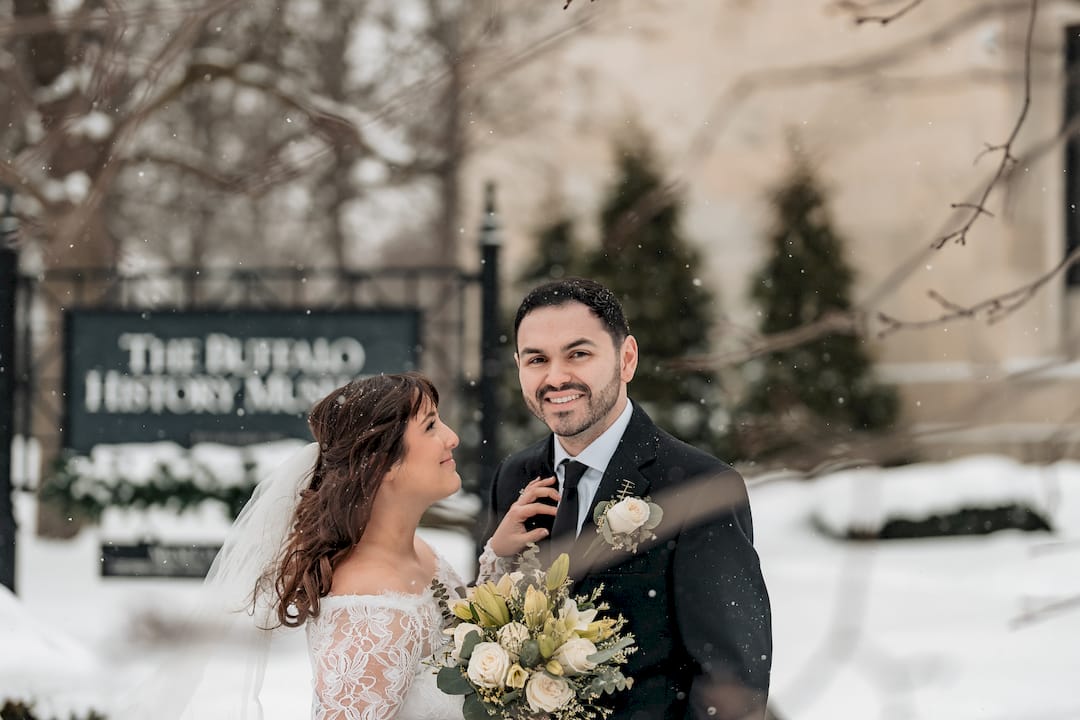
The Portico overlooks Delaware Park and Hoyt Lake, making it one of the most photographed spots at any Buffalo museum event space. The neoclassical marble columns frame the view in a way that feels both grand and natural, which is a rare combination in an urban venue.
Cocktail hours on the Portico work especially well in late spring and early fall when Buffalo weather cooperates. Guests move naturally from the indoor ceremony to the outdoor Portico, and the shift in setting creates a clear emotional transition between the ceremony and the celebration. That kind of built-in flow is something most venues have to manufacture with lighting or decor. Here, the architecture does it for you.
For summer weddings, tent options on the terraces give you outdoor ambiance with weather protection. The venue is not air-conditioned, so planning for heat during July and August is not optional. A tented terrace with fans or a late afternoon start time solves most of the problem without sacrificing the outdoor feel.
3. National Historic Landmark status adds cultural weight to your celebration
The Buffalo History Museum is a National Historic Landmark designed in 1862 by architect George Cary, with direct ties to the 1901 Pan-American Exposition. That history is not decorative. It is structural, and it changes how guests experience the space.
Most wedding venues are built to be neutral so that couples can project their own aesthetic onto them. The Buffalo History Museum works in the opposite direction. The building has a defined character, and your wedding takes on that character. Guests feel the weight of the space before a single flower arrangement is placed.
“The venue’s strong architectural statements allow couples to focus on personal meaningful elements instead of over-decorating.” — Junebug Weddings
The Neoclassical style with black marble interiors and grand staircases creates natural photo opportunities that require no additional setup. The marble Portico alone produces images that look like they belong in an editorial spread. For couples who care about photography, this venue removes the need to rent elaborate backdrops or build elaborate floral installations just to get a compelling shot.
-
Neoclassical architecture with black marble interiors and grand columns
-
Grand staircases ideal for portraits and bridal party photos
-
Marble Portico with Delaware Park views as a natural ceremony backdrop
-
Cultural connection to the 1901 Pan-American Exposition adds storytelling depth
-
Works equally well for black-tie formal weddings and relaxed garden party aesthetics
4. Tappo Restaurant Group handles all catering onsite
Outside catering is not permitted at the Buffalo History Museum, and Tappo Restaurant Group holds the exclusive catering contract. That constraint sounds limiting until you understand what it actually delivers.
Tappo’s team knows the venue’s kitchen layout, loading dock access, and service flow better than any outside caterer ever could. They have executed weddings of every size in this space and understand exactly where bottlenecks happen during cocktail hour service or when a 200-person dinner needs to be plated simultaneously. That institutional knowledge translates directly into smoother service on your wedding day.
-
Tappo handles all food and beverage, eliminating vendor coordination complexity
-
Menu customization is available within Tappo’s established offerings
-
Staff familiarity with venue logistics reduces day-of surprises
-
Consistent quality control because one team owns the full catering experience
-
Couples work directly with Tappo during planning to finalize menus and service style
Pro Tip: Schedule a tasting session with Tappo early in your planning timeline, ideally six to nine months before your wedding date. Menu decisions affect your rental needs, staffing count, and event flow, so locking in catering details early removes one of the biggest variables from your planning process.
The trade-off is real. You choose from Tappo’s menu rather than bringing in a caterer whose food you already know and love. For most couples, the reliability and logistical simplicity outweigh that limitation. For couples with very specific culinary requirements, it is worth a direct conversation with Tappo about what flexibility exists within their offerings.
5. The venue team’s flexibility makes complex weddings manageable
Couples consistently highlight the museum staff’s professionalism, flexibility, and genuine care for decorations and delicate items. In a historic building with irreplaceable artifacts, that level of attentiveness is not standard. It is earned through years of managing events in a space where the stakes for damage are genuinely high.
The staff coordinates closely with couples on decor placement, ensuring that personal touches do not conflict with the museum’s preservation requirements. That process sounds bureaucratic but in practice it functions more like a collaboration. The team knows which walls can hold installations, which floors can support dance floors, and which areas need protective coverings. You get that knowledge for free when you book the venue.
Seamless coordination between the venue team and Tappo also means fewer gaps in communication on your wedding day. Both teams work in the same building regularly, which eliminates the friction that happens when a venue and a caterer are meeting each other for the first time at your wedding setup.
6. Contact Christa early to secure your date and start planning
Christa is the dedicated contact for bookings and planning at Tappo Venues at the Buffalo History Museum. Reaching out to her early is not just good advice. It is the difference between getting your preferred date and settling for your third choice.
Popular dates at this venue book well in advance, particularly September and October Saturdays when Buffalo weather is at its most reliable and the surrounding Delaware Park foliage adds natural color to outdoor photos. If your wedding vision includes the Portico at golden hour with fall leaves in the background, you need to be planning at least 12 to 18 months out.
A site tour with Christa also gives you information that no website or photo gallery can provide. You will see how natural light moves through the State Court Room at different times of day, understand the acoustic character of the Stateroom for live music, and get a realistic sense of how your guest count fits each space. That visit typically clarifies decisions that couples spend weeks debating from a distance.
7. The venue’s grandeur reduces your decor budget
One of the most practical financial arguments for choosing the Buffalo History Museum is that the building itself does most of the decorative work. Experienced planners recommend letting the venue’s history and design take center stage rather than layering decor on top of it.
Couples who try to compete with the architecture by over-decorating typically spend more money and achieve less visual impact than couples who work with the building’s existing character. A few well-placed floral arrangements, candles on tables, and personal details like custom menus or a curated playlist create a cohesive atmosphere without the $15,000 to $25,000 floral budgets that blank-canvas venues often require.
This does not mean minimal effort. It means strategic effort. Identify two or three moments in your wedding where you want decor to make a statement, and let the marble columns and grand staircases handle the rest. The ceremony backdrop in the State Court Room, for example, needs almost nothing added to it to photograph beautifully.
8. Indoor-to-outdoor event flow creates a natural guest experience
The full venue flow moves from an indoor ceremony in the State Court Room, to a cocktail hour at the Portico, to a reception in the Stateroom or Penfold Portico Gallery. That progression gives guests a clear sense of movement through your wedding day without requiring complicated logistics or signage.
Each transition also gives your photographer a new setting to work with. The shift from the formal marble interior to the open-air Portico to the warm reception room creates visual variety in your wedding gallery without requiring multiple locations or transportation between venues. BGF Photography, which specializes in candid documentary coverage at historic venues, uses these natural transitions to capture genuine emotional moments as guests move between spaces.
Tents on the terraces extend the outdoor options and give you a contingency plan if weather becomes a factor. The key is building your timeline with these transitions in mind rather than treating them as logistical afterthoughts. A 30-minute cocktail hour on the Portico followed by a clear announcement directing guests to the reception room keeps energy high and prevents the drift that happens at venues where the flow is ambiguous.
9. Personal touches matter more here than at generic venues
Because the Buffalo History Museum carries so much inherent character, the personal details you add stand out more sharply against that backdrop. A custom vow booklet, a signature cocktail named after your relationship, or a curated playlist that reflects your shared history reads as intentional rather than decorative in this setting.
Couples who have married here often cite the contrast between the building’s formality and their personal warmth as one of the defining qualities of their wedding day. Guests notice when a couple has thought carefully about the details, and the museum’s gravitas amplifies that perception. A handwritten note at each place setting feels more meaningful in a room with 150-year-old architecture surrounding it than it does in a hotel ballroom.
This is also where working with a photographer who understands candid storytelling pays off. The personal moments, a grandmother reading your custom menu card, two friends laughing during the cocktail hour on the Portico, your partner’s expression during your vows in the State Court Room, are the images that define a wedding gallery. The architecture provides the frame. Your story fills it.
10. The museum works for multiple wedding styles and sizes
The Buffalo History Museum is not a one-size-fits-all venue, but it accommodates a wider range of wedding styles than its formal exterior suggests. Black-tie weddings with full orchestras and plated dinners for 200 guests fit naturally in the Stateroom. Smaller, more intimate celebrations of 60 to 80 guests in the Penfold Portico Gallery feel gathered and personal rather than sparse.
Garden party aesthetics work surprisingly well here. Wildflower arrangements against black marble create a striking visual tension that photographs beautifully. Couples who lean into that contrast rather than trying to make the venue feel like something it is not consistently produce the most memorable results. The building is confident in its identity, and the best weddings here are ones where the couple is equally confident in theirs.
For couples exploring unique wedding ideas in Buffalo, the museum represents a category of venue that most cities simply do not have available. The combination of genuine historic significance, professional event infrastructure, and a setting that photographs at an editorial level is rare. That combination is why couples keep choosing it.
Key takeaways
Buffalo History Museum weddings succeed because the building’s historic character, professional catering partnership, and flexible event spaces work together to reduce planning complexity while raising the aesthetic ceiling.
| Point | Details |
|---|---|
| Three distinct event spaces | State Court Room (120), Stateroom (200), and Penfold Portico Gallery (100) serve different wedding functions. |
| Tappo catering simplifies logistics | Exclusive onsite catering removes vendor coordination friction and ensures consistent service quality. |
| Architecture reduces decor costs | The venue’s Neoclassical design does most of the visual work, lowering floral and decor budgets. |
| Book early and contact Christa | Popular dates fill 12 to 18 months out; early contact secures your date and shapes your planning. |
| Weather planning is non-negotiable | The venue is not air-conditioned, so tent options and smart timing protect summer weddings. |
Why this venue changed how I think about historic spaces
I have photographed weddings at a lot of Buffalo venues, and the Buffalo History Museum operates differently from all of them. Most venues are designed to disappear so that the couple becomes the visual story. The museum refuses to disappear, and that is exactly what makes it work.
When two people stand in front of those black marble columns and exchange vows, the building adds weight to the moment rather than distracting from it. The guests feel it. The couple feels it. And it shows in every frame.
What I tell couples who are on the fence about this venue is simple: if you want a wedding that feels like an event, this is your place. If you want a wedding that feels like a party in a pretty room, look elsewhere. The museum demands a certain intentionality from couples, and the ones who bring that intentionality consistently produce the most memorable weddings I have covered.
The one thing I would push back on is the idea that this venue is only for formal or traditional couples. Some of the most relaxed, joyful weddings I have documented happened here. The contrast between the building’s gravitas and a couple’s genuine warmth and humor creates a tension that makes for extraordinary candid photography. Do not let the marble intimidate you. Let it work for you.
— Billy
Capture every moment of your Buffalo History Museum wedding
The Buffalo History Museum gives you architecture that photographs at an editorial level. BGF Photography is built to match it. BGF Photography specializes in candid wedding photography and hybrid coverage, pairing photography and videography under one cohesive style so your gallery and film feel like they belong together. Every frame is captured with a natural, unobtrusive approach that lets genuine moments unfold without interruption. From the ceremony in the State Court Room to the cocktail hour on the Portico, BGF Photography documents the full story of your day. Explore photography and video packages designed for historic venues, or visit the full services overview to start planning your coverage today.
FAQ
What spaces are available for weddings at the Buffalo History Museum?
The museum offers three primary event spaces: the State Court Room for ceremonies up to 120 guests, the Stateroom for receptions up to 200 guests, and the Penfold Portico Gallery for intimate gatherings up to 100 guests. Outdoor terraces and the marble Portico are also available for cocktail hours and ceremonies.
Is outside catering allowed at the Buffalo History Museum?
Outside catering is not permitted. Tappo Restaurant Group holds the exclusive catering contract and handles all food and beverage service, which simplifies logistics and provides consistent quality for couples planning their wedding at this venue.
How far in advance should I book the Buffalo History Museum for my wedding?
Booking 12 to 18 months in advance is strongly recommended, particularly for fall Saturdays in September and October. Contacting the venue’s dedicated representative, Christa, early in your planning process secures your preferred date and allows time for site tours and detailed planning.
Is the Buffalo History Museum air-conditioned?
The venue is not air-conditioned, which makes weather planning critical for summer weddings. Tent options on the outdoor terraces provide flexibility, and scheduling your ceremony and cocktail hour during cooler parts of the day reduces heat-related discomfort for guests.
What makes the Buffalo History Museum a good choice for wedding photography?
The museum’s Neoclassical architecture, black marble interiors, grand staircases, and Portico overlooking Delaware Park and Hoyt Lake create natural photo backdrops that require minimal additional setup. The indoor-to-outdoor event flow also gives photographers multiple distinct settings within a single venue.