
Most couples spend months choosing a photographer, then hand over a rough schedule the week of the wedding and hope for the best. That gap is exactly why understanding why wedding day timeline matters photography is so critical. Your timeline is not a logistical formality. It is the single biggest factor determining whether your photographer captures every moment you care about or spends the day scrambling to catch up. A thoughtful, photography-aware schedule protects your investment, your memories, and honestly, your sanity on one of the most significant days of your life.
Table of Contents
Key takeaways
| Point | Details |
|---|---|
| Timeline drives photo quality | How your day is scheduled directly affects lighting, coverage, and the overall feel of your images. |
| Golden hour needs protection | Plan portraits 45 minutes before sunset to capture the most flattering natural light of the day. |
| Buffers prevent cascade failures | Build 10 to 20 minutes of buffer between major blocks to absorb delays without losing photo time. |
| First look changes everything | Scheduling a first look shifts portraits before the ceremony, easing pressure and freeing cocktail hour. |
| Communicate early with your photographer | Share your timeline draft months in advance so your photographer can flag conflicts before the day. |
Why wedding day timeline matters for photography outcomes
Think of your wedding day as a film shoot with one take. There is no reshooting the ceremony kiss, no second chance at the tearful first look, no do-over for the golden light hitting the reception venue at 7:14 PM. The importance of wedding timeline planning comes down to this: your photographer can only work with the time and light you give them.
A well-structured wedding photography schedule does several things at once:
-
Covers every key moment. Most wedding photography packages provide 8 to 10 hours of coverage, from getting ready through the start of the reception. Without a timeline, that window fills up unevenly, leaving gaps in the story.
-
Protects golden hour for portraits. The best light of the day disappears fast. If portraits are not specifically scheduled around it, they will not happen in it.
-
Prevents rushed or missed shots. When one block runs long, the next one gets compressed. Rushed portraits look rushed. Missed moments are gone.
-
Reduces stress for everyone. When your photographer knows what is coming and when, they can anticipate moments instead of reacting to chaos.
Pro Tip: Share your venue’s sunset time with your photographer at least two months before the wedding. This single piece of information shapes the entire portrait schedule.
How timeline affects photos is not abstract. A couple who schedules family formals with no buffer after a 30-minute ceremony will find themselves rushing into cocktail hour portraits with flat midday light and frazzled expressions. A couple who builds the day intentionally around their photographer’s needs will have images that look effortless, because the day actually was.
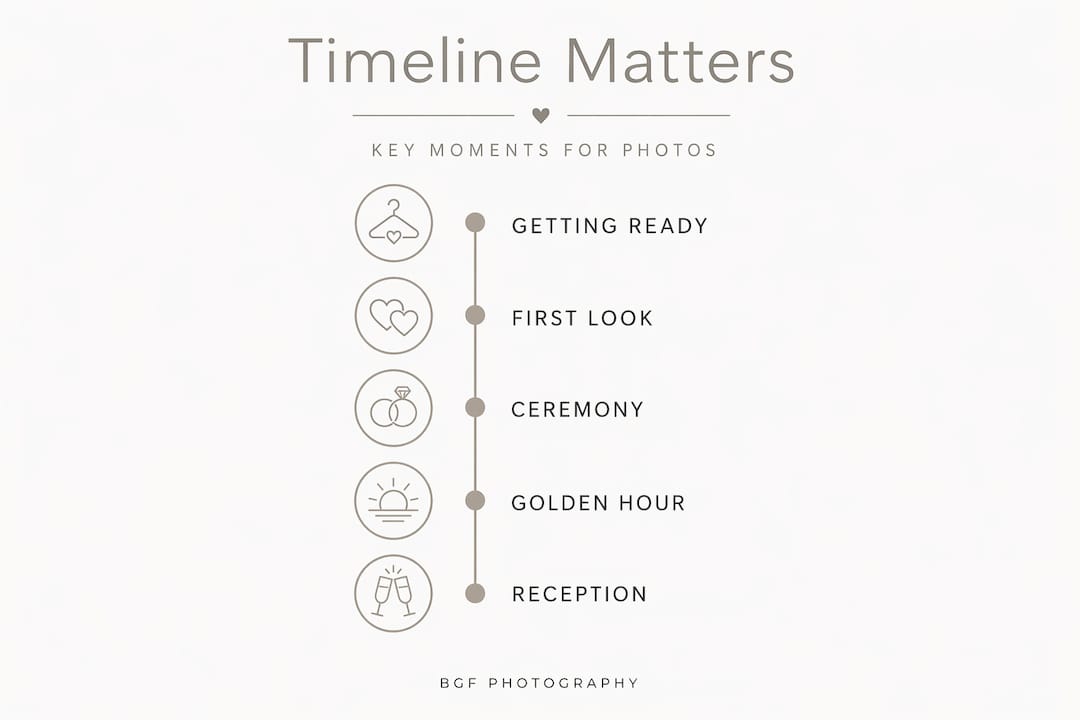
Golden hour and why it changes everything
Golden hour is the 45 to 60 minutes before sunset when the sun sits low and casts warm, diffused light that flatters every skin tone and fills backgrounds with a soft glow. No flash, no editing preset, no amount of skill fully replicates what that light does naturally. For wedding portraits, it is the difference between photos that look beautiful and photos that look cinematic.
Here is the misconception that costs couples their best shots: many assume that having the ceremony during golden hour means they will get golden hour photos. It does not work that way. During a ceremony, your photographer is documenting the event from a fixed position. Scheduling the ceremony earlier and reserving golden hour specifically for portraits produces dramatically stronger images, because you are actually in the light rather than sitting in front of it.
To build your timeline around golden hour, work backward from sunset:
-
Look up the exact sunset time for your wedding date and location.
-
Subtract 45 minutes. That is when your portrait session should begin.
-
Subtract another 30 to 45 minutes for travel, touch-ups, and bridal party photos.
-
Work backward from there to set your ceremony end time.
-
Then build the rest of the morning and afternoon to support that anchor point.
This approach treats golden hour as the fixed point it is, rather than something you will “get to if there is time.” There is rarely time if you do not plan for it.
Pro Tip: If your venue has a specific outdoor spot that catches the best light, visit it at the same time of day a few weeks before the wedding. You will know exactly where to stand and how long you have before the light shifts.
A practical example: a June wedding in Buffalo, NY might see sunset around 8:45 PM. That means portraits should start no later than 8:00 PM. If the ceremony ends at 6:30 PM and family formals take 30 minutes, you have a 90-minute window for cocktail hour and bridal party shots before the golden hour session. That is a workable day. Without that planning, the couple ends up doing portraits at 9:15 PM in the dark.
Building a timeline that protects your photos
Understanding the structure of a photography-friendly timeline means knowing what each block requires and where the bottlenecks hide.
The “ready by” rule
Photography coverage should begin when hair and makeup are finishing, not starting. This lets your photographer capture rings, shoes, the dress on the hanger, and candid moments between you and your people without the pressure of a half-finished look. The “ready by” time is not when you want to be done. It is a hard deadline that everything else feeds into.
First look vs. post-ceremony portraits
| Approach | Pros | Cons |
|---|---|---|
| First look (pre-ceremony) | Calmer portraits, frees cocktail hour, reduces nerves | Requires earlier start, less traditional |
| Post-ceremony portraits | Traditional reveal, emotional ceremony moment intact | Time pressure, cocktail hour often sacrificed |
Couples who do a first look consistently report a calmer, more relaxed portrait experience. The ceremony reveal is still emotional. The difference is that you are not sprinting through portraits while guests wait for you at cocktail hour.
Family formals and realistic timing
Family formals take 20 to 40 minutes on average, and a long list can push past 45 minutes without careful management. That is a significant chunk of your photography window. Keep the list to immediate family and a few key groups. Save extended family reunion shots for the reception.
Buffers that actually protect your day
Building 10 to 20 minutes of buffer between major blocks is not padding. It is insurance. Makeup runs 15 minutes long. The shuttle is late. Someone needs a moment. Without buffers, every delay compounds into the next block. With them, the day absorbs those moments without losing photo time.
Key places to build buffers into your wedding photography schedule:
-
After getting ready, before the first look or ceremony departure
-
Between ceremony end and family formals
-
Between family formals and bridal party portraits
-
Before the reception entrance to allow for touch-ups and a private moment
How to build and communicate your timeline
Planning a wedding day timeline that works for photography is a collaboration, not a solo project. Here is how to approach it well.
Start the conversation with your photographer during the booking process, not the month before the wedding. Share your venue, your ceremony time, and your sunset time. Ask them what they need and where they see potential conflicts. A photographer who has shot your venue before will have opinions worth hearing.
Use a shot list and assign family photo wranglers for formals. Choose someone who knows both sides of the family and can move people efficiently. This single step can cut family formal time nearly in half.
Additional wedding day photography tips for building a timeline that holds:
-
Share the finalized timeline with your entire vendor team, not just your photographer
-
Build your timeline in a shared document so your planner, coordinator, and photographer can all flag issues
-
Assign someone other than the couple to track time on the wedding day
-
Avoid scheduling portraits immediately after a meal, when energy dips and touch-ups are needed
-
Confirm all travel times between locations in real conditions, not Google Maps estimates
Pro Tip: Ask your photographer to review your timeline draft and mark every block where they need uninterrupted access to you. Those windows are non-negotiable. Everything else can flex.
The benefits of a wedding timeline extend beyond photos. Guests feel the difference between a day that flows and one that stalls. Vendors perform better when they know what is coming. And you, as the couple, actually get to be present rather than constantly wondering what happens next.
My honest take on timelines after years of shooting weddings
I have photographed weddings where the couple handed me a timeline and weddings where there was no plan at all. The difference in the final gallery is not subtle. It is night and day.
What I have learned is that couples almost always underestimate how fast the day moves. An hour sounds like a long time until you are in a wedding dress, surrounded by family, trying to get from a church to a park to a reception hall. Those transitions eat time in ways that are genuinely hard to anticipate if you have never experienced it.
The couples who end up with the strongest images are not always the ones with the biggest budgets or the most photogenic venues. They are the ones who treated the timeline as a creative tool rather than a scheduling chore. When I know I have 45 minutes at golden hour, I can plan specific shots, scout the exact location in advance, and show up ready to make something beautiful. When I am handed 15 minutes because the ceremony ran long and family formals took forever, I am doing damage control.
I also want to say something that does not get said enough: a good timeline makes the day more enjoyable for you. Not just for the photos. When there is structure, there is space to breathe. I have watched couples go from anxious and rushed to genuinely relaxed just because someone built a realistic schedule. The photos reflect that. Relaxed couples look like themselves. Stressed couples look like they are surviving.
If you take one thing from everything here, let it be this. Your photographer cannot manufacture time or light. But with a solid plan, they can do extraordinary things with both.
— Billy
Work with a photographer who plans with you
At BGF Photography, timeline planning is built into how we work with every couple. We do not show up and figure it out. We collaborate with you months in advance to build a schedule that protects golden hour, covers every moment you care about, and gives the day room to breathe. Whether you are booking photography only or our hybrid photo and video coverage, we help you think through every block so nothing gets left to chance. If you want to see what that looks like in practice, explore our wedding photography packages or browse real wedding galleries to see what a well-planned day actually produces.
FAQ
Why does the wedding day timeline matter for photography?
Your timeline determines what light your photographer works with, how much time exists for each moment, and whether key shots get captured or missed. A photography-aware schedule is the foundation of a strong final gallery.
When should couple portraits happen on the wedding day?
Couple portraits should begin 45 minutes before sunset to take full advantage of golden hour light, which produces the most flattering and visually striking images of the day.
How long should family formals take?
Family formals typically take 20 to 40 minutes depending on the size of your list. Keeping the list focused on immediate family and assigning a wrangler keeps things moving without overrunning your schedule.
What is a first look and should we do one?
A first look is a private moment between the couple before the ceremony, photographed by your photographer. It shifts most portraits to before the ceremony, which frees cocktail hour and makes the overall day feel significantly more relaxed.
How far in advance should we share our timeline with our photographer?
Share a draft timeline at least two to three months before the wedding. This gives your photographer time to flag conflicts, suggest adjustments, and plan specific shots around your venue and light conditions.