
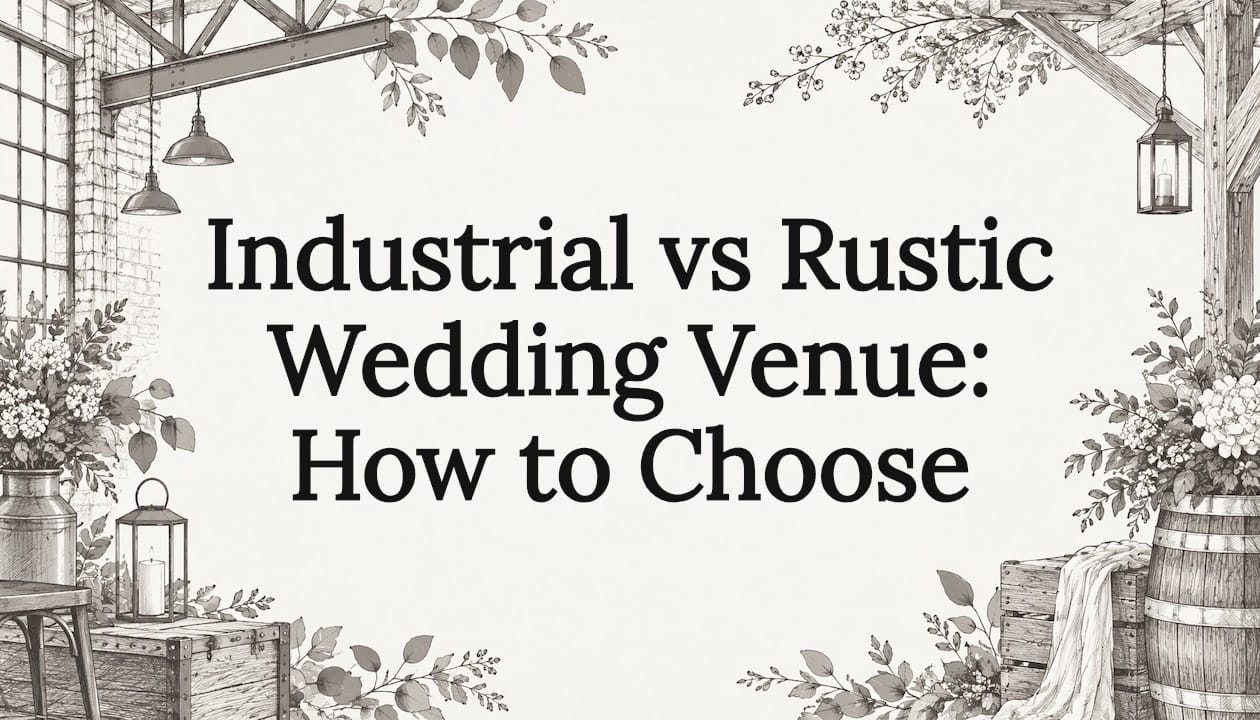
An industrial venue is a blank, hard-edged canvas of brick, steel and concrete. A rustic venue is a warm, finished setting of wood, stone and open land. The better choice is the one whose practical details fit your guest list, your budget and your timeline, and the one that gives your photographer and videographer good light to work with. Most couples decide on looks first and discover the costs and logistics later. This guide runs the comparison in the order that saves you the most trouble, and then shows what each room means for the photos and film you will keep for decades.
TL;DR
- Industrial venues (lofts, warehouses, factories) arrive nearly empty, so decor is up to you. Rustic venues (barns, ranches, lodges) arrive with a look already built in.
- A low rental fee is not a low total. Raw barns often need generators, restrooms, tents and lighting, and many industrial rooms need rentals and softening.
- Ask what comes with the room and what the noise curfew is before you fall for either style.
- Light decides how your photos and video look: dim barns after sunset and echoing concrete rooms both need a plan.
- Book your photo and video team early enough to walk the venue with them.
Table of Contents
- What counts as industrial and what counts as rustic
- How they feel: atmosphere and decor flexibility
- The practical checklist before you pick a style
- What each style really costs
- How the venue shapes your photos and video
- Booking photo and video for either venue
- Our perspective
- FAQ
- Sources
What counts as industrial and what counts as rustic
The two labels get blurred, so start with plain definitions.
Industrial venues are converted warehouses, lofts and factories. Carats and Cake lists the shared traits of US industrial venues: exposed brick, steel beams, large windows, metal lighting fixtures, visible piping, concrete floors and an airy feel. The Knot adds open floor plans and describes restored lofts, warehouses and factories with brick walls, soaring windows and exposed beams.
Rustic venues are barns, ranches, farms and lodges. Primrose Hill Events describes them with exposed wood beams, plank walls, stone and string lights. Camarillo Ranch Events makes a useful distinction: a barn wedding describes the location, while a rustic wedding describes the style, built on wood, stone, greenery and linen.
There is also a hybrid. Plenty of exposed-brick warehouse spaces blend both looks, and The Bricks notes that built-in character like this lets the decor budget go to accents instead of covering a blank box. If a venue sits between the two categories, judge it on the checklist below, not on the label.

How they feel: atmosphere and decor flexibility
The biggest difference is how much work the room does for you.
Industrial: a canvas you finish
Chicago Style Weddings says the wood, glass and metal in industrial spaces adapt to themes from sleek and modern to bohemian. The Knot describes the "vast emptiness" of these venues as leaving decor largely to the couple, whether you want romantic, glam, eclectic or even rustic.
That flexibility comes with a job. Primrose Hill Events notes that concrete and steel can feel cold and echo loudly, so couples should budget for draping, rugs, greenery and warm light. Industrial rooms suit jewel tones, black palettes and cocktail-style receptions, and they give a city-night, dramatic feel.
Rustic: a mood that is already there
Primrose Hill Events describes rustic as warm, grounded and unpretentious, the kind of room where guests relax faster and stay later. Chicago Style Weddings points out the flip side: a strongly established aesthetic can limit how far you can restyle the space. Camarillo Ranch Events argues that leaning into the existing architecture instead of covering it up reduces decor costs.
One caution that keeps rustic from sliding into cliché: Blue Cedar advises starting with the setting, not with mason jars and string lights, because the venue decides how the ceremony, reception, food, music and guest movement actually work.
A quick way to decide
| Question | Leans industrial | Leans rustic |
|---|---|---|
| Mood you want | Dramatic, modern, city-night | Warm, relaxed, natural |
| Decor effort | Higher, you build the look | Lower, the room supplies it |
| Palette | Jewel tones, black, metallics | Greenery, linen, wood tones |
| Location | Usually urban, near hotels | Usually rural, more driving |
| Guest feel | Stylish, cocktail energy | Dance sooner, stay later |
If you are torn, look at what you already own in your head: a Pinterest board full of candlelight on brick, or one full of long farm tables and open fields. That board is usually your answer.
The practical checklist before you pick a style
Style is the easy part. These are the details that decide whether the day runs smoothly.
What comes with the room
Little Wedding Planner argues that the real difference between the two styles is not the wall finish but what comes with the room. A warehouse can arrive with a kitchen, sound system and every chair, while an old shed can arrive with only tables and crockery. Carats and Cake says industrial venues often include bathrooms, power generators and mobile kitchens for caterers, and may include speakers, tables and chairs.
Ask both kinds of venue for a written list of what is included and, as Pix Wedding recommends, a line-item quote of everything that is not included, so you can price generators, tents, restrooms and lighting before you sign.
Noise curfew and end time
The same Little Wedding Planner piece says to read the music curfew first. A remote property can promise the whole night, while an inner-city room keeps the neighbors' bedtime. ThePerfectWedding.com points out that a 10 PM hard stop effectively ends the reception at 9:45 PM after the last dance and exit. That matters for your photo and video timeline too, and our guide to choosing a reception coverage end time walks through three timelines.
Weather and flow
Chicago Style Weddings notes that industrial venues are climate-controlled and typically close to accommodations and transportation. Rustic venues need a closer look: Primrose Hill Events advises touring for real climate control, restrooms, lighting after sunset and a rain plan. The Bricks asks whether weather backup is built in or bolted on, and says to price a tent before comparing rental fees if it is not included.
Blue Cedar adds the questions that matter at a farm or lakeside property: where guests park, how far they walk, where catering unloads, how accessible the grounds are for older guests, and whether there is room for a dance floor after tables and a bar are added.
Distance and guest travel
If the venue is more than 30 minutes from where guests stay, ThePerfectWedding.com suggests budgeting $500 to $2,000 for shuttle service. In Western and Central New York, a barn in the Finger Lakes can be a gorgeous drive for you and a long night for guests without a ride home, so price that before it becomes a surprise.
Ceremony and reception in one place
The Bricks says a well-designed floor plan can rotate from ceremony to cocktail hour to reception without guests leaving the building, but you should verify the square footage genuinely serves both functions. We cover the upsides of this setup in single venue wedding benefits.
What each style really costs
Headline rental fees mislead in both directions. Use these published figures as ranges to compare against your local quotes, not as promises for your date.
Rustic venue costs
- Pix Wedding's 2026 guide prices barn rentals at $2,000 to $8,000, working farms at $1,500 to $6,000 and ranches at $2,000 to $7,000.
- The same guide lists hidden rustic costs: a generator at $200 to $500, portable restrooms at $300 to $800, a tent at $1,500 to $10,000, lighting at $500 to $3,000 and a dance floor at $300 to $1,000. A $3,000 barn can quickly reach $8,000 to $12,000.
- Lotus Wood Farm, writing about the Hudson Valley in August 2026, says raw agricultural barns can require $8,000 to $20,000 in infrastructure add-ons and often cost more in total than restored event barns despite lower headline fees.
- Wedding Guide Anatole puts barn and rustic venues at $5,000 to $12,000 and notes generators, restrooms and climate control are often extra.
Industrial venue costs
- AROOSAi's 2026 guide says industrial venues typically charge $2,000 to $12,000 for rental, with wider ranges in major markets, and many do not include catering, tables, chairs or linens.
- With Joy reports New York City industrial rentals averaging $2,000 to $5,000 for the space alone, before catering and bar service charges, security deposits and overtime. It puts industrial-style lighting at $500 to $1,000.
- A Brooklyn loft listing on Here Comes the Guide shows $3,000 to $5,000 depending on the day for a 14-hour rental that includes 130 chairs, 14 banquet tables and heat and air conditioning, with separate costs for catering, alcohol, insurance and a refundable deposit.
What this means for your budget
The pattern is consistent: a venue is roughly 25 to 35 percent of a total wedding budget according to Paperlust, and the cheaper-looking option is rarely cheaper once you add what is missing. Pix Wedding estimates a full rustic barn wedding with catering, rentals, lighting and decor at $15,000 to $40,000, about the same as a traditional venue once extras are counted. Compare totals, not rental fees. Build a spreadsheet with the same rows for each finalist: rental, tables and chairs, linens, restrooms, power, climate control, lighting, tent, shuttle, insurance and overtime.
How the venue shapes your photos and video
This is where the style choice stops being abstract. The room is the backdrop for every frame and the light source for most of them.
Industrial rooms
Big factory windows and pale walls can give soft, directional daylight for portraits and a getting-ready scene, and brick and metal give texture to candid moments. The challenges are mixed light and sound. Dim, warm bulbs next to cool window light can produce color casts, which is why a lighting plan helps. Our wedding day lighting plan for couples explains how to avoid color mismatches, and the Rochester wedding lighting guide covers local rooms. Echo matters for video: speeches in a concrete room can sound harsh, so rugs, draping and a good sound setup help your film as much as your guests.
Rustic rooms
Barns and lodges have warm wood tones that flatter skin and film beautifully, and open land gives golden-hour portraits. The challenge is after sunset: Primrose Hill Events specifically advises checking lighting once the sun goes down, and dark wood ceilings absorb light. If your reception runs late in a barn, ask how it is lit and plan the exits and dance floor with that in mind. Our guides to low light wedding photography and dance floor photo ideas show what a good plan looks like.
Style that lasts
Whichever you pick, the photos should feel like your day and not a trend. Our piece on wedding aesthetic in photos that last covers how to choose details you will still love in thirty years. If you are leaning toward a less conventional room, nontraditional wedding venue benefits is a good next read.
Walk the venue with your team
The best moment to find these issues is before the contract, not on the wedding day. Showing your photographer and videographer the room, or at least photos of it at the hour your reception will run, lets them tell you where the light will fall and where the dance floor should go. Booking one team for both photo and video helps here, because one conversation covers both and the two share a single plan for light and timing.
Booking photo and video for either venue
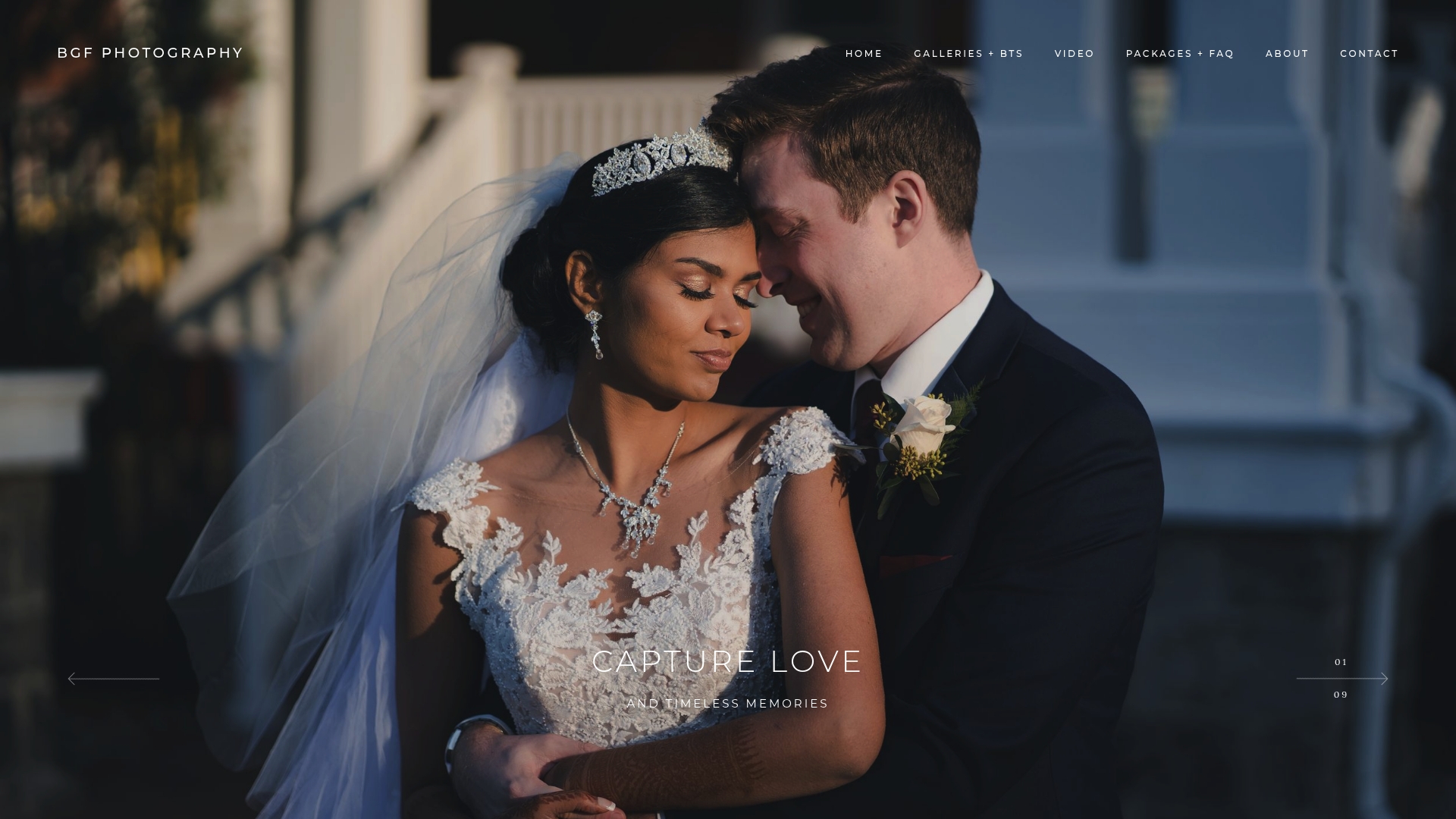
We cover weddings in Buffalo, Rochester and the Finger Lakes, from restored brick buildings in the city to barns and lakeside properties outside it. Our approach is candid and unobtrusive: we let real interactions unfold and document them, so the guests who relax in a rustic barn or dance in an industrial loft are the ones you see in your gallery. We also offer hybrid coverage, so photography and videography are booked together in one cohesive style and vision, and optional film photography for a nostalgic look.
For reference, our published pricing for 2026 (see the full investment page) is:
- Full Wedding Day: $4,500 to $5,200
- 3-6 Minute Highlight Video: $1,400
- 9-15 Minute Featurette Video: $1,800
- 30-60 Minute Full Length Video: $2,600
- Engagement Session: $600
- Medium Format and 35MM Film: $100 per roll
- Additional Drone Pilot: $500 to $700
The engagement session is a low-pressure way to get used to being photographed before the wedding.
When you have a date and a venue, or even a shortlist of two, see our packages and pricing and tell us which room you are leaning toward.
Our perspective
We have a simple view on this question: the venue is a stage, and the best stage is the one that lets you forget the camera is there. Industrial or rustic, the photos that people keep are rarely the staged ones. They are your dad wiping his eyes during the toast, your grandmother on the dance floor, the quiet look between you after the ceremony.
That is why we shoot candidly and stay unobtrusive. A natural approach works in a brick loft and in a barn, because it follows people instead of directing them. If you add film, the warmth of wood and the texture of brick both take on a nostalgic quality that is hard to fake.
We also think photo and video belong together. When one team covers both under a single vision, the gallery and the film look like the same day told two ways, and you only plan the light, timing and shot list once. Our hybrid coverage is built for exactly that.
Pick the venue that suits your guests and your budget, then bring us in early. We would rather walk the room with you than solve its problems on the day.
Billy
FAQ
Is an industrial venue cheaper than a rustic one?
Not reliably. Published ranges overlap heavily: industrial rentals run roughly $2,000 to $12,000 and barns $2,000 to $8,000 or more, per the guides cited above. What decides the total is what is included. Get line-item quotes from each venue and compare the full cost with rentals, restrooms, power, lighting and insurance added.
Which style is better for photos and video?
Both work well when the lighting is planned. Industrial rooms offer window light and texture but can echo and show color casts from mixed bulbs. Rustic barns offer warm tones and golden-hour portraits but can get dark after sunset. Visit with your photographer and videographer and ask them where the light falls at your ceremony and reception times.
Can I mix industrial and rustic?
Yes. Many warehouse venues have exposed brick and timber that read as both, and The Knot notes that industrial spaces suit rustic decor too. Start from what the room already has and add natural textures like linen, greenery and wood through your tables, florals and rentals.
What should I ask a venue before booking?
Ask what is included, the music curfew, the rain or weather plan, the climate control, the restrooms, the lighting after dark, whether decor rentals are on site and how the layout works for your guest count. Also ask for a list of everything not included so you can price it in advance.
Sources
- Choosing Your Wedding Venue: Industrial Elegance vs Rustic Charm, Chicago Style Weddings
- Industrial Wedding Venues, Carats and Cake
- 12 Stunning Industrial Wedding Venues in the US, The Knot
- Wedding Venue Styles: Rustic vs Modern vs Elegant, Primrose Hill Events
- What Is a Rustic Wedding? Camarillo Ranch Events
- Cherry Valley Wedding Venues Compared, The Bricks
- Rustic Country Wedding Ideas for Barn and Lawn Venues, Blue Cedar
- Industrial or Rustic, Ask What Comes With the Room, Little Wedding Planner
- Rustic Wedding Venues Compared, Pix Wedding
- How to Compare Wedding Venues, ThePerfectWedding.com
- Barn Wedding Venue in the Hudson Valley: 11 Must-Knows, Lotus Wood Farm
- Wedding Venue Cost: 2025 Price Guide by Type, Wedding Guide Anatole
- Industrial Chic Wedding Venues: Complete Guide, AROOSAi
- Industrial Wedding Venues NYC, With Joy
- Dumbo Loft Weddings, Here Comes the Guide
- How to Choose a Wedding Venue: Checklist, Paperlust