
TL;DR:
- Weather heavily influences Rochester wedding videography by affecting lighting, audio, and filming logistics on the wedding day. Overcast skies create ideal soft light, while rain and snow introduce unique challenges and opportunities for storytelling, requiring proper gear and planning. Proper preparation, including backup locations and skilled audio equipment, ensures the final film captures the day's emotional and visual essence despite unpredictable weather conditions.
Weather is the single most unpredictable variable in Rochester wedding videography, directly shaping lighting quality, audio clarity, filming logistics, and the emotional tone of your final film. Rochester sits in western New York, where lake-effect snow, summer thunderstorms, and rapidly shifting cloud cover can all appear within the same weekend. Understanding why weather affects Rochester wedding videography helps you make smarter decisions during booking, timeline planning, and day-of coordination. Videographers who work regularly in this region treat weather not as an obstacle but as a production condition that requires preparation, the right gear, and a creative eye.
How Rochester weather conditions shape your wedding film
Rochester delivers four genuinely distinct seasons, and each one presents a different set of filming conditions. Sunny summer days feel ideal until the camera rolls. Direct overhead sun creates harsh shadows across faces, blows out white dresses, and forces videographers to hunt for open shade or use diffusion tools to soften the contrast. That chasing takes time and limits spontaneous coverage.
Overcast and cloudy skies are actually a videographer's preferred condition. Overcast skies act as a natural softbox, diffusing light evenly across the scene and eliminating the harsh shadows that direct sun creates. This effect is nearly impossible to replicate with artificial lighting on location. The result is a painterly, cinematic look that holds up beautifully on screen.
Rain introduces a different set of challenges and creative possibilities. Wet surfaces reflect light, adding depth and texture to outdoor shots. Rain transforms into a storytelling asset when a videographer uses clear umbrellas, shallow depth of field, and rain-streaked windows as compositional elements. The emotional weight of a couple laughing in the rain often produces the most memorable footage of the entire day.
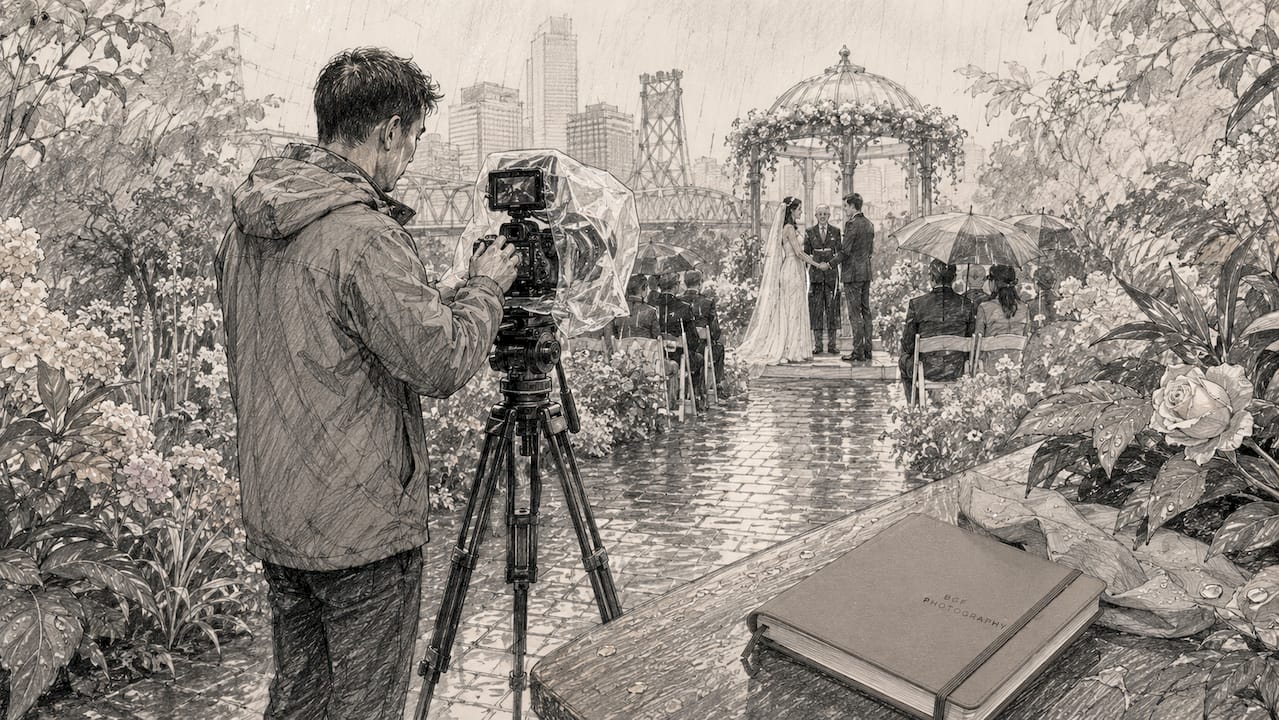
Snow creates a visually striking backdrop but introduces real equipment challenges. Cold temperatures drain camera batteries faster, condensation forms on lenses when moving between warm and cold environments, and bright snow can fool camera meters into underexposing faces. Experienced videographers carry hand warmers for batteries, allow gear to acclimate before shooting, and dial in manual exposure settings before stepping outside.
Wind is the most technically damaging weather condition for video production. It generates constant ambient noise that bleeds into microphone recordings and can make vow audio completely unusable. A skilled videographer addresses this before the ceremony starts, not during it.
- Sunny: Seek open shade, use diffusion panels, schedule portraits near golden hour to avoid overhead glare.
- Overcast: Shoot freely outdoors. Soft, even light flatters every subject and requires minimal correction in post-production.
- Rainy: Deploy clear umbrellas, shoot through rain-streaked glass, and frame puddle reflections as compositional elements.
- Snowy: Protect gear from condensation, carry spare batteries, and use manual exposure to prevent snow from underexposing faces.
- Windy: Use directional microphones with foam windscreens, position subjects with their backs to the wind, and rely on lavalier mics clipped close to the body.
Pro Tip: Ask any videographer you are considering to show you a full-length film shot on a rainy or overcast day. How they handle imperfect conditions reveals far more about their skill than a highlight reel shot on a perfect summer afternoon.
Why audio is the first thing weather destroys
Audio quality is the most predictive factor for long-term satisfaction with a wedding film. Couples rewatch their film for the vows, the speeches, and the laughter. When wind or rain ruins that audio, no amount of beautiful visuals compensates for the loss.
Wind and rain generate broadband ambient noise that sits in the same frequency range as human speech. A standard on-camera microphone or even a boom mic without proper shielding picks up that noise and buries the voices underneath it. The problem compounds outdoors, where there are no walls to block wind gusts or muffle rainfall.
The professional solution is dual lavalier microphones. Dual lavalier mics increase usable vow audio from 12% to over 70% in windy or rainy conditions. A lavalier clips directly to the officiant or groom, placing the microphone capsule inches from the speaker's mouth and physically shielding it from ambient noise. Running two simultaneously means one serves as a backup if the other fails or gets bumped.
Here is how a prepared videographer protects your audio on a difficult weather day:
- Clip lavalier mics before the ceremony begins. Waiting until the last minute creates rushed placement and missed levels checks.
- Use foam windscreens on every external microphone. Foam reduces wind noise without significantly affecting voice frequencies.
- Record to a dedicated audio recorder as a backup. Devices like the Zoom H5 or Tascam DR-40X capture a separate audio track independent of the camera.
- Place a recorder near the speaker system. If the venue uses a PA system, a line-out feed from the soundboard captures clean audio regardless of outdoor conditions.
- Build 10–15 minute buffers around ceremony start times. Timeline buffers around major events give the team time to re-rig audio if weather conditions change suddenly.
Pro Tip: During your final meeting with your videographer, ask specifically how they handle audio in wind and rain. If they cannot name the specific microphones and recorders they use, that is a red flag worth addressing before you sign.
How Rochester's seasons shift your filming window
Rochester's golden hour arrives at dramatically different times depending on the season. In june and july, sunset falls after 8:30 p.m., giving couples a long, flexible window for outdoor portraits after the ceremony. By november, that same golden light disappears before 5:00 p.m. Rochester's golden hour shifts significantly by season, and failing to align your timeline with those shifts means missing the best natural light of the day.
This seasonal shift has a direct impact on how your wedding day should be structured. A fall or winter wedding that schedules portraits at 5:00 p.m. will be filming in near-darkness. The videographer then relies on artificial lighting, which changes the look and feel of the footage entirely.
The table below shows how filming conditions compare across Rochester's main wedding seasons.
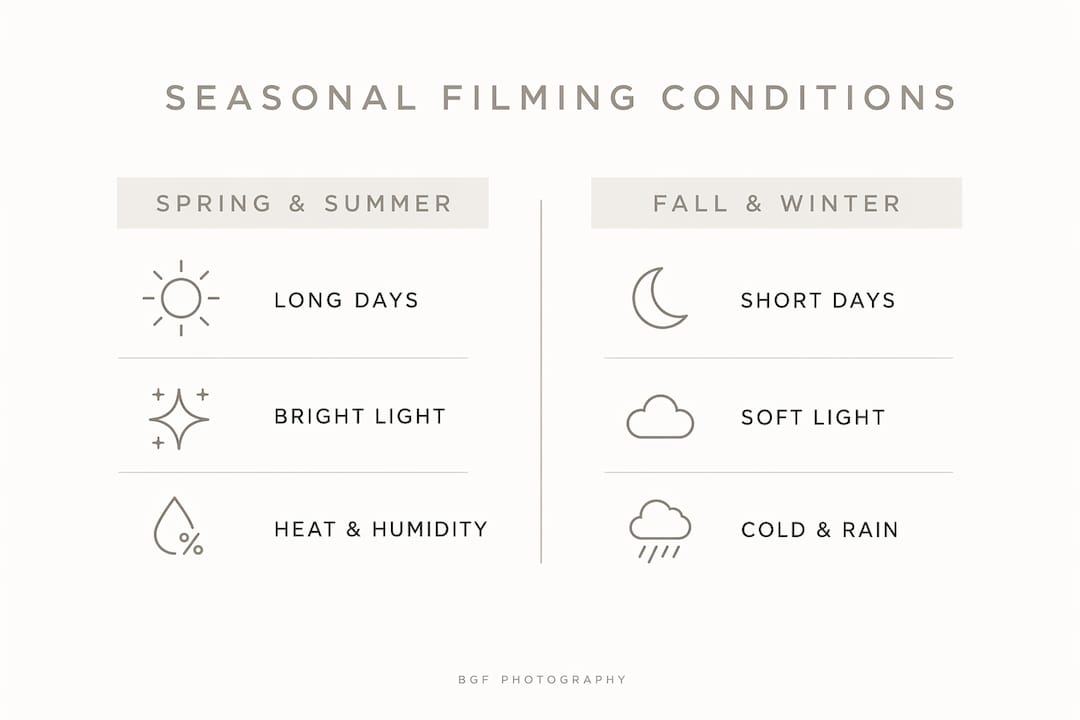
| Season | Golden hour timing | Natural light quality | Primary challenge |
|---|---|---|---|
| Spring (april–may) | 7:30–8:00 p.m. | Soft, warm, variable cloud cover | Unpredictable rain and mud |
| Summer (june–august) | 8:15–8:45 p.m. | Long window, harsh midday sun | Overhead glare during afternoon ceremonies |
| Fall (september–october) | 6:30–7:15 p.m. | Rich, warm tones, shorter window | Rapidly shrinking daylight after october |
| Winter (november–february) | 4:30–5:00 p.m. | Low, directional, very short window | Cold gear issues, extremely tight portrait time |
The practical takeaway is that your ceremony end time and portrait block need to be planned with the season's sunset in mind, not just the venue's preferred schedule. Share your full timeline with your videographer at least four weeks before the wedding. A good videographer will flag any conflicts between your schedule and the available light before the day arrives.
Indoor venue transitions also eat into the filming window. Moving a wedding party from a ceremony space to a reception hall, coordinating family formals, and managing guest flow can consume 30–45 minutes of the portrait window. Couples who account for that transition time in their planning consistently end up with more relaxed footage and better natural light coverage.
What you can do right now to protect your wedding film
Preparation before the wedding day is the most effective tool couples have against weather-related videography problems. Proactive backup location plans reduce emotional stress and produce better video outcomes because a calm couple films authentically. Stress shows on camera, and the uncertainty of not having a plan is often worse than the weather itself.
Here is what couples planning a Rochester wedding should do well before the date:
- Identify a backup indoor or tented location. Confirm this with your venue before you sign the contract. Knowing the backup exists removes the anxiety of watching the forecast all week.
- Review full-length wedding films, not just highlight reels. Watching at least 3 full-length films helps you assess how a videographer performs across an entire day, including the moments when weather creates real challenges.
- Ask about the videographer's gear for adverse conditions. A prepared team carries rain covers for cameras, extra batteries, and redundant audio recorders. These are not luxury items. They are standard professional equipment.
- Discuss contingency plans during your booking meeting. Weather conversations should happen before the contract is signed, not the morning of the wedding.
- Share your venue's indoor spaces with your videographer in advance. Knowing the layout lets them identify good natural light sources, power outlets for lighting rigs, and backup ceremony spots before the day arrives.
Choosing a videographer with a portfolio that demonstrates skill across different weather conditions is the strongest protection you have. Style matching is the strongest predictor of client satisfaction, beyond price and reviews. A videographer whose portfolio shows only perfect sunny days has not proven they can handle Rochester's reality.
Pro Tip: When reviewing a videographer's portfolio, look specifically for films shot in fall or winter. Rochester's local geography and weather create conditions that not every videographer has experience managing. A portfolio that includes those seasons tells you the team has been tested.
You should also discuss power access with your videographer. Outdoor ceremonies in tented or garden settings may not have reliable power for lighting rigs or audio recorders. Knowing this in advance lets the team bring battery-powered alternatives rather than discovering the problem during setup.
Finally, communicate your contingency plan to all vendors, not just the videographer. When your photographer, caterer, and florist all know the backup plan, the transition happens smoothly and the camera keeps rolling without interruption.
Key takeaways
Weather shapes every technical and creative decision in a Rochester wedding film, from lighting and audio to timeline and gear selection.
| Point | Details |
|---|---|
| Overcast beats sunny for video | Cloudy skies create soft, even light that is nearly impossible to replicate artificially. |
| Audio is the highest-risk element | Dual lavalier mics raise usable vow audio from 12% to over 70% in wind and rain. |
| Season determines your portrait window | Rochester's golden hour arrives before 5:00 p.m. in winter, requiring tight timeline planning. |
| Backup plans reduce stress and improve footage | Couples with confirmed indoor alternatives film more authentically because the uncertainty is gone. |
| Portfolio review is your best filter | Watching full-length films in varied weather reveals a videographer's real skill level. |
What I've learned filming Rochester weddings in every season
Weather stress is real, but the actual day-of impact is almost always smaller than couples expect. I have filmed ceremonies in driving rain, filmed portraits in snow, and captured first dances during power outages caused by summer storms. In nearly every case, the couple who had a plan walked through it calmly. The couple without a plan spent the day anxious, and that anxiety shows in the footage.
Rain is genuinely one of my favorite conditions to film in. The light is soft, the colors are saturated, and the emotional stakes feel higher. There is something about a couple choosing to stand outside in the rain that reads as deeply committed on screen. Clear umbrellas, a willing couple, and a videographer who knows how to use rain as a compositional element produce footage that highlight reels are built around.
The timeline issue is the one I wish more couples took seriously earlier. I have seen beautiful fall weddings lose their entire golden hour portrait window because the ceremony ran 20 minutes long and the family formals took longer than expected. Those 10–15 minute buffers around major events are not padding. They are the margin that separates a rushed film from a relaxed one.
My honest advice is to review your videographer's work in conditions that match your wedding season. If you are getting married in october in Rochester, ask to see an october film. Ask how they handled the light. Ask what microphone setup they used for the ceremony. The questions you ask before booking determine the quality of the film you get back.
Weather is part of your wedding's story. The best films I have made in Rochester did not happen despite the weather. They happened because of it.
— Billy
BGF Photography's approach to Rochester wedding films
Rochester weather does not wait for a convenient moment. BGF Photography builds weather contingency planning into every consultation, from timeline structuring to gear selection and backup location scouting.
BGF Photography's 2026 packages are designed with Rochester's seasonal conditions in mind, covering hybrid photography and videography under one cohesive style so your entire day is documented consistently. Whether your wedding day brings golden fall light or a gray november sky, the team arrives prepared with redundant audio systems, weather-protected gear, and a timeline built around your actual sunset. Review the full package details and reach out for a personalized consultation at BGF Photography's investment page.
FAQ
Why does weather affect wedding video quality so much?
Weather directly controls natural lighting, audio conditions, and filming logistics. Harsh sun, wind noise, and rain each require different technical responses that affect the final film's look and sound.
What is the best weather for a Rochester wedding video?
Overcast skies produce the most flattering and cinematic natural light for wedding films. That soft, diffused light eliminates harsh shadows and is nearly impossible to replicate with artificial lighting.
How do videographers protect audio during wind and rain?
Professionals use dual lavalier microphones clipped close to speakers, foam windscreens on all external mics, and dedicated audio recorders as backups. This combination raises usable vow audio success rates dramatically in adverse conditions.
When should I schedule portraits for a fall or winter Rochester wedding?
Schedule portraits to finish at least 30 minutes before sunset. Rochester's golden hour arrives before 5:00 p.m. in november and december, so ceremony end times and family formals need to be planned accordingly.
How do I know if a videographer can handle bad weather?
Ask to watch a full-length film shot during a rainy or overcast day. A videographer who can show you strong work in difficult conditions has proven they can handle Rochester's unpredictable weather.