
Most couples wait 6 to 12 weeks for a complete film wedding gallery, with a digital sneak peek arriving in 48 to 72 hours or up to a week. That range holds for a standard hybrid or full-film wedding booked outside peak season. Heavy roll counts, custom scans, or destination shipping push delivery toward the far end, so ask your photographer for a written maximum before you sign anything.
TL;DR:
- Film wedding photographs usually take 6 to 12 weeks for full delivery due to lab processing, scanning, shipping, and extensive editing, unlike digital photos which often arrive in 2 to 6 weeks.
- Peak wedding season can extend film turnaround times by an additional 1 to 3 weeks, especially with higher roll counts, special processing, or international shipping delays.
- Couples should get specific, written delivery dates for both sneak peeks (within days) and full galleries (maximum weeks), including details on extra charges and damaged roll policies.
- Hybrid workflows offer a partial digital preview within days while the slower film process completes, making the wait feel shorter without rushing quality.
- Rush processing options are available but often costly, and physical steps—development and scanning—are the main bottlenecks that cannot be sped up significantly.
Table of Contents
- Film Wedding Photo Turnaround Vs. Digital: What The Numbers Actually Show
- Where The Time Actually Goes In A Film Wedding Workflow
- What Actually Stretches Or Shrinks Your Wait
- What To Put In Writing Before You Book
- Three Realistic Timelines You Can Map To Your Own Wedding
- Can You Actually Speed Up Film Delivery?
- How BGF Photography Sets Delivery Expectations From Day One
- Why We Think Film's Slower Timeline Is Part Of What You're Paying For
- Get Your Film Delivery Timeline In Writing With BGF Photography
- Sources
- FAQ
Film Wedding Photo Turnaround Vs. Digital: What The Numbers Actually Show
Digital-only wedding photographers typically deliver a full gallery in 2 to 6 weeks. Film photographers work on a longer clock, usually 6 to 12 weeks, because the images have to leave the camera, travel to a lab, get chemically developed, and get scanned before anyone touches a computer for editing.
A survey of 1,850 wedding photographers found most digital shooters deliver between 2 and 4 weeks, but 11% took longer than eight weeks, and film photographers clustered toward that slower end of the Shotkit wedding photo delivery survey. It's largely film and hybrid photographers whose timeline depends on a lab they don't control.
Pro Tip: Ask any photographer quoting a "2 to 4 week" turnaround whether that number includes film. If they shoot any film at all, that number almost never applies to the full gallery.
Here's how the two workflows typically break down:
- Digital full gallery: 2 to 6 weeks, driven almost entirely by the photographer's own editing queue.
- Film full gallery: 6 to 12 weeks, driven by lab processing, scanning, shipping, and then editing.
- Sneak peek (either format): 48 hours to 1 week, usually a handful of digital images or camera-phone backups shared before the film even reaches the lab.
- Peak season adjustment: Add 1 to 3 weeks to any of the above during spring and fall, when labs and photographers both process a backlog of weddings at once.
The sneak peek exists precisely because film takes longer. A photographer can hand you five to ten digital preview images within days, long before a single roll comes back from the lab. That gap between "here's a taste" and "here's everything" is the single most misunderstood part of film wedding photography.
Seasonality matters more with film than digital. During peak wedding months, labs process a flood of orders from photographers across the country at once, not just yours. Richard Photo Lab's turnaround page explicitly notes that quoted processing times are averages that shift week to week depending on volume. A lab that turns around orders in four business days in February might need seven or eight in June.
If you're weighing film versus digital wedding photography for your own wedding, turnaround time should factor into that decision as much as the visual look you're chasing. Film's nostalgic quality comes with a real time cost, and no photographer can process chemistry faster than the chemistry allows.
Where The Time Actually Goes In A Film Wedding Workflow
Film turnaround isn't one black box. It's a chain of discrete steps, and each one eats a predictable slice of the calendar. Understanding the chain helps you spot where a photographer's promised date is realistic and where it's wishful thinking.
- Shipping film to the lab (1 to 3 days). Most photographers mail rolls within a few days of the wedding rather than carrying them home indefinitely. Labs start their turnaround clock the day film physically arrives, not the day it was shot.
- Lab development and scanning (a few days to 4 weeks). This is the widest range in the whole process. Bay Photo's published turnaround lists standard C-41 color mail-in processing as short as 3 business days, while black-and-white and E6 slide film typically take longer. Richard Photo Lab lists its own averages by machine and process, and both labs note that number of rolls and any special requests can stretch that window.
- Return shipping (1 to 3 days). Scans and negatives travel back to the photographer, sometimes digitally first if the lab offers online delivery ahead of physical negatives.
- Photographer culling (several days to a week). The photographer sorts thousands of frames down to the best few hundred, discarding blinks, blur, and duplicates.
- Color grading and retouching (1 to 3 weeks). Film scans often need consistent color correction across rolls shot on different stocks, in different light, at different times of day. Some couples also request retouching on select images, which adds time per photo.
- Export and delivery (a few days). Final files get compiled, formatted, and uploaded to a gallery or delivered as downloads.
Add it up and you land close to the practitioner-reported range of 6 to 12 weeks for a full film wedding, factoring in lab development, scanning, and photographer editing according to Tov Studio Photo's breakdown of film wedding business timelines. Mail time alone can eat 2 to 6 days round trip before a single frame gets edited.
Hybrid workflows shortcut the emotional wait without shortcutting the real work. A photographer shoots part of the day digitally and part on film, then sends the digital sneak peek fast while the film scans arrive on their normal schedule. Many experienced film photographers lean on exactly this approach, delivering a quick preview while preserving the slower film pipeline behind it, according to Tov Studio Photo's analysis of hybrid delivery practices. It's not a way to speed up film. It's a way to make the wait feel shorter, which for most couples is the point.
If you're curious how many images actually come out of a wedding day, a breakdown of typical wedding photo counts shows why culling and grading hundreds of images takes real hours, not minutes, regardless of format.
What Actually Stretches Or Shrinks Your Wait
Turnaround ranges are averages, not guarantees. Several concrete factors move your specific delivery date up or down, and knowing them lets you ask better questions before you book.
- Roll count. A wedding shot on 15 rolls takes noticeably longer through the lab than one shot on 5, since scanning time scales with frame count, not just order count.
- Special processing. Push or pull processing, cross-processing, or custom color profiles all add manual steps a standard C-41 run skips entirely.
- Lab backlog and staffing. Labs experience the same seasonal crunch photographers do, and a short-staffed week in July looks nothing like a quiet week in January.
- Format mix. Medium-format and large-format scans generally run slower and cost more per frame than 35mm, which affects both processing time and price.
- Shipping method. Overnight shipping to and from the lab can shave several days off the total compared with standard ground shipping, though it costs more.
- In-house rescans. Some photographers rescan select negatives themselves at higher resolution after the lab's initial pass, which adds time but can improve final quality.
Richard Photo Lab specifically calls out roll count and special requests as the two biggest levers on their published turnaround estimates. A wedding with a normal roll count and no special requests moves through the system close to the lab's stated average. A wedding with 20 rolls and a request for oversized TIFF scans on the best twenty images does not.
What To Put In Writing Before You Book
A verbal promise about delivery timing is worth exactly nothing once the bröllopsfotograf i Stockholm » heldagsbröllopsfotografering contract is signed. Get these four things in writing, and you eliminate almost every source of post-wedding frustration.
- **A sneak-peek window with a specific number of days, not a vague "soon." Ask for something like "5 to 10 images within 72 hours" rather than accepting silence until the full gallery arrives.
- A final delivery date or a maximum number of weeks after the wedding. "6 to 12 weeks" is a reasonable range to see in a contract; "when it's ready" is not.
- A clear list of what's billed separately, including film stock, lab processing, scanning fees, and any rush charges, so nothing surprises you on the final invoice.
- A damaged-roll and rescan clause. Film can be lost, fogged, or damaged in transit. Ask what happens, and who covers the cost, if a roll comes back unusable.
Getting your wedding photo turnaround in writing protects both sides. It gives the photographer a defined obligation and gives you a concrete date to plan around instead of an open-ended promise. If a photographer resists putting a delivery window in the contract, treat that as a warning sign, not a formality they simply forgot.
Three Realistic Timelines You Can Map To Your Own Wedding
Ranges are useful, but a calendar date is more useful. Here's how three common booking types typically play out from "I do" to "gallery delivered."
Hybrid local wedding, off-peak season. Your sneak peek of 5 to 10 digital images lands within 2 to 4 days. The photographer ships film to the lab within 2 days of the wedding, gets scans back in 1 to 2 weeks, then spends 2 to 4 weeks culling, grading, and exporting the full gallery. Total: roughly 6 to 8 weeks from wedding day to complete delivery.
Full film wedding, peak season (May through October). The same steps apply, but lab backlogs and photographer editing queues both run longer. Expect the sneak peek within a week and the full gallery closer to 10 to 12 weeks, sometimes slightly beyond if the photographer is juggling multiple peak-season weddings at once.
Destination wedding with film. Add shipping time in both directions, and possibly customs delays if film crosses an international border before reaching the lab. Plan for the upper end of the film range, 10 to 12 weeks or slightly more, and don't schedule anything time-sensitive, like a save-the-date announcement built on your photos, before that window closes.
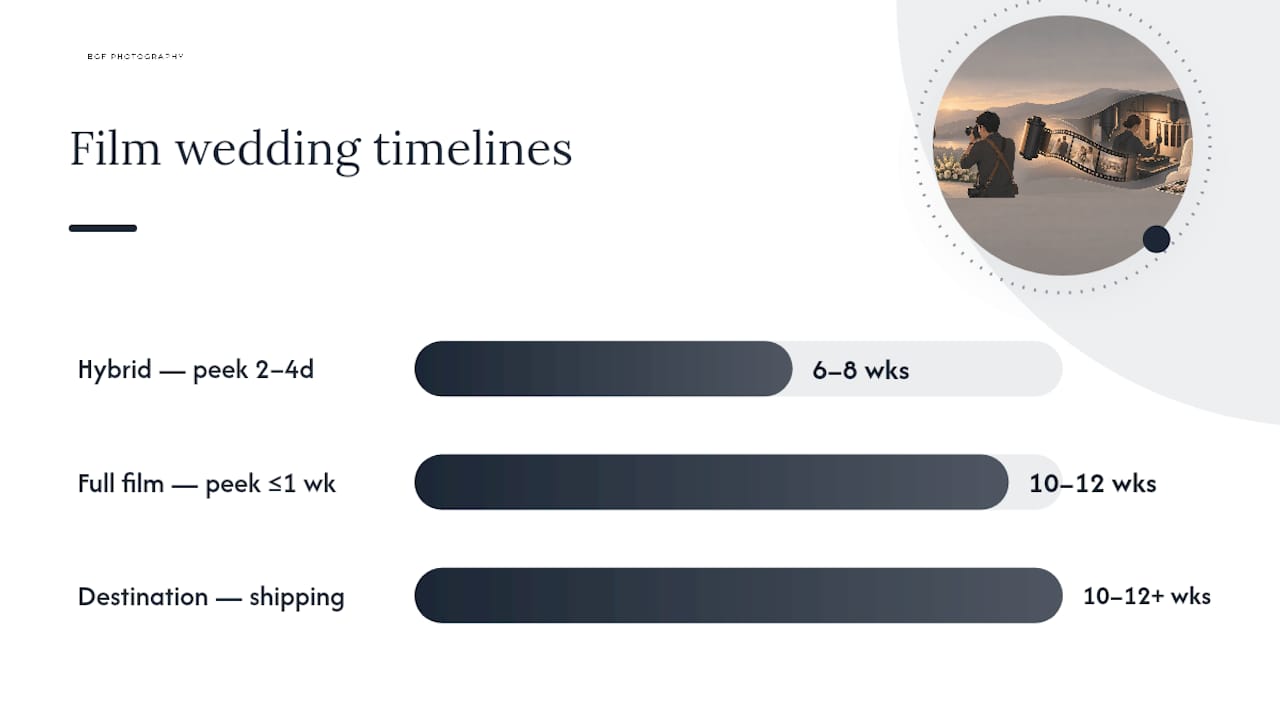
These numbers are starting points, not guarantees for your specific photographer. Convert whatever range they quote into an actual calendar date the moment you book, so you're tracking a deadline instead of an estimate that drifts.
Can You Actually Speed Up Film Delivery?
Somewhat, and it usually costs money. A few honest options exist if waiting genuinely isn't workable for your situation.
- Rush lab tiers. Some labs offer expedited processing, like a 2-day rush on C-41 color film, for an added per-roll fee, according to Bay Photo's published rush options.
- Priority scanning on select rolls. Ask your photographer if the lab can prioritize a handful of "hero" rolls, like the ceremony and first dance, so you get key images faster even if the full set lags.
- Low-res digital previews for immediate sharing. If you just need something to post or send to family, ask for quick, uncorrected exports rather than waiting for fully graded final images.
- Front-loaded editing. Some photographers cull and rough-grade digital backups first, then apply final color work once film scans arrive, so less work stacks up at the end.
Pro Tip: Rush fees usually apply per roll, not per order, so rushing your entire wedding's film can add up fast.
The tradeoff is real. AI-assisted culling and editing have sped up plenty of digital workflows, but the physical steps of film, development and scanning, remain stubbornly manual according to an Aftershoot industry report on AI in photography. No software shortens the time chemistry needs to develop a negative.
How BGF Photography Sets Delivery Expectations From Day One
We build sneak-peek windows and final delivery dates directly into every contract, whether a couple books our full wedding day coverage, hybrid photo and video, or our medium format and 35mm film options. Couples get a specific number of days for a preview gallery and a maximum number of weeks for the full film delivery, not a vague promise.
Sample language we recommend every couple ask for, regardless of who they book: a sneak-peek deadline stated in days, a final gallery date stated in weeks with a hard maximum, and clear rush-fee terms if you want select rolls prioritized. We handle film pass-through costs, meaning lab processing and scanning fees, as a transparent line item rather than folding them invisibly into the package price. Hybrid delivery means you see digital highlights fast while the film scans follow on their own honest timeline.
Why We Think Film's Slower Timeline Is Part Of What You're Paying For
Film's manual steps aren't a flaw to apologize for. Development and scanning happen at a lab's pace, not a photographer's, and that partnership is what produces the tonal quality couples book film for in the first place. Trying to compress that timeline artificially usually means sacrificing the quality that made film worth choosing.
What we push back on is silence. A couple should never be left guessing whether their gallery is running normally or has fallen through the cracks. That's why sneak peeks exist, and why a written maximum delivery date belongs in every contract we sign. If you're weighing film for your own wedding and want specifics on how our timeline works for your date, reach out and we'll walk through it plainly.
— Billy
Get Your Film Delivery Timeline In Writing With BGF Photography
BGF Photography stands out for pairing a candid, unobtrusive shooting style with the option for genuine film photography, plus hybrid photo and video coverage under one cohesive look, so you're not juggling two vendors with two different timelines.
Our packages range from the Full Wedding Day at $4,000 to $4,700 to standalone Medium Format and 35mm Film at $100 per roll, and every quote spells out what's billed separately, including lab processing and scans, before you sign. We serve couples in the Western New York region, and contracts include a sneak-peek window and a maximum delivery date expressed in weeks. If you're planning a wedding around film photography and want a straight answer on when your images will actually arrive, visit our investment page to see current package pricing and request a consultation for your date.
Sources
- Richard Photo Lab – Film Turnaround Times
- Bay Photo film turnaround post
- Shotkit — Wedding photo delivery survey
- Aftershoot — AI in photography industry report 2025
- Tov Studio Photo — Vintage film photographer pivot guide
FAQ
What Is A Reasonable Turnaround Time For Wedding Photos?
For digital-only photography, 2 to 6 weeks is standard, with most photographers in the Shotkit survey delivering within 2 to 4 weeks. For film or hybrid coverage, 6 to 12 weeks is the realistic range once lab development, scanning, and editing are all accounted for.
What Is The 30-5 Rule For Weddings?
The "30-5 rule" isn't a standardized photography industry term, and definitions vary depending on who's using it. Rather than rely on an informal rule, ask your photographer directly for a written sneak-peek window and final delivery date so you're working from a specific commitment instead of a rule of thumb.
What Is The 20-60-20 Rule In Photography?
Like the 30-5 rule, this isn't a recognized standard within wedding photography turnaround practices, and no consistent definition applies across photographers. Focus your questions on concrete numbers, sneak-peek days and final delivery weeks, rather than named rules that vary by who's telling you about them.
Is $4,000 A Lot For A Wedding Photographer?
It depends heavily on what's included, but $4,000 to $4,700 sits within the range many full-service photographers charge for complete wedding day coverage, including a package like BGF Photography's Full Wedding Day service. Film adds cost on top of a base package, typically around $100 per roll for processing and scanning, so ask what's bundled before comparing prices across photographers.
Why Does Film Take Longer To Deliver Than Digital Photos?
Film has to physically travel to a lab, get chemically developed, and get scanned before any editing can begin, while digital files are ready for editing the moment the camera card is imported. That extra physical step is why film galleries typically take 6 to 12 weeks compared with 2 to 6 weeks for digital, according to lab turnaround data from Richard Photo Lab.