
For an 8-hour wedding day, expect somewhere between 400 and 600 edited images, with 6-hour coverage landing closer to 250 to 400 and full two-day weddings often reaching 700 to 1,200. The rough math behind those numbers is 40 to 100 edited photos per hour of coverage. Where you fall in that range depends on your photographer's style, whether they bring a second shooter, and how eventful your day actually is, among other factors.
TL;DR:
- Adding a second shooter can significantly increase the final photo count by capturing different angles and moments simultaneously.
- A curated gallery of around 400 well-edited images generally offers a better storytelling experience than a larger, unfiltered set of over 1,000 images.
- Delivery of wedding photos typically occurs within 4 to 8 weeks, with peak season causing potential delays beyond this window.
- Expect about 50 to 70 images per hour of coverage, with event complexity and style affecting the exact number.
- Clarify in your contract whether the photographer caps galleries or delivers all usable images to avoid surprises.
Table of Contents
- How Many Wedding Photos Do You Get by Coverage Length?
- What Factors Raise or Lower Your Final Photo Count?
- Why a Smaller, Curated Gallery Usually Beats a Huge One
- When Will You Actually Receive Your Wedding Photos?
- What Should Go in Your Photography Contract?
- A Photographer's View on Realistic Photo Counts
- What Actually Matters When Choosing a Photographer
- Ready to Book Photography That Fits Your Timeline?
- Sources
- FAQ
How Many Wedding Photos Do You Get by Coverage Length?
The number you should expect scales almost directly with hours booked, but not in a perfectly straight line. A 2-hour elopement typically nets 75 to 150 edited images. A 4-hour micro-wedding lands around 150 to 300. From there, the ranges widen:
- 6-hour partial day coverage: 250 to 400 edited images
- 8-hour full-day coverage: 400 to 600 edited images
- 10-hour extended coverage: 600 to 800 edited images
- Two-day multi-day weddings: 700 to 1,200 edited images
The math is simple once you see it. An 8-hour day at 50 images per hour gets you 400 edited photos. Add a second shooter and push the pace to 70 per hour across 10 hours, and you land closer to 700. That per-hour benchmark of 50 to 100 edited images per hour is the industry's working shorthand, though it flexes with style and how much is actually happening in front of the lens.
Two photographers covering the same 8 hours can still deliver very different totals. A documentary-heavy shooter chasing candid reactions all day tends to produce more usable frames than one who spends an hour on formal portraits alone. Guest count matters too. A wedding with 200 guests and three separate events (ceremony, cocktail hour, reception) simply generates more photographable moments than an intimate backyard ceremony for 30.
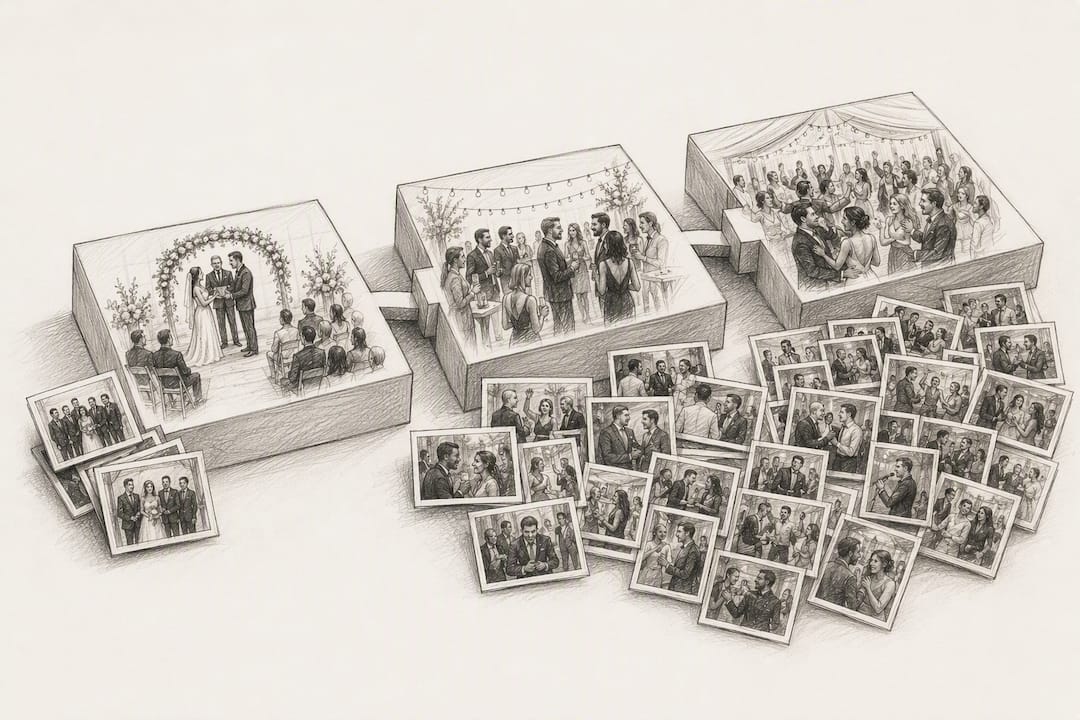
What Factors Raise or Lower Your Final Photo Count?
Your contract's stated hours are only the starting point. Several variables push the final number up or down before you ever see your gallery.
- Second shooter: Adding a second photographer increases usable frames because two angles catch moments one camera would miss, especially during a first look or a crowded reception floor.
- Shooting style: Documentary and candid approaches generate more raw material to cull from than posed-heavy sessions, while film photography (shot on medium format or 35mm) naturally limits frame count since every roll is finite.
- Guest count and event density: More guests and more distinct segments of the day, first look, ceremony, family formals, reception, after-party, all add photographable moments.
- Venue and lighting conditions: Dim reception halls or fast-moving dance floors sometimes force a photographer to be more selective about which frames make the final cut.
- Delivery philosophy: Some studios cap galleries at a set number; others deliver every usable frame regardless of count.
Pro Tip: Ask your photographer directly whether they cap galleries or estimate by the hour. The answer tells you more about what to expect than any average you'll find online.
Why a Smaller, Curated Gallery Usually Beats a Huge One
More photos does not mean better photos. A photographer who hands you 1,200 images from a 6-hour day probably has not culled thoroughly, which means you're wading through duplicate expressions and inconsistent edits to find the handful you'll actually print.
Editorial selection is a service you're paying for, not a corner someone cuts. A curated gallery of 400 well-chosen, consistently edited images tells your wedding day's story better than 1,000 near-duplicates ever could. Handing over everything shifts the culling work back onto you, which defeats the point of hiring a professional in the first place.
A high count is justified in specific cases: multi-day weddings, coverage with two shooters across several events, or ceremonies with unusually large guest lists. Outside those situations, a bloated gallery is often a signal of thin editing, not extra value.
When Will You Actually Receive Your Wedding Photos?
Delivery timing follows a fairly predictable rhythm across the industry, though peak season adds real delays worth planning around.
| Delivery stage | Typical timeline |
|---|---|
| Preview or first look | 2 to 3 weeks |
| Sneak peek gallery | 2 to 3 weeks |
| Full edited gallery | 4 to 8 weeks |
| Full gallery, peak season | 6 to 8 weeks |
Those standard delivery windows hold for most digital-first studios, but film photography or heavy retouching adds time on top, since film requires scanning before editing even begins. Rush delivery is often available for a surcharge if you need images sooner, say, for a slideshow at an upcoming event. Editing itself is labor intensive: photographers commonly spend 20 to 36 hours culling and editing a single wedding's worth of images before export, which is why "next week" promises should raise an eyebrow.
What Should Go in Your Photography Contract?
Verbal promises about photo counts and delivery dates disappear the moment there's a disagreement. Put the specifics in writing before you sign.
- Estimated edited-image range for your booked hours, not just a vague "hundreds of photos."
- Sneak-peek timing, so you know when the first taste of images arrives.
- Full gallery deadline, with a written note about peak-season adjustments.
- File resolution and usage rights, confirming you receive high-resolution files with a personal-use print release.
- Rush fees, spelled out as a specific dollar amount or percentage, not "contact us."
- Album selection process, if a printed album is part of your package.
At your consult, ask directly: Do you cap galleries at a set number? How many edited images per hour do you typically deliver? Will we receive high-resolution files, or is that an upsell? Package contents vary wildly between studios, so the same word "package" can mean 200 photos from one vendor and 800 from another.
Pro Tip: Treat vague language like "you'll get plenty of photos" as a red flag. A photographer confident in their workflow will give you a real number range without hesitation.
A Photographer's View on Realistic Photo Counts
A photographer may build coverage around candid, unobtrusive documentation paired with hybrid photo and video services, an approach that tends to generate a steady, consistent volume of usable images rather than a handful of posed standouts. Understanding the gap between raw frames captured and edited images delivered helps explain why a camera can fire off thousands of shots in a day while the final gallery holds a fraction of that.
- A 6-hour micro-wedding typically produces a tighter, more intimate gallery focused on key moments.
- An 8-hour full wedding day covers more ground: getting ready, ceremony, portraits, and reception, resulting in a broader, more varied gallery.
- Written turnaround-time expectations prevent the guesswork that leads to frustrated couples checking their inbox daily.
What Actually Matters When Choosing a Photographer
Chasing the highest possible photo count is the wrong goal. Prioritize a photographer whose style fits your vision, ask for consistent editing across the whole gallery, and get delivery windows and file rights in writing before you sign anything. BGF Photography's hybrid and film options are one path worth considering if a nostalgic, candid style appeals to you, but the real priority is finding someone whose approach matches how you want your day remembered.
— Billy
Ready to Book Photography That Fits Your Timeline?
An advantage can be the combination of photography and videography under one cohesive vision, avoiding coordinating separate vendors with separate looks. Couples seeking genuine, unobtrusive coverage plus the option of nostalgic film photography can find both under a single contract with clear delivery terms.
Coverage options range from the Full Wedding Day package at $4,000 to $4,700 to add-ons like an Engagement Session at $500 or Medium Format and 35mm Film starting at $100 per roll. If you're weighing hours against expected gallery size, the investment page breaks down every package so you can compare coverage length to what you'll actually receive. Reach out to check availability for your date and get a written estimate of your gallery size and delivery timeline before you commit.
Sources
- How long does it take to get wedding photos back
- Wedding Photo Delivery Expectations (Preview vs Full Gallery) - Tov Studio Photo
- How Many Photos Do You Get From a Wedding Photographer?
- More Photos On A Wedding Day Does Not Mean Better Quality
FAQ
How Many Photos Are Normal for a Wedding?
For a standard 8-hour wedding day, 400 to 600 edited images is typical. Shorter coverage yields fewer, longer coverage or a second shooter pushes that number higher.
Is 400 Wedding Photos a Lot?
Four hundred images is right in the normal range for 6 to 8 hours of coverage, not an unusually high or low number. It only becomes worth questioning if your coverage was significantly shorter than 6 hours, since that would suggest a higher-than-typical per-hour rate or lighter culling.
What Is the 20-60-20 Rule in Photography?
Definitions of this rule vary by source, and it isn't a standardized industry framework tied to specific wedding image counts. Rather than treating it as a fixed formula, focus on the delivery benchmarks and per-hour ranges covered above, which come from documented industry practice.
Is 300 Photos Enough for a Wedding?
Three hundred images fits comfortably within the 250 to 400 range typical for 6-hour partial-day coverage. For a full 8-hour day, 300 would sit on the low end, worth asking your photographer about if that's what's quoted for longer coverage.