
Lock your ceremony time first, then build every other block backward from it, adding buffers between locations and deciding early whether you want a first look. That single decision order, done in that sequence, is what separates a wedding day that flows from one that feels like a sprint. BGF Photography builds every couple's schedule around a simple standard called the "ready by" rule, which we'll break down below.
- Ceremony time is the anchor, never the starting point
- Buffers absorb the small delays every wedding has
- First look or not changes almost everything downstream
Keep reading for copy-paste templates you can drop straight into your own schedule.
Key Takeaways
A working wedding photography timeline locks the ceremony time first, builds backward with real buffers, and protects family formals, golden hour, and reception events above everything else.
| Point | Details |
|---|---|
| Lock ceremony time first | Every other block, from getting ready to portraits, gets built backward from this anchor. |
| Follow the "ready by" rule | Hair and makeup should be finishing, not starting, when your photographer arrives. |
| Build in real buffers | Add 5 to 10 minutes between locations and 20 to 30 minutes for long family-formal blocks. |
| Cap family formals at 10 to 15 groupings | This keeps the block under 30 minutes with a designated wrangler running it. |
| Plan your timeline with BGF Photography | A planning meeting maps your ceremony time, buffers, and priorities into one shared schedule for photo and video. |
Table of Contents
- Why a Wedding Photography Timeline Matters
- Sample Wedding Photography Timeline Templates
- What Timing Rules and Buffers Keep a Wedding on Track?
- What Does a Sample Timeline Look Like Hour by Hour?
- How Do You Organize Family and Formal Photos Efficiently?
- When Should You Schedule Golden Hour Portraits?
- Wedding Photography Checklist and Copyable Timeline
- What to Bring to Your Wedding Photography Planning Meeting
- What I've Learned Building Timelines for Weddings
- Get Your Wedding Photography Timeline Built With BGF Photography
- Sources
- FAQ
Why a Wedding Photography Timeline Matters
A schedule without buffers doesn't bend, it breaks. One late hair appointment, one traffic jam between venues, one grandmother who can't find her shoes, and suddenly your golden hour portraits vanish along with your cocktail hour. Photographers see this constantly: the timeline isn't paperwork, it's the thing that decides whether you actually get to experience your own wedding or spend it herding people from spot to spot.
A wedding photography timeline built correctly does three things well.
- Protects the ceremony and reception moments that can't be reshot, like vows and toasts
- Frees you to actually be present at cocktail hour instead of stuck in portraits
- Prevents the two most common failures: rushed family photos and missed golden hour light
Sample Wedding Photography Timeline Templates
Every wedding boils down to two structural choices, and they produce two very different day shapes. Pick one, then adjust the clock times to fit your ceremony.
Template A: With a first look
- Photographer arrival, detail shots (rings, dress, invitations)
- Getting ready coverage, both partners
- First look and couple portraits
- Wedding party and family formals (partial, before ceremony)
- Ceremony
- Remaining family formals, then straight into cocktail hour
- Reception
Template B: No first look
- Photographer arrival, detail shots
- Getting ready coverage, both partners separately
- Ceremony
- Family formals immediately after
- Couple portraits during cocktail hour
- Guests move to cocktail hour while portraits happen
- Reception
A first look front loads the portrait work, which is why it tends to preserve more of your cocktail hour. Skipping it means your formals and couple portraits all get compressed into the window right after "I do," which works fine on a longer timeline but gets tight on a shorter one. If you've booked six hours of coverage instead of ten, trim Template A by combining wedding party and family formals into one continuous block rather than two separate ones.
What Timing Rules and Buffers Keep a Wedding on Track?
Photographers rely on a handful of rules of thumb because guesswork is what wrecks timelines. The most important one is the "ready by" rule: hair and makeup should be finishing, not starting, when your photographer arrives. If your photographer is scheduled to arrive at 1:00 PM, your stylist should be putting on finishing touches, not still curling the first bridesmaid's hair.
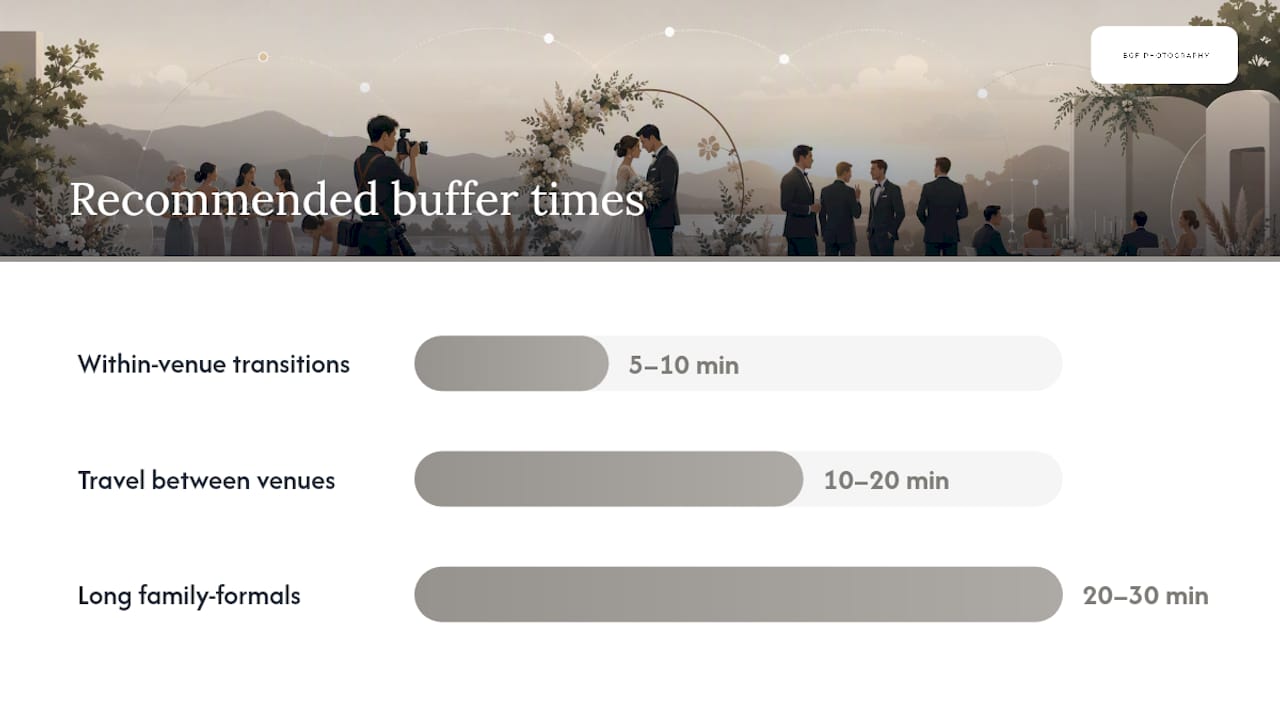
Beyond that, build these buffer defaults into every block:
- 5 to 10 minutes between blocks in the same location (bedroom to hallway, hallway to ceremony space)
- 10 to 20 minutes for any travel between venues
- 20 to 30 minutes for family formals when your list runs long
Three pressure points deserve extra protection: ceremony start time, the family formals block, and reception events like toasts and first dances. Everything else can flex a little. Those three can't, because guests, officiants, and caterers are all locked to them too.
Pro Tip: Build your buffers into the schedule you hand to your wedding party, not just the one you keep for yourself. If they only see the "real" times, any delay eats straight into your portrait window instead of the buffer.
What Does a Sample Timeline Look Like Hour by Hour?
Seeing the blocks in context makes the abstract rules click. Here's how three common ceremony start times shake out.
- 2:00 PM ceremony. With a first look: getting ready from 10:00 AM, first look at 12:30 PM, family and wedding party portraits until 1:45 PM, ceremony at 2:00 PM, cocktail hour fully intact by 2:45 PM. Without a first look, push family formals to right after the ceremony and expect a shorter cocktail hour window for guests before you rejoin them.
- 4:00 PM ceremony. Getting ready from 12:00 PM, first look around 2:00 PM if you're doing one, ceremony at 4:00 PM, family formals from 4:30 to 5:00 PM, then couple portraits timed to catch the tail end of usable light before dinner.
- 5:30 or 6:00 PM ceremony. This start time is built around golden hour, so portraits typically happen in short bursts before the ceremony and again immediately after, with cocktail hour compressed to 30 or 40 minutes so you don't lose the light.
If your coverage window is tight, drop extended family groupings first and protect the couple portraits and golden hour block. Those images are the ones you can't get back.
How Do You Organize Family and Formal Photos Efficiently?
Family formals are where timelines usually fall apart, mostly because the list balloons past what's realistic. Keep it to 10 to 15 groupings total. At 1 to 2 minutes per grouping, that keeps the whole block under 30 minutes, which is the target.
- Designate one person, not the couple, as the "wrangler" who physically pulls each group forward
- Send the shot list to that wrangler in advance, with names, not just relationships
- Announce groupings by name over a microphone or loudly if no sound system is available
- Stage the block right at the ceremony exit so nobody has to relocate
A prioritized shot list and a clear staging system do more to shorten this block than any amount of rushing through it.
When Should You Schedule Golden Hour Portraits?
Block 10 to 20 minutes specifically for golden hour, and check your exact sunset time for that date and location well in advance. Then plan conservatively. Overcast skies and early darkness both shrink your usable window faster than you'd expect.
If golden hour portraits matter to you, decide in advance what gets shortened to protect them, whether that's cocktail hour coverage or a longer extended-family list. For more on protecting this window specifically, our golden hour planning guide walks through timing by season.
Pro Tip: Set a phone alarm for 15 minutes before sunset on your wedding day. It sounds unnecessary until you're the couple who realizes at dusk that the "best light of the day" already came and went.
Wedding Photography Checklist and Copyable Timeline
Keep this list handy while you're finalizing details with your planner or photographer.
- Confirm photographer arrival time and detail shots you want captured
- Set "ready by" times for hair and makeup, not just start times
- Assign a family-formals wrangler and finalize the shot list
- Block a dedicated golden hour window if it's a priority
- Collect vendor phone numbers (planner, DJ, videographer) for day-of coordination
- Build a compact, one-line timeline to send to your wedding party
A single-line compact timeline shared with vendors avoids the confusion that longer multi-page itineraries tend to create. Something like: "1:00 PM photographer arrival, 2:30 PM first look, 4:00 PM ceremony, 4:30 PM formals, 5:00 PM cocktail hour, 6:00 PM reception" fits on a phone screen and travels well by text. Send it to your planner, officiant, DJ, and wedding party at least a week out, then again the morning of.
What to Bring to Your Wedding Photography Planning Meeting
BGF Photography finalizes every couple's schedule in a dedicated planning meeting, and coming prepared makes it faster and more accurate. Bring your guest count, family formals list, vendor contact numbers, venue logistics (parking, staging space, indoor backup), and your priority order for portraits versus candid coverage.
That's also where we map out hybrid photo and video coverage so both teams are working from one shared schedule instead of two competing ones, and where venues with tight staging space get broken into smaller micro-blocks so nothing feels rushed.
What I've Learned Building Timelines for Weddings
The best photos on a wedding day are almost never the posed ones. They're the candid moment right after the vows, the laugh during a toast nobody saw coming. A timeline's real job is protecting the space for those moments to happen, not filling every minute with posed shots. A resilient schedule with real buffers gives that space room to exist. If you're building yours, we're happy to walk through it with you at a planning meeting.
Get Your Wedding Photography Timeline Built With BGF Photography
You could piece together a timeline from generic templates and hope it holds up, or you could build it with the team that's going to be executing it on the day. BGF Photography pairs candid, unobtrusive photography with hybrid videography and an optional film option, all under one cohesive planning process instead of two separate vendors working from two separate schedules.
That matters most in the planning meeting, where we map your ceremony time, buffers, family list, and golden hour window into one schedule your whole wedding party can follow. Check our packages and pricing details and reach out to book your planning meeting for a date in Buffalo, Rochester, or the Finger Lakes.
Sources
- The Ultimate Wedding Photography Timeline for Your Big Day — Brides
- Wedding Photography Timeline Template (Schedules + Buffers) — Photo-logica
- Essential Elements in a Wedding Photography Timeline Guide — Charlie Patric
FAQ
How Far in Advance Should I Build My Wedding Photography Timeline?
Most couples finalize their timeline four to six weeks before the wedding, once headcounts and vendor details are confirmed, though a rough draft is worth building as soon as your ceremony time is set.
Should I Do a First Look?
A first look moves portraits earlier in the day and typically preserves more of your cocktail hour, while skipping it compresses formals and couple portraits into the window right after the ceremony.
How Long Should Family Formals Take?
Keep your list to 10 to 15 groupings at 1 to 2 minutes each, which keeps the entire block under 30 minutes when a designated wrangler is staging people in advance.
What Buffer Times Should I Use Between Locations?
Add 5 to 10 minutes for transitions within the same venue, 10 to 20 minutes for travel between separate venues, and 20 to 30 minutes for long family-formal sessions.
How Does BGF Photography Help Build a Timeline?
BGF Photography finalizes each couple's schedule in a dedicated planning meeting, mapping ceremony time, buffers, family formals, and golden hour into one shared timeline for both photo and video coverage.