

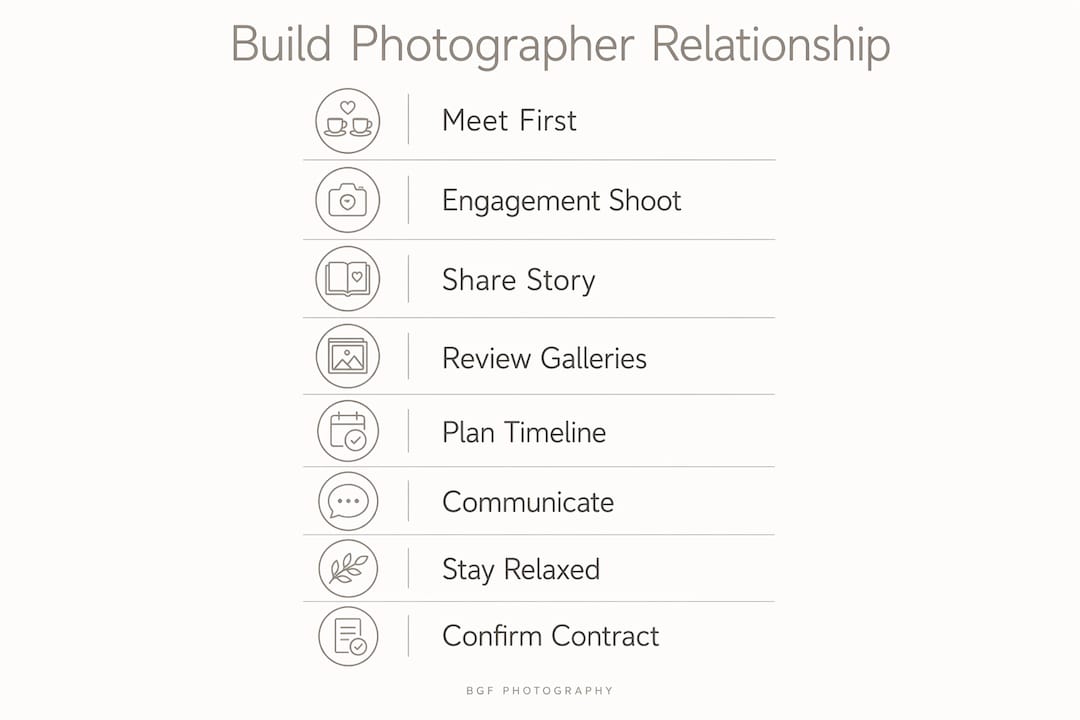
The fastest way to build a genuine relationship with your wedding photographer before the wedding comes down to four steps: meet in person or on video before you sign anything, book an engagement session to practice in front of the camera, share your story and a prioritized shot list early, and confirm every logistical and contractual detail in writing. Do those four things and you walk into your wedding day with a photographer who already knows how you laugh, what you care about, and exactly where to be.
Here is your quick-start checklist:
-
Meet first, sign second. Schedule a relaxed in-person or video call before committing. Chemistry cannot be judged from a portfolio alone.
-
Book an engagement session. It is the single best low-pressure rehearsal for both of you.
-
Share your story and top five shot priorities. Send a short written summary so your photographer can prepare creatively.
-
Lock down the contract. Named photographer, backup plan, delivery timeline, retainer terms — all in writing before the wedding date is held.
The role of trust in wedding photography is well documented: when couples feel genuinely comfortable with their photographer, the images shift from posed to real. The Professional Photographers of America (PPA) consistently emphasizes pre-wedding communication as a professional standard, and the LA Times recommends asking to see full wedding galleries before booking. Start there.
Table of Contents
-
5. Plan your timeline, shot list, and venue walkthrough together
-
8. Confirm your contract, deliverables, and backup plan in writing
1. Meet your photographer before you sign anything
The single most important step to build a photographer relationship before the wedding is a real conversation, not a contact form. Meet at least once in a relaxed setting — a café, your venue, or a video call — before you commit.
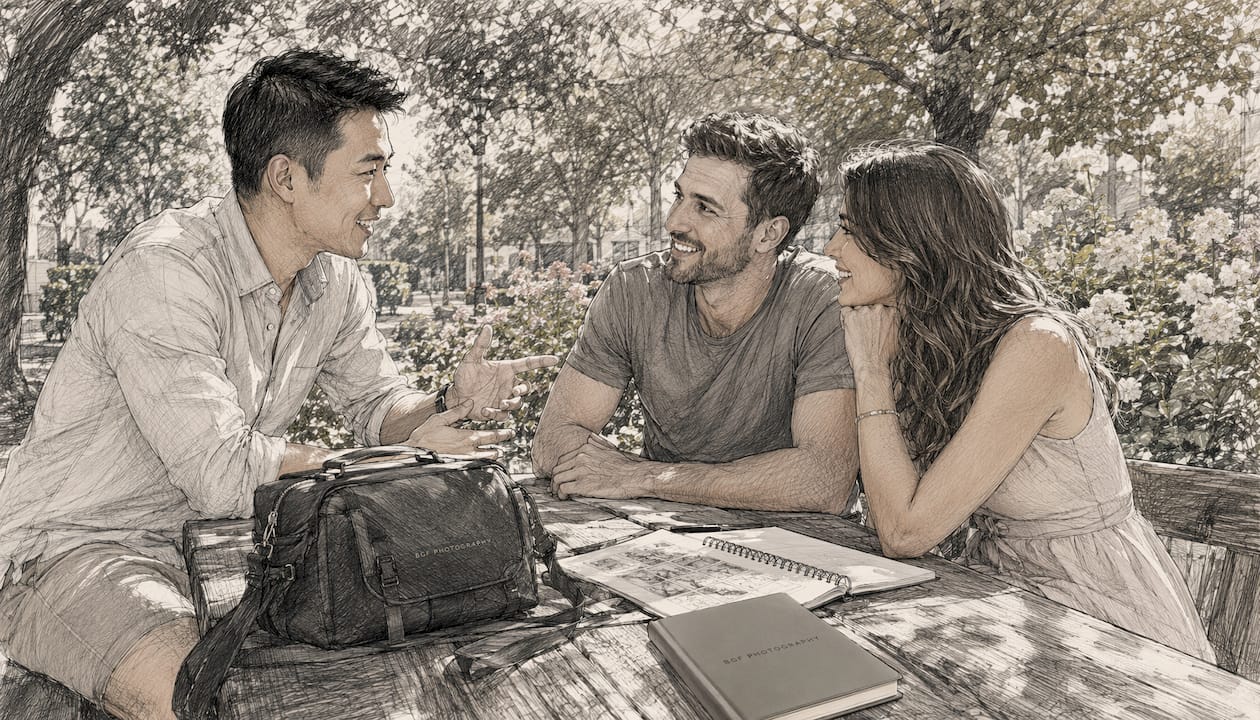
Chemistry matters because your photographer will be present for most of your wedding day: getting-ready moments, ceremony, portraits, reception. If the energy feels off in a 30-minute conversation, it will feel worse when you are in a wedding dress.
When to meet and how often:
-
Before booking: one initial meeting to confirm chemistry, style alignment, and availability
-
4–6 months out: a planning meeting to review timeline, shot list, and venue details
-
2–4 weeks out: a final check-in to confirm logistics, vendor contacts, and any last-minute changes
-
Day before (optional): a quick venue walkthrough if you have not done one yet
Statistic: Experts recommend booking your photographer 12–15 months in advance to secure peak-season dates. That means your first meeting should happen well before most couples even think about it.
In-person vs. video call: In-person meetings let you read body language and get a feel for how the photographer moves through a space. Video calls via Zoom or FaceTime work well when schedules or distance make in-person impractical — you still get tone, energy, and communication style. The format matters less than the conversation itself.
Questions to cover in your first meeting:
-
How do you describe your shooting style?
-
Who will actually photograph our wedding?
-
How do you handle tight timelines or unexpected delays?
-
What does your backup plan look like if you get sick?
-
Can we see two or three full wedding galleries?
A conversational meeting style reveals personality fit far better than a rigid checklist. Use topic prompts, not a script. If the photographer answers questions directly, listens well, and makes you feel at ease, that is a strong signal.
Pro Tip: Bring a short list of topic prompts rather than a formal questionnaire. A natural back-and-forth conversation tells you far more about how a photographer will direct you on the wedding day than any scripted Q&A.
2. Use an engagement session to build real rapport
If you can do one thing to improve your wedding photos before the wedding day, it is this: book an engagement session. Engagement sessions let couples practice posing, learn how they respond to a photographer’s direction, and build genuine rapport in a low-stakes environment. The wedding day is not the time to figure out how you feel in front of a camera.
The practical benefits go beyond comfort. You get images for save-the-dates and invitations, you learn which poses feel natural versus forced, and you discover how your photographer communicates direction. That last point matters more than most couples expect.
What to bring and how to prepare:
-
Wear something you feel genuinely comfortable in, not your most formal outfit
-
Choose a location that means something to you as a couple
-
Arrive a few minutes early so you are not rushing into the shoot
-
Tell your photographer one or two things you are nervous about beforehand
Micro-exercises to try during the session:
-
Walk and talk: stroll together and have a real conversation while the photographer shoots
-
Whisper a memory: lean in and whisper a specific shared memory to your partner
-
Countdown kiss: your photographer counts down from three; the anticipation creates natural expressions
-
Laugh on purpose: tell each other the worst joke you know — forced laughter almost always turns real
These exercises, drawn from how photographers guide couples through natural interactions, reveal which prompts produce the most authentic reactions for you specifically. Your photographer learns your cues; you learn their rhythm.
Pro Tip: After the session, tell your photographer which prompts felt most natural. That feedback directly shapes how they will direct you on the wedding day. Two minutes of honest debrief is worth more than an hour of posing practice.
For more on what to expect, BGF Photography’s guide on why an engagement session prepares couples walks through the process in detail.
3. Share your story and visual priorities early
Trust and clear communication let a photographer capture authentic emotion rather than staged poses. The fastest way to align creative intent is to share a short written summary of your story and your top five priorities before your planning meeting.
Story prompts to get you started:
-
Where did you meet, and what was the moment you knew this was serious?
-
What does your relationship actually look like day-to-day? (Quiet mornings? Loud dinners with family?)
-
Are there people or moments at the wedding that carry extra emotional weight?
-
What feeling do you want to have when you look at these photos in 20 years?
How to prioritize your shot list:
Separate your list into two columns: “must-have” and “would love.” Must-haves are non-negotiable (a photo with your grandmother, the first look, the ring detail). Would-loves are nice if time allows. Keeping the must-have list to ten or fewer shots gives your photographer room to work without feeling like a checklist machine.
Copyable summary template:
Send this before your planning meeting. It gives your photographer time to think creatively rather than spending the meeting gathering basic information. For a deeper look at how to frame this conversation, BGF Photography’s post on communicating your vision covers the full process.
4. Request and review full wedding galleries
Portfolio highlights are curated to impress. Full, unedited wedding galleries are where you see the real work: how a photographer handles a dimly lit reception hall, a harsh midday ceremony, a chaotic family formal. Ask for two or three complete galleries from recent weddings before you book.
What to look for when reviewing full galleries:
-
Editing consistency: Do the colors and tones stay consistent from ceremony to reception, or do they shift noticeably?
-
Lighting variety: Are indoor reception shots as strong as the golden-hour portraits?
-
Full-day coverage: Does the gallery include getting-ready moments, ceremony details, candid reception shots, and portraits — or does it thin out after the ceremony?
-
Second-shooter work: If a second shooter was present, is their framing and editing consistent with the primary photographer’s?
-
Candid-to-posed balance: Does the gallery feel like a real day, or mostly directed shots?
Inconsistencies across lighting situations often indicate a highlight-driven portfolio rather than steady, full-day coverage. A photographer who delivers beautifully in every condition — not just the golden-hour window — is the one you want.
After reviewing, ask:
-
“Which of these weddings was the most challenging logistically, and why?”
-
“How do you handle low-light receptions without flash?”
-
“Can you show me a gallery from a venue similar to ours?”
5. Plan your timeline, shot list, and venue walkthrough together
A clear timeline and a prioritized shot list do one specific thing: they free your photographer to focus on storytelling instead of logistics. When the schedule has breathing room and the must-have shots are written down, nobody is scrambling.
Sample photo windows to build into your timeline:
-
Getting ready: 60–90 minutes for detail shots, candid prep moments, and first reactions
-
First look (if applicable): 20–30 minutes in a private location before the ceremony
-
Family formals: 30–45 minutes immediately after the ceremony while everyone is still together
-
Wedding party portraits: 20–30 minutes
-
Couple portraits / golden hour: 20–30 minutes, timed to the sunset at your venue
Mini shot-list template:
| Category | Must-Have Shots |
|---|---|
| Getting ready | Dress detail, rings, first reaction from parent |
| Ceremony | First look/processional, vows, first kiss, ring exchange |
| Family formals | List specific family groupings by name |
| Candid reception | First dance, speeches, cake cutting, guests dancing |
| Couple portraits | Golden-hour portraits, one film frame if applicable |
Venue walkthrough tips:
Walk the venue with your photographer at the same time of day as your ceremony. Point out: where natural light enters the ceremony space, any sight-line obstructions (pillars, trees), the backup indoor location if weather changes, and where power outlets are for any equipment needs.
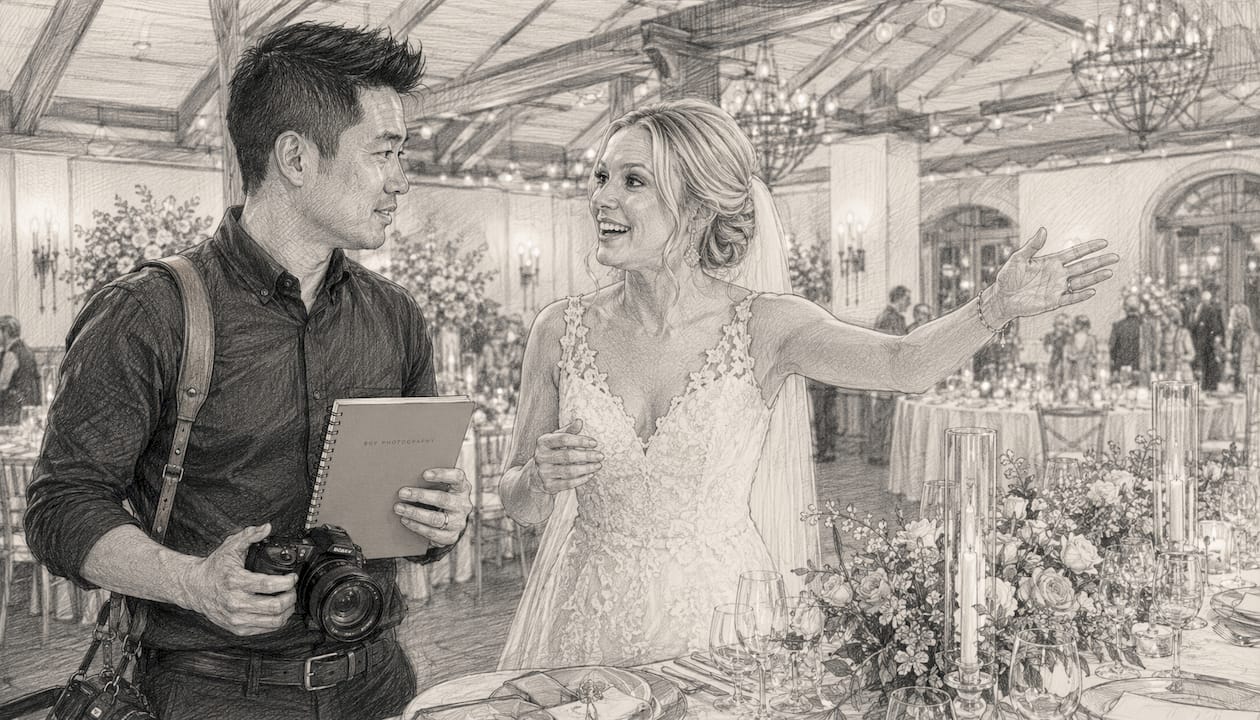
Pro Tip: Golden hour lasts roughly 20–40 minutes depending on the season and your location. Build it into the timeline as a non-negotiable block, and factor in travel time if your portrait location is separate from the reception venue. Losing that window to a delayed family formal is one of the most common timeline mistakes.
For more on how the timeline affects your photos, see BGF Photography’s guide on why your wedding day timeline matters.
6. Keep your communication clear and consistent
Good wedding photographer communication does not require constant contact. It requires the right information at the right time, through a channel you both agree on. Decide early: one channel for logistics (email works well for a paper trail), one for quick creative notes (text is fine).
Communication do’s and don’ts:
-
Do confirm decisions in writing after every meeting
-
Do give at least two weeks’ notice for any timeline or vendor changes
-
Do send your final shot list and vendor contact sheet 7–10 days before the wedding
-
Don’t send last-minute changes the day before without a phone call first
-
Don’t use multiple channels for the same conversation — it creates confusion
Post-meeting recap template (copyable):
Sending this after every meeting takes two minutes and prevents the most common source of wedding-day surprises: two people who each remember the conversation differently.
Pro Tip: If you make a significant change — new venue layout, added family grouping, shifted timeline — send a revised document, not just a text. A single updated PDF is easier for your photographer to reference than a thread of messages.
7. Stay relaxed and connected on the wedding day itself
Everything you did before the wedding — the meetings, the engagement session, the shared story — pays off here. But a few small rituals on the day itself help sustain that comfort when nerves are highest.
Day-of practices that actually help:
-
Greet your photographer by name when they arrive and take 60 seconds to check in before the day accelerates
-
Before portraits, take three slow breaths together as a couple — it sounds small, but it visibly changes body language
-
Agree on a private “comfort cue” with your photographer beforehand: a word or gesture that means “we need 30 seconds to reset”
-
During family formals, designate one family member as the coordinator who calls names and moves people into position — this keeps the couple out of the logistics and present in the moment
Honest conversations about vision and anxieties before the wedding make these day-of moments possible. When your photographer already knows you get nervous in large groups or that you hate stiff poses, they can adjust their approach without you having to explain it mid-ceremony.
Pro Tip: Tell your photographer one specific thing that makes you laugh as a couple — an inside joke, a phrase, anything. A photographer who can make you genuinely laugh during portraits will get images no amount of posing can produce. Share it before the day, not during.
For more on staying natural in front of the camera, BGF Photography’s post on how to prepare for candid wedding photos covers the full approach.
8. Confirm your contract, deliverables, and backup plan in writing
A clear written contract is not a formality. It is the document that protects both of you if anything goes wrong. Before you sign, confirm every one of these items is explicitly named.
Contract checklist:
-
Named photographer: The specific person who will shoot your wedding, not just the studio
-
Hours of coverage: Start time, end time, and overtime rate if the day runs long
-
Second shooter: Whether one is included, and if so, who
-
Retainer and payment schedule: Amount due to hold the date, remaining balance due date
-
Cancellation and postponement policy: What happens to your retainer if you cancel or reschedule
-
Backup plan: What happens if the photographer is sick or has an emergency on the day
-
Image delivery timeline: How many edited images, in what format, and by when
-
Image usage rights: Who can use the photos and how (social media, print, publication)
Refusing to provide a written contract or being evasive about who will actually shoot the wedding are significant warning signs. A professional photographer will have clear, written answers to every item on this list.
Reasonable delivery timelines vary, but 6–12 weeks for edited digital images is a common industry standard. If a clause is missing from the contract, ask for a written amendment before you sign — not after.
9. Ask these questions during your consultation
The goal of a consultation is not to quiz your photographer on equipment specs. It is to understand their working style, problem-solving approach, and how they will handle your specific wedding. Ask open questions that require real answers.
Essential questions to ask:
-
Are you available on our date, and will you personally be the one shooting?
-
How many weddings have you photographed at our venue or in similar conditions?
-
Can you share two or three full wedding galleries from the past year?
-
How do you handle a timeline that runs 30 minutes behind?
-
What is your backup plan if you have a medical emergency on our wedding day?
-
Do you bring a second shooter, and who is that person?
-
How do you approach family formals — do you direct, or do you prefer a more relaxed approach?
-
How do you edit your images, and can we see before/after examples?
-
What is your delivery timeline for edited photos?
-
Do you retain the raw files, and for how long?
-
What does your contract say about image usage rights?
-
What happens to our retainer if we need to postpone?
A comprehensive question set helps you spot contract gaps, understand deliverables, and compare photographers beyond surface-level portfolio highlights. The line that opens the most useful conversations: “Can you share two or three full weddings similar to ours?”
10. Watch for these red flags
Some behaviors reliably predict problems. Catching them early protects your investment and your wedding day.
Red flags to take seriously:
-
No written contract: A professional always works from a signed agreement. No exceptions.
-
Refusal to share full galleries: If a photographer only shows highlights, ask why. Resistance is a signal.
-
Evasive answers about who will shoot: If the person you meet is not the person who will be there, you need to meet the actual photographer before signing.
-
Inconsistent or slow communication: How a photographer communicates during booking is how they will communicate when you need them most.
-
No backup plan: Equipment fails. Photographers get sick. A professional has a clear contingency and will tell you exactly what it is.
-
Pressure to book immediately: Urgency tactics are a substitute for genuine confidence in their work.
-
Vague delivery timelines: “A few months” is not an answer. Get a specific date range in writing.
Decision flow:
Ask the question. Evaluate the answer. If the answer is evasive, ask once more directly. If it remains vague or defensive, request a written clarification before signing. If they refuse, walk away.
11. How BGF Photography builds relationships with couples
BGF Photography’s standard process is built around one premise: the more comfortable you are with your photographer before the wedding, the more authentic your images will be. The process runs in four stages.
Stage 1 — Intro meeting: A relaxed conversation (in person or video) to confirm chemistry, discuss your vision, and answer your questions before anything is signed.
Stage 2 — Engagement session: A dedicated shoot that functions as both a rapport-building exercise and a creative rehearsal. BGF prepares couples beforehand with specific prompts and exercises so the session feels natural, not performative.
Stage 3 — Timeline confirmation: BGF builds the timeline with you over a video call. The timeline is built collaboratively, with golden-hour portraits protected as a non-negotiable block.
Stage 4 — Contract and final check-in: Every deliverable, backup plan, and logistical detail is confirmed in writing 2–4 weeks before the wedding.
Pro Tip: Before your BGF engagement session, write down two or three moments from your relationship that still make you smile when you think about them. Share them with your photographer beforehand. Those specific memories become the raw material for the most genuine expressions of the day.
BGF Photography serves couples in Buffalo, Rochester, and the Finger Lakes region of New York, with hybrid photo and video coverage available under one cohesive style. Film photography and drone coverage are also available for couples who want that added dimension.
Key Takeaways
Building a genuine relationship with your wedding photographer before the wedding requires four consistent actions: meet early, practice together, communicate clearly, and confirm everything in writing.
| Point | Details |
|---|---|
| Meet before you sign | Confirm chemistry and communication style in a relaxed conversation before committing. |
| Book an engagement session | Use micro-exercises like walk-and-talk and whisper-a-memory to build natural rapport. |
| Share your story and shot list | Send a written summary with your top five priorities before the planning meeting. |
| Confirm the contract in full | Named photographer, backup plan, delivery timeline, and retainer terms must all be in writing. |
| BGF Photography’s process | BGF builds trust through an intro meeting, engagement session, venue walkthrough, and written contract confirmation. |
Why the relationship matters more than the portfolio
The conventional wisdom in wedding photography advice is to focus on style: find a photographer whose editing you love, whose portfolio matches your aesthetic, and you are done. That logic is not wrong — but it is incomplete.
Style is table stakes. What actually determines whether your photos feel alive is whether you trusted the person holding the camera. A technically skilled photographer who makes you tense produces technically skilled photos of tense people. A photographer you genuinely like, who knows your nervous habits and your real laugh, produces something different.
The couples who walk away with the images they actually wanted almost always did the same things: they met their photographer more than once before the wedding, they did an engagement session, and they had honest conversations about what they were nervous about. Not because those steps are on a checklist, but because they understood that the relationship is the product.
The engagement session is where this becomes concrete. Couples who skip it often describe their wedding portraits as “fine.” Couples who did one — and who used it to actually communicate with their photographer rather than just pose — describe their portraits as the ones they did not expect to love. That gap is not about lighting or editing. It is about comfort.
BGF Photography: candid coverage built on connection
For couples in Buffalo, Rochester, and the Finger Lakes region of New York, BGF Photography offers a relationship-first approach to wedding photography and videography. The process starts with a no-pressure consultation — in person or by video — where you can ask every question on your list, see full wedding galleries, and decide whether the fit is right before anything is signed.
BGF Photography specializes in hybrid photo and video coverage under one cohesive style, so you are not coordinating two separate vendors with two separate visions. Film photography and drone coverage are available for couples who want that added dimension. Every booking includes a clear written contract with a named photographer, a backup plan, and a confirmed delivery timeline — no vague answers, no surprises.
To check availability for your date and view current wedding packages, reach out directly. Dates for peak season book 12–15 months in advance, so the earlier you connect, the better.
Useful sources and further reading
-
Professional Photographers of America (PPA) — industry standards for contracts, ethics, and professional practice
-
The Knot — broad wedding planning resources including photographer search and reviews
FAQ
Do you need to meet your photographer before the wedding?
Yes. Meeting your photographer before the wedding — in person or by video — confirms chemistry, communication style, and expectations that no portfolio can reveal. Most consultations take 20–40 minutes and cover style, timeline, and key questions.
How far in advance should you book a wedding photographer?
Experts recommend booking 12–15 months in advance to secure peak-season dates. Your first meeting should happen before that booking, so you are confident before you pay a retainer.
What should you ask to see before hiring a wedding photographer?
Request two or three full wedding galleries from recent weddings, not just portfolio highlights. Full galleries reveal editing consistency, low-light handling, and full-day coverage in ways curated highlights cannot.
How does an engagement session help your wedding photos?
An engagement session lets you practice posing, learn your photographer’s direction style, and build genuine comfort in front of the camera before the wedding day. Couples who complete one typically feel more relaxed during wedding portraits, which shows directly in the images.
What are the biggest red flags when hiring a wedding photographer?
The clearest warning signs are: no written contract, refusal to share full galleries, evasive answers about who will actually shoot the wedding, and no stated backup plan for emergencies. Any one of these warrants a direct follow-up question — and if the answer remains vague, walk away.