

TL;DR:
- A wedding photography planning meeting is a crucial pre-wedding session where couples and their photographer design a detailed coverage plan, including creative vision and timeline logistics. It ensures a clear schedule with buffers, shot lists, and vendor coordination, minimizing the risk of missed moments and schedule collapse. Proper preparation and collaboration with all vendors are essential for seamless, stress-free wedding day coverage.
A wedding photography planning meeting is a dedicated session where you and your photographer collaborate to design the complete photographic coverage of your wedding day, aligning on creative vision, timeline logistics, and every critical moment in between. This meeting is the industry’s standard pre-wedding consultation, and it is the single most important conversation you will have before your photographer arrives on the day itself. At BGF Photography, this session shapes everything from golden hour scheduling to family formal coordination. Couples who arrive prepared walk away with a photographer who understands exactly what they want, a realistic timeline that accounts for real-world delays, and far less stress on the wedding day itself.
What is a wedding photography planning meeting and what does it cover?
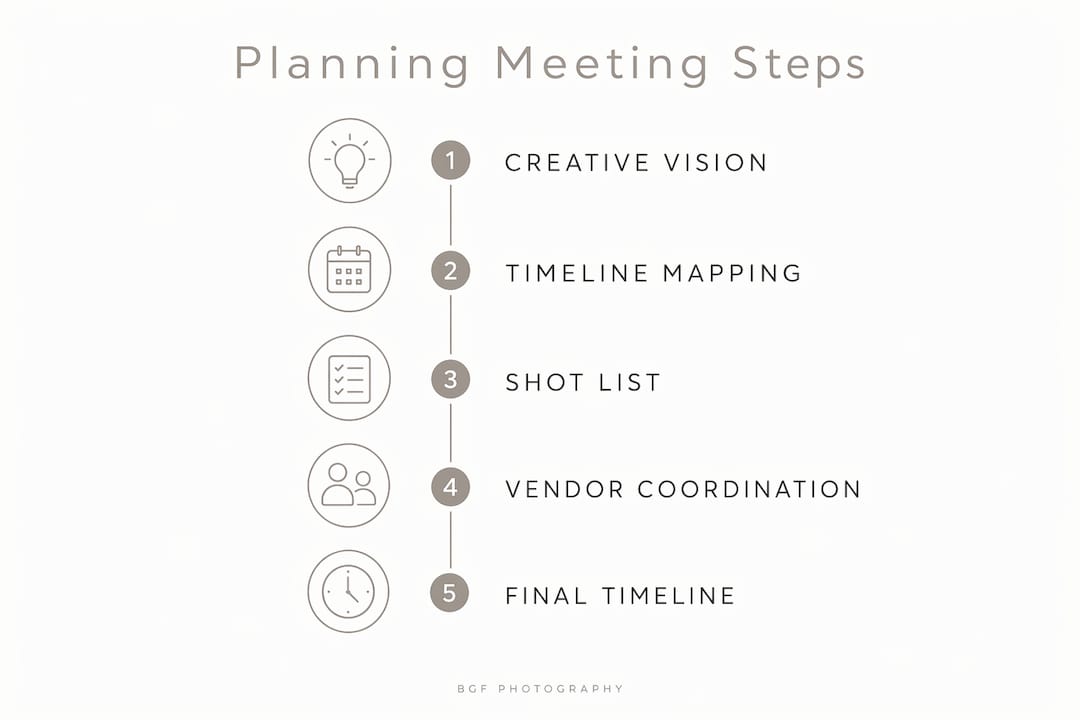
The wedding photography planning meeting covers six core areas: creative vision, timeline structure, shot lists, vendor coordination, deliverables, and contingency planning. Each area directly affects the quality and completeness of your final photo gallery.

Creative vision and style preferences come first. You share inspiration images, discuss whether you prefer candid documentary coverage or more directed editorial portraits, and confirm the overall aesthetic. This is where photographers like BGF Photography align their natural, unobtrusive approach with your specific expectations.
Timeline discussion is the backbone of the meeting. Your photographer will map out arrival times, getting-ready coverage, ceremony start, portrait windows, and reception moments. Photographers use planning meetings to tailor timelines incorporating first looks, portraits, and formals based on your style and venue. A well-built timeline is the difference between a gallery that tells the full story and one with obvious gaps.
Shot list and family formal planning follows. You will identify must-have images, list the specific family groupings you need, and note any special requests such as a grandparent who cannot stand for long. Golden hour portraits typically happen 30 to 45 minutes before sunset and represent the best opportunity for beautiful couple photos. Protecting that window starts here.
Vendor coordination rounds out the agenda. You discuss how your photographer will work alongside your videographer, coordinator, and florist to avoid conflicts and missed moments.
Pro Tip: Bring a printed or digital copy of your venue’s floor plan to the meeting. Knowing where natural light enters the ceremony space and where the bridal suite is located helps your photographer plan shot angles and transition times before ever setting foot in the building.
How does the planning meeting protect your wedding day timeline?
Timeline collapse is the most common reason couples end up with incomplete photo coverage. The planning meeting is where you build the schedule that prevents it.
The process works in four steps:
-
Map every photo segment with a start and end time. Getting ready, first look, wedding party portraits, family formals, ceremony, cocktail hour portraits, and reception details each need a defined window. Vague blocks like “portraits after ceremony” create chaos on the day.
-
Build 15 to 30 minute buffers between segments. Realistic scheduling buffers protect key photo windows like golden hour when real-life delays push the schedule back. A ceremony that runs 10 minutes long should not cost you your sunset portraits.
-
Schedule a first look if it fits your vision. A first-look session before the ceremony typically allows most couple and wedding party portraits to be completed early, freeing the reception timeline for candid moments and dancing coverage.
-
Assign a family wrangler. Assigning a family wrangler familiar with both families can reduce the time needed for family formal photos by 20 to 30 minutes. This person calls names, gathers groups, and keeps things moving so your photographer can focus on framing rather than crowd control.
The final output of this conversation is a photographer-specific timeline. A photographer’s customized timeline differs significantly from the full event schedule because it focuses exclusively on photo segments, buffer zones, and vendor coordination to optimize flow. Sharing this document in a digital format with your coordinator and vendors keeps everyone working from the same plan.
Pro Tip: Ask your photographer to share the timeline in a tool like Google Docs or Notion so your coordinator can update it in real time as the wedding date approaches. Static PDFs become outdated fast.
Here is how a photographer-specific timeline compares to a standard event schedule:
| Feature | Standard event schedule | Photographer-specific timeline |
|---|---|---|
| Coverage windows | General start/end times | Defined photo segments with transitions |
| Buffer time | Rarely included | 15 to 30 minutes built between segments |
| Vendor contacts | Sometimes listed | Included with direct contact info |
| Golden hour | Not flagged | Explicitly protected and timed |
| Family formals | Listed as one block | Broken into individual groupings with order |
How to prepare for your wedding photography meeting
Preparation is what separates a productive 60-minute meeting from a vague conversation that leaves both sides guessing. Couples who prepare photo inspiration, shot lists, and questions ahead of the meeting get clearer communication and better photographic outcomes.
Here is what to bring and have ready before you sit down:
-
A preliminary wedding day timeline. You do not need a finalized schedule, but knowing your ceremony start time, venue locations, and approximate reception end time gives your photographer the framework to build from.
-
A family formal shot list. Work with both families before the meeting to compile every grouping you need. Include names and relationships so your photographer can call groups efficiently. A list of 20 groupings takes far longer than a list of 10, so be intentional. Alternatively, assign someone who is familiar with family members to wrangle the various combinations.
-
A list of must-have moments. These are the non-negotiable images: the ring exchange, a specific emotional moment with a parent, a detail shot of your grandmother’s heirloom jewelry. Write them down so nothing is left to chance.
-
Venue-specific details. Note any restrictions such as no flash during the ceremony, limited access to certain areas, or a venue coordinator who controls room access. Surprises on the wedding day cost time.
-
Questions about logistics and style. Ask how your photographer handles low-light reception coverage, what happens if it rains during outdoor portraits, and how they coordinate with a second shooter if one is included.
Reading through a wedding planning checklist before the meeting also helps you identify gaps in your own planning that the photographer can help you address.
How do photography meetings integrate with videography and other vendors?
When you book both photography and videography, the planning meeting becomes a coordination hub for your entire creative team. Integrated planning meetings with both photographer and videographer improve coverage flow and reduce schedule overlap. This is one of the core advantages of booking a hybrid team like BGF Photography, where both services operate under one cohesive style and vision.
Key coordination points to cover in the meeting include:
-
Syncing timelines across all vendors. Your photographer’s timeline should be shared with your videographer, coordinator, and venue contact. Sharing a photographer-specific timeline in a shareable digital format improves day-of coordination by giving every vendor real-time access to the latest plan.
-
Scheduling collaborative portrait moments. Decide which portrait sessions the videographer will cover alongside the photographer and which moments each will capture independently. Overlap during key moments like the first look is intentional. Overlap during family formals rarely adds value and slows things down.
-
Discussing venue logistics. Some venues have narrow aisles, low ceilings, or restricted areas that affect where both photo and video teams can position themselves. Mapping this out in advance prevents two people competing for the same angle during the ceremony.
-
Setting communication channels. Agree on how your photographer and videographer will communicate on the wedding day. A shared group text with your coordinator creates a single channel for real-time updates.
Pro Tip: If your photographer and videographer are separate companies, ask both to join a single planning call at least once before the wedding. Even a 20-minute conversation between the two teams eliminates the majority of day-of coordination conflicts.
Reviewing questions to ask your videographer before this meeting helps you walk in with the right prompts to get both teams aligned.
Key takeaways
A wedding photography planning meeting is the single session that converts a vague wedding day into a structured, coverage-optimized plan with clear expectations for every vendor involved.
| Point | Details |
|---|---|
| Define the meeting’s purpose | Use it to align on creative vision, timeline, shot lists, and vendor coordination before the wedding day. |
| Build in buffer time | Schedule 15 to 30 minutes between photo segments to protect golden hour and absorb real-world delays. |
| Prepare before you arrive | Bring inspiration images, a family shot list, must-have moments, and venue-specific details to maximize the session. |
| Assign a family wrangler | Designating one person to organize family groups can save 20 to 30 minutes during formals. |
| Integrate your full vendor team | Share the photographer-specific timeline with your videographer and coordinator in a live digital document. |
Why this meeting matters more than couples expect
Most couples treat the planning meeting as a formality. They show up, answer a few questions, and assume the photographer will figure it out. That assumption is where things go wrong.
The real test of a productive meeting is whether the conversation moves past a generic shot list into nuanced coverage windows with transition buffers and contingency planning. I have seen weddings where a 10-minute ceremony delay cascaded into missed golden hour portraits simply because no one had built a buffer into the schedule. I have also seen the opposite: a couple who arrived at their meeting with a detailed and clear vision, a clear timeline, and specific inspiration images walked away with a gallery that looked exactly like what they had envisioned.
The misconception I hear most often is that a planning meeting is about telling the photographer what to shoot. It is actually about building a shared mental model of the entire day. When your photographer knows that your grandmother cannot walk far, that your venue has a stunning staircase on the second floor, and that you care more about candid reception moments than posed portraits, every decision they make on the wedding day reflects that knowledge.
Flexibility matters too. Collaborative scheduling reduces day-of stress by creating clear expectations for both couple and vendors, but the best photographers treat the timeline as a guide rather than a contract. Build the plan carefully, then trust your photographer to adapt when the day surprises you.
— Billy
Plan your wedding photography with BGF Photography
BGF Photography offers hybrid wedding coverage across Buffalo and Rochester, NY, combining candid photography and cinematic videography under one cohesive creative vision. Every couple receives a dedicated planning session designed to map out the full wedding day, protect key moments like golden hour, and coordinate seamlessly with your other vendors. Whether you are still exploring photography package options or ready to book, the planning process starts with a conversation. Schedule your consultation early. The best dates fill quickly, and the earlier your photographer understands your vision, the better your coverage will be.
FAQ
What is a wedding photography planning meeting?
A wedding photography planning meeting is a pre-wedding consultation where you and your photographer align on creative vision, timeline structure, shot lists, and vendor coordination to design complete coverage of your wedding day.
When should you schedule the planning meeting?
Schedule the meeting four to eight weeks before your wedding, when your timeline is mostly set but still flexible enough to incorporate your photographer’s recommendations.
How long does a wedding photography planning meeting take?
Most planning meetings run 60 to 90 minutes. Couples with complex timelines, large family formal lists, or hybrid photo and video coverage may need closer to two hours.
What should you bring to the wedding photography meeting?
Bring a preliminary wedding day timeline, a family formal shot list if applicable, a list of must-have moments, and any venue-specific restrictions or logistics your photographer needs to know.
Does the planning meeting cover videography coordination?
Yes. If you have booked both photography and videography, the planning meeting should include timeline syncing, collaborative portrait scheduling, and communication protocols for both teams on the wedding day.