

Start with the full group, lock the classic frames first, and then add two or three movement prompts — that's the formula that produces a gallery you'll actually love. The best bridal party photo ideas follow a clear order: secure the album-safe shots before anything playful, because if the timeline slips, you'll still have the frames that matter most.
Here's the short list to prioritize:
- Full wedding party, wide frame — everyone together, clean background, eyes to camera
- Couple with each side separately — bride with bridesmaids, groom with groomsmen
- Closest-person combos — maid of honor, best man, siblings
- Walking shot — natural movement, genuine smiles, no posing required
- Champagne pop or toast — high energy, easy to direct, always gets a real reaction
- Candid getting-ready moments — robes, laughter, jewelry details
Photographers consistently recommend securing the clean full group frame first so that if time runs short, the most important shot is already done. Build a time buffer into your timeline and the difference in expressions is immediate. BGF Photography uses exactly this approach — classic groupings first, candid prompts second — for every wedding in Buffalo, Rochester, and the Finger Lakes.
Table of Contents
- 1. Full wedding party group shot
- 2. Couple with each side separately
- 3. Closest-person combos (maid of honor, best man, siblings)
- 4. Walking shot
- 5. Champagne pop or toast
- 6. Candid getting-ready moments
- 7. Detail shots (rings, dress, florals)
- Getting-ready and detail shots that complete the gallery
- Props and activities that photograph well
- Verbal prompts and pose variations that create natural reactions
- Simple lighting and location rules that improve every shot
- When to schedule bridal-party photos and a sample timeline
- Bridal-party etiquette and common costs
- A photographer-approved shot order and checklist
- Key Takeaways
- Why the shot list matters less than the pace
- BGF Photography covers every shot on this list
- Useful sources and further reading
- FAQ
1. Full wedding party group shot
The full group shot is the one image every family member will ask about. Shoot it first, before anyone drifts off or the energy dips.
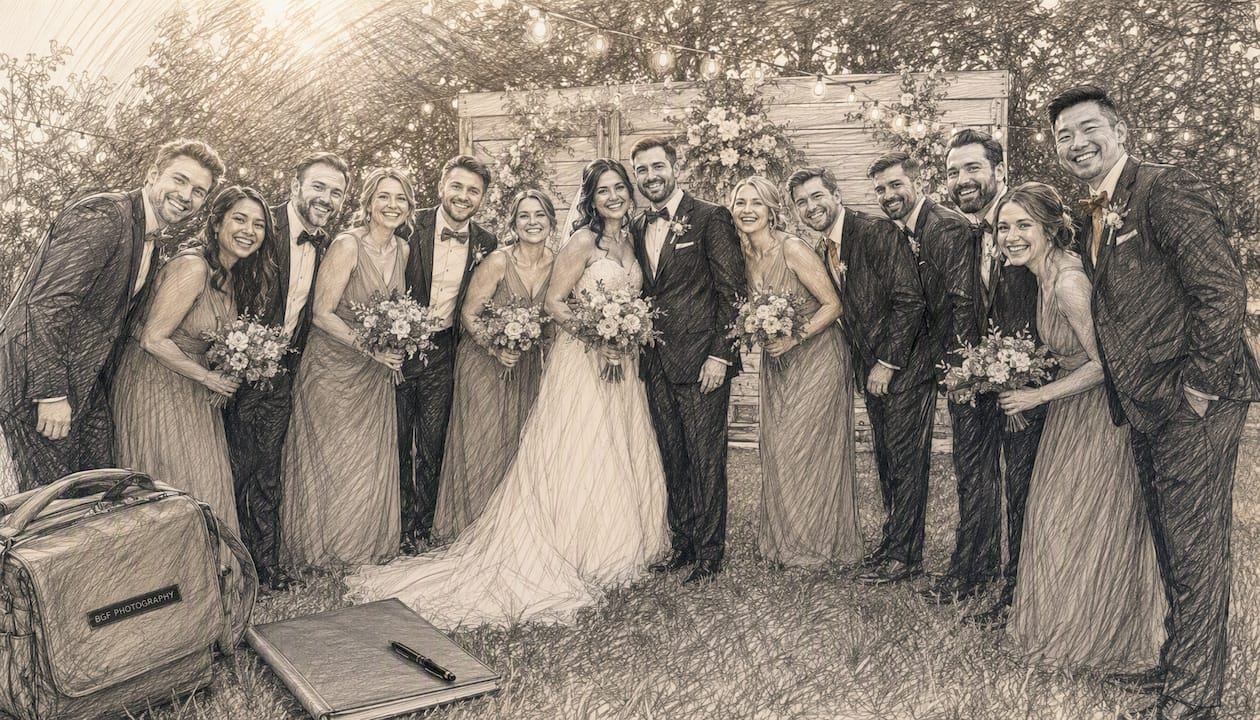
Why it matters: If the timeline compresses, this frame is already secured. Everything else is a bonus.
Framing note: Go wide first to capture everyone cleanly, then move to a medium crop without reshuffling people. Two frames, one setup, no wasted time.
Variation: After the clean shot, ask everyone to look at the couple and cheer. You get a genuine reaction in under 30 seconds.
For large parties of ten or more, stagger into two rows — taller people behind, shorter in front, everyone angled slightly inward. Close the gaps so there's no awkward negative space between people.
2. Couple with each side separately
Split the group immediately after the full shot. Bride with bridesmaids, groom with groomsmen — these are the two frames families print and frame.
Framing note: Keep the same location and background. Change the framing, not the spot.
Variation: Clean pose first (eyes to camera), then a relaxed version where everyone looks at the bride or groom. Two distinct moods, same setup.
For small parties: If you have two or three bridesmaids, a tight medium crop feels more intimate than a wide frame with too much empty space.
3. Closest-person combos (maid of honor, best man, siblings)
These smaller groupings are where the real personality shows up. Two or three people, less choreography, more genuine connection.
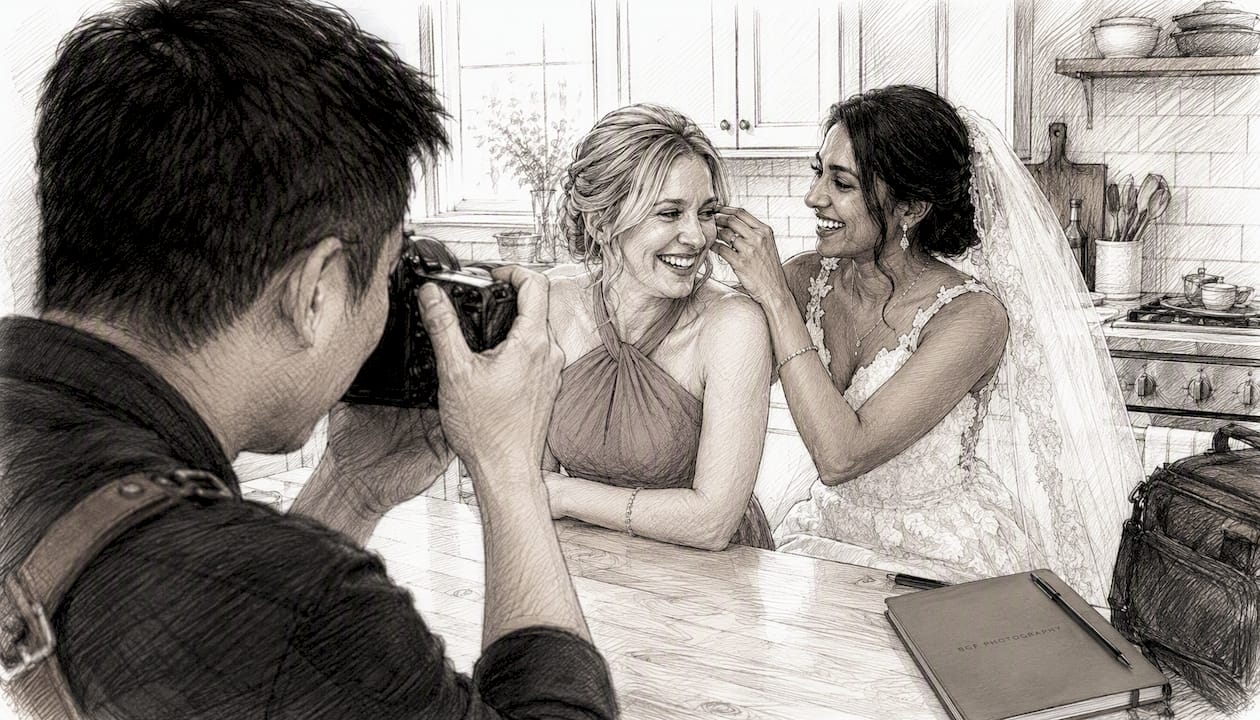
Why it matters: The maid of honor and best man photos often become the most-shared images on social media. They're also the fastest to shoot — one to two minutes each.
Variation: Give them a prompt instead of a pose. "Tell her the one thing you've been meaning to say all day" produces a real moment every time.
4. Walking shot
Ask the group to walk toward the camera, talking and laughing. Nobody has to pose. The movement creates natural energy and the expressions take care of themselves.
Framing note: Shoot from slightly below eye level and give the group room to walk into the frame. A wide-angle lens here adds depth without distortion.
Variation: Walking away from the camera works just as well and gives you a completely different editorial feel — useful for albums that need visual variety.
5. Champagne pop or toast
High energy, easy to direct, and the cleanup is minimal if you use a single bottle. The champagne pop is one of the most reliable fun bridal party photos in any gallery because the reaction is always genuine.
Framing note: Shoot in burst mode. The best frame is usually the one right after the pop, not during it.
Variation: Skip the pop and go straight to a toast. Everyone clinks glasses, looks at the couple, and laughs. Cleaner, faster, still full of energy.
6. Candid getting-ready moments
The getting-ready window is where the most authentic images of the day happen. Nobody is performing for the camera yet — they're just present.
Key shots: Bridesmaids helping with the dress or veil, someone fixing a boutonnière, a quiet moment between the bride and her mom, and the group laughing at something nobody planned.
Variation: Ask the photographer to stay back and shoot from across the room. The distance removes self-consciousness and the images look completely different from posed portraits.
7. Detail shots (rings, dress, florals)
Detail shots balance the gallery and take less than ten minutes total when staged well. Ring and dress details: 3–6 minutes. Floral and accessory details: 2–3 minutes.
Staging tip: Use a neutral surface (white linen, a wooden table, a windowsill) and natural light. Keep the background simple. The detail is the subject — everything else should disappear.
Getting-ready and detail shots that complete the gallery
The getting-ready window is underused by most couples. It's also the easiest place to capture candid bridal party photos because nobody is thinking about the camera yet.
Recommended checklist:
- Robes or matching pajamas (group shot before anyone is fully dressed)
- Ring detail on a neutral surface near a window
- Dress on a hanger against a clean background (door, wall, or window light)
- Putting on jewelry — especially heirlooms or gifts from the couple
- Candid laughter during hair and makeup
- Individual glam portraits before the dress goes on
- Boutonnières being pinned (groom's side)
- Vow book or letters, closed, as a detail
Time estimates: Ring and dress details take 3–6 minutes when staged in advance. Glam group portraits take 5–8 minutes. Candid moments during prep happen on their own — the photographer just needs to be in the room.
Pro Tip: Prioritize heirlooms and gifts first. Rings, veils, vow books, and jewelry gifted by the couple are the items most likely to get overlooked when time runs short. Stage them near a window before the photographer arrives so they're ready to shoot immediately.
For quick staging, place items on a white hand towel or linen napkin near the brightest window in the room. No props, no fuss — just clean light and a simple surface.
Props and activities that photograph well
Props work when they add personality without slowing the flow. The rule is simple: one prop at a time, easy to deploy, easy to remove.
Props that consistently photograph well:
- Champagne flutes (plain glass, no visible logos)
- Confetti or flower petals for a toss shot
- Matching robes or custom embroidered jackets
- A simple sign or banner ("Finally Mrs. ___" or the wedding date)
- Classic car or vintage vehicle for a departure or arrival shot
- Umbrellas in a coordinating color for outdoor coverage
Food and drink ideas: Milkshakes, pizza boxes, or a charcuterie spread create casual, candid energy that works well for couples who want their gallery to feel relaxed rather than formal. Keep it consistent with the overall aesthetic — a pizza box at a black-tie wedding reads as a gag, not a vibe.
What to avoid:
- Oversized branded items (beer cans, soda bottles with visible logos)
- Fragile props that require careful handling and slow the pace
- Anything that requires significant cleanup between shots
- Props that only work for one person and leave the rest of the group standing awkwardly
The one-prop-at-a-time rule keeps transitions fast. Introduce the prop, shoot it, hand it off, move on. The moment you have three props in play at once, the session stalls.
Verbal prompts and pose variations that create natural reactions
The best wedding party poses don't come from rigid choreography. They come from a good prompt delivered at the right moment. Photographers who give light direction and cues rather than pre-planned poses consistently get more authentic expressions, especially with large groups.
Here's a short list of prompts that work:
- "Eyes to camera, big smiles" — the clean, album-safe baseline
- "Now look at the couple" — shifts energy without a full repose
- "Whisper your worst dance move to the person next to you" — produces genuine laughter in under five seconds
- "On three, everyone bring it in and cheer" — high energy, works for any group size
- "Walk toward me like you own the place" — natural movement, no stiffness
- "Tell her one thing you haven't said yet today" — quiet, emotional, works beautifully for the maid of honor shot
Energy progression: Start clean (eyes to camera, composed), move to relaxed (natural smiles, looking at each other), then go for the big reaction (cheer, laugh, movement). Three distinct moods from the same spot.
Height and spacing: Use stairs or a two-row stagger when the group is larger than six. Taller people behind, shorter in front. Close the gaps — negative space between people reads as disconnection in photos.
Pro Tip: Designate one person as the group wrangler before the session starts — ideally the maid of honor or best man. Have them call the next two people into position while the photographer is still shooting the current grouping. This alone can cut transition time in half.
Simple lighting and location rules that improve every shot
You don't need a perfect location. You need one good spot with consistent light and a clean background.
Light dos and don'ts:
- Do position the group in open shade or with their backs to the sun (backlight) for even, flattering exposure
- Do expose for faces, not the background
- Don't place anyone in a half-sun, half-shade setup — it creates uneven skin tones and squinting
- Don't shoot directly into harsh midday sun without a diffuser or shade
Framing defaults: Pick one reliable spot and change the framing rather than the location. Wide frame first (everyone visible, environment included), then medium (waist up, tighter connection), then tight (faces, expressions, details). No reshuffling required.
Location tips:
- Outdoors: look for even shade under trees, covered walkways, or the shaded side of a building
- Indoors: position the group near the largest window in the room and use the natural light as your primary source; for natural light bridal portraits, this is almost always the best option
- Small spaces: use a texture-rich wall or architectural detail as the background and keep the group close together to fill the frame
Quick on-site checklist:
- Are faces evenly lit? (No harsh shadows across anyone's face)
- Is the background simple? (No distracting signs, cars, or clutter)
- Is anyone squinting? (If yes, rotate the group)
- Does the light match the rest of the session? (Consistency across the gallery matters)
When to schedule bridal-party photos and a sample timeline
The first-look vs. post-ceremony decision shapes your entire photo timeline. Both work — the trade-offs are real.
First look (photos before the ceremony): Scheduling bridal-party photos before the ceremony provides more flexibility, keeps the bridal party fresh, and frees up cocktail hour for guest time. The couple sees each other privately, the formal photos are done, and everyone can relax after the ceremony.
Post-ceremony (traditional): More emotionally charged because the ceremony just happened, but the timeline compresses fast. Guests are waiting, cocktail hour is running, and the pressure shows in expressions.
Multiple timeline scenarios exist — first look with all formals before the ceremony, first look with bridal party only before the ceremony, some photos before and some after, or everything after. Each has legitimate trade-offs depending on venue, travel time, and party size.
Sample timelines:
| Coverage Level | Full Party | Each Side | Small Combos | Buffer | Total |
|---|---|---|---|---|---|
| Tight (12–18 min) | 5–6 min | 3 min each | Skip or 1 min each | — | 12–18 min |
| Standard (18–25 min) | 6–8 min | 4–5 min each | 1–2 min each | 5 min | 18–25 min |
| Ideal (30 min) | 8 min | 5–6 min each | 2 min each | 15–30 min | 30 min |
The 15–30 minute buffer is the single most impactful change most couples can make. A rushed schedule is the most common reason bridal party photos look stiff. Build the buffer in and the expressions take care of themselves.
For detailed wedding day timeline planning, working backward from your ceremony time helps identify exactly where the buffer fits.
Pro Tip: Lock one primary location for bridal party photos before the wedding day. Running between three spots eats 10–15 minutes of shooting time. One great spot with varied framing beats three mediocre spots every time.
Bridal-party etiquette and common costs
Knowing who pays for what before the wedding removes a significant source of tension. The general expectation in the U.S. is that bridesmaids cover their own dress, shoes, and accessories. Bridesmaids are typically expected to pay for their own dresses, according to wedding planner Lindsey Nickel of Lovely Day Events.
Optional extras — professional hair, makeup, specific jewelry the couple wants everyone to wear — are where the etiquette gets nuanced. Couples who cover those optional costs tend to create a more relaxed dynamic, especially when uniformity matters for photos. Gifting jewelry or accessories is a common way to handle this without making it feel transactional.
Etiquette checklist for communicating costs:
- Tell bridesmaids the dress budget and style direction as early as possible
- Be explicit about what the couple is covering vs. what each person pays
- If you want specific hair or makeup, offer to cover it or give bridesmaids the option to opt out
- Gift accessories (earrings, hair pieces) rather than requiring purchase
- Have the cost conversation privately, not in a group chat where social pressure builds
The timing matters as much as the wording. Early and direct is always better than vague and last-minute. Mid-market wedding photographers often cost several thousand dollars, and couples who allocate extra time for bridal party coverage should factor that into their overall photography budget.
A photographer-approved shot order and checklist
This is the order professional photographers use because it protects the most important frames first. If the timeline slips, you already have what you need.
Sample shot order:
- Full wedding party, wide frame (everyone together)
- Full wedding party, medium crop (no repositioning)
- Couple with bridesmaids (bride's side)
- Couple with groomsmen (groom's side)
- Bridesmaids group only
- Groomsmen group only
- Maid of honor with couple
- Best man with couple
- Any additional closest-person combos (siblings, close friends)
- One movement or fun shot (walking, champagne, cheer)
Checklist to share with your photographer:
- Locked location with lighting notes (shade, window, backlight)
- Must-have shot list in priority order
- Names and faces of the two or three people who must be in specific shots
- Contact name for the bridal-party wrangler
- Confirmed time buffer in the schedule
- Any props and when to introduce them
Timeline reference: A standard set runs for a duration when the group is organized and the location is locked. An ideal, full-coverage set runs longer. Protect the first two frames (full group and each partner with their side) if time becomes constrained — everything else is additive.
For organizing large group portraits on the wedding day, the same shot-order logic applies: biggest group first, then break down.
Pro Tip: Share the shot list and wrangler contact with your photographer at least two weeks before the wedding, not the morning of. Use the vendor timeline sharing process to make sure everyone has the same schedule.
Key Takeaways
Securing the full group shot first and building a 15–30 minute buffer into your timeline are the two decisions that most directly determine whether your bridal party photos look relaxed and genuine or rushed and stiff.
| Point | Details |
|---|---|
| Shoot full group first | Secure the wide and medium group frame before any sub-groupings so top-priority shots are protected if time slips. |
| Build a 15–30 minute buffer | A relaxed timeline produces natural expressions; a rushed one is the most common cause of stiff bridal party photos. |
| Lock one primary location | One great spot with varied framing beats running between multiple locations and losing 10–15 minutes of shooting time. |
| Designate a wrangler | Assign the maid of honor or best man to call people into position during transitions to cut downtime between groupings. |
| BGF Photography approach | BGF Photography uses a candid-first, classic-groupings-second framework for every wedding in Buffalo, Rochester, and the Finger Lakes. |
Why the shot list matters less than the pace
Most couples spend hours building the perfect shot list and almost no time thinking about pace. That's the backwards approach.
A 20-shot list executed in a relaxed 35 minutes produces better images than a 10-shot list executed in a frantic 15. The expressions in the first scenario are present and genuine. In the second, everyone looks like they're waiting for it to be over — because they are.
The other thing most articles won't tell you: the "fun" shots almost always land better when they come after the clean ones, not before. Once the album-safe frames are done, the pressure lifts. The champagne pop, the walking shot, the cheering group — those moments are genuinely fun when nobody is worried about whether the formal photos are finished yet.
BGF Photography's hybrid coverage (photo and video under one cohesive style) means the candid moments between shots get documented too, not just the posed ones. The film option adds a warmth to getting-ready and detail frames that digital alone doesn't replicate. For couples in Western New York who want both timeless and candid coverage, that combination is hard to find under one roof.
BGF Photography covers every shot on this list
Putting together a shot list is the easy part. Having a photographer who can execute it efficiently, keep the energy up, and still catch the unplanned moments between shots — that's where the gallery actually comes together.
BGF Photography offers candid wedding photography and videography in Buffalo, Rochester, and the Finger Lakes, with hybrid photo/video packages that keep both services under one consistent style. Optional film photography adds a nostalgic quality to getting-ready and detail frames. Timeline coordination support means you're not figuring out the shot order alone.
If you want to send your shot checklist directly and get a sense of what coverage looks like for your date, the packages and pricing page has full details on what's included. Reach out through the site to check availability and get a quote tailored to your wedding day.
Useful sources and further reading
- What Do Bridesmaids Pay For? — The Knot — Standard etiquette guidance on bridesmaid expenses and dress costs.
- Who Pays for Bridesmaid Dresses? — Business Insider — Current trends in how couples and bridesmaids split optional costs.
- Why Your Wedding Day Timeline Matters for Photography — BGF Photography Blog — BGF Photography's perspective on scheduling and buffer time.
- How to Prepare for Candid Wedding Photos — BGF Photography Blog — Preparation strategies for getting-ready shots and candid coverage.
FAQ
When should bridal party photos be taken?
The most flexible option is before the ceremony via a first look, which frees cocktail hour and keeps the party fresh. Post-ceremony works too but compresses the timeline significantly.
Who typically pays for bridesmaid expenses?
Bridesmaids generally cover their own dress, shoes, and accessories. Couples often cover optional extras like hair, makeup, or gifted jewelry when they want a uniform look.
How long do bridal party photos take?
A standard set runs 18–25 minutes with a prepared group and locked location; a full-coverage set with small combos and fun shots can extend to 30 minutes or more, especially if you build in a 15–30 minute buffer.
How do you get natural-looking wedding party photos?
Use verbal prompts instead of rigid poses — "look at the couple," "whisper something," or "walk toward me" — and shoot the clean frame first so the group relaxes before the candid shots.
What should I give my photographer before the wedding?
Share a prioritized shot list, the name of your bridal-party wrangler, lighting notes for your chosen location, and a confirmed time buffer — at least two weeks before the wedding day.