

TL;DR:
- A wedding family photo checklist of 10 to 15 groupings helps capture essential portraits efficiently within half an hour. Assigning one wrangler per family side and using a pre-filled, first-name list speeds up the process and minimizes delays. Keeping the list focused and movement minimal allows for meaningful photos while respecting time constraints.
Use this ready-to-copy wedding family photo checklist of several groupings, arranged bride’s side first, then groom’s side, then both sides together, to get every must-have portrait done in about half an hour. At roughly 2–3 minutes per grouping once everyone is in place, a focused list of 10–15 shots keeps the session tight without sacrificing anything important. Print or text the list below to your photographer and your family wrangler before the wedding day.
Core checklist (copy and send to your photographer):
-
Couple alone (just the two of you, first)
-
Couple + bride’s parents
-
Couple + bride’s immediate family (parents + siblings)
-
Couple + groom’s parents
-
Couple + groom’s immediate family (parents + siblings)
-
Couple + bride’s grandparents
-
Couple + groom’s grandparents
-
Couple + both sets of parents
-
Couple + full immediate family, both sides
-
Full family group (optional — one shot only)
Give this list to your family wrangler and photographer at least one week before the wedding. Fill in first names next to each role so no one is guessing who “the bride’s maternal grandmother” is when the clock is running.
Pro Tip: Assign one wrangler per family side, not one for the whole group. Two people who actually know the family by name will move the session twice as fast as one overwhelmed coordinator.
Table of Contents
-
What does your wedding family photo checklist look like in full?
-
How do you run family portraits efficiently on the wedding day?
-
How do you handle divorced parents, blended families, and other sensitive situations?
-
What posing tips actually make family portraits look better?
-
Printable family portrait checklist you can hand to your photographer
-
Why shorter lists get better photos: a photographer’s perspective
What does your wedding family photo checklist look like in full?
Most photographers recommend capping formal family portraits at a moderate number of groupings as the sweet spot between thorough coverage and a timeline that doesn’t collapse. The logic is simple: start with the largest group on each side, then release people one by one to form smaller groupings. No one has to be called back, and the session flows forward instead of stalling.
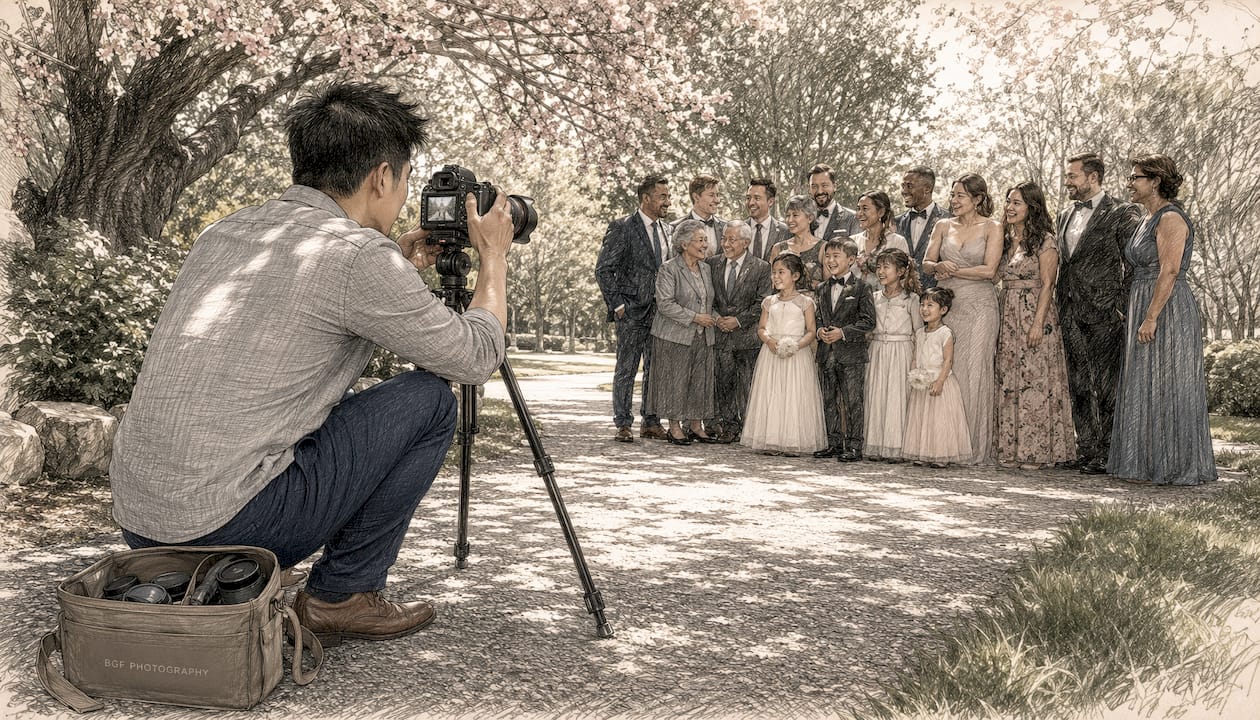
Bride’s side groupings
Work from large to small. Start with everyone, then peel off.
-
Couple + bride’s parents (must-have)
-
Couple + bride’s parents + siblings (must-have)
-
Couple + bride’s siblings only (optional)
-
Couple + bride’s maternal grandparents (must-have if present)
-
Couple + bride’s paternal grandparents (must-have if present)
-
Couple + bride’s parents + grandparents — a full-generation shot (optional)
-
Couple + bride’s extended family: aunts, uncles, cousins (optional — consider moving to cocktail hour)
Naming tip: Write “Couple + Maria & James (bride’s parents)” rather than just “bride’s parents.” When a wrangler is scanning a list mid-session, a first name is faster than a title.
Groom’s side groupings
Mirror the bride’s side structure exactly.
-
Couple + groom’s parents (must-have)
-
Couple + groom’s parents + siblings (must-have)
-
Couple + groom’s siblings only (optional)
-
Couple + groom’s maternal grandparents (must-have if present)
-
Couple + groom’s paternal grandparents (must-have if present)
-
Couple + groom’s parents + grandparents (optional)
-
Couple + groom’s extended family (optional — cocktail hour candidate)
Both sides combined
These are the shots that take the most coordination, so save them for after each side’s individual groupings are done.
-
Couple + both sets of parents (must-have)
-
Couple + both sets of parents + all siblings (must-have)
-
Couple + all grandparents (optional)
-
Full family group — one version only (optional)
A single full-family portrait beats multiple overlapping “everyone” shots every time. Pick one configuration, get it right, and move on.
Pro Tip: If divorced parents are in the picture, list their shots explicitly and separately. Ask the couple privately whether they want both parents in the same frame before the wedding day — never sort that out in front of guests.
The order matters as much as the list itself. Starting with the largest group and releasing people to form smaller ones means nobody has to be tracked down twice. It’s the single biggest time-saver in the entire formal block.
How do you run family portraits efficiently on the wedding day?
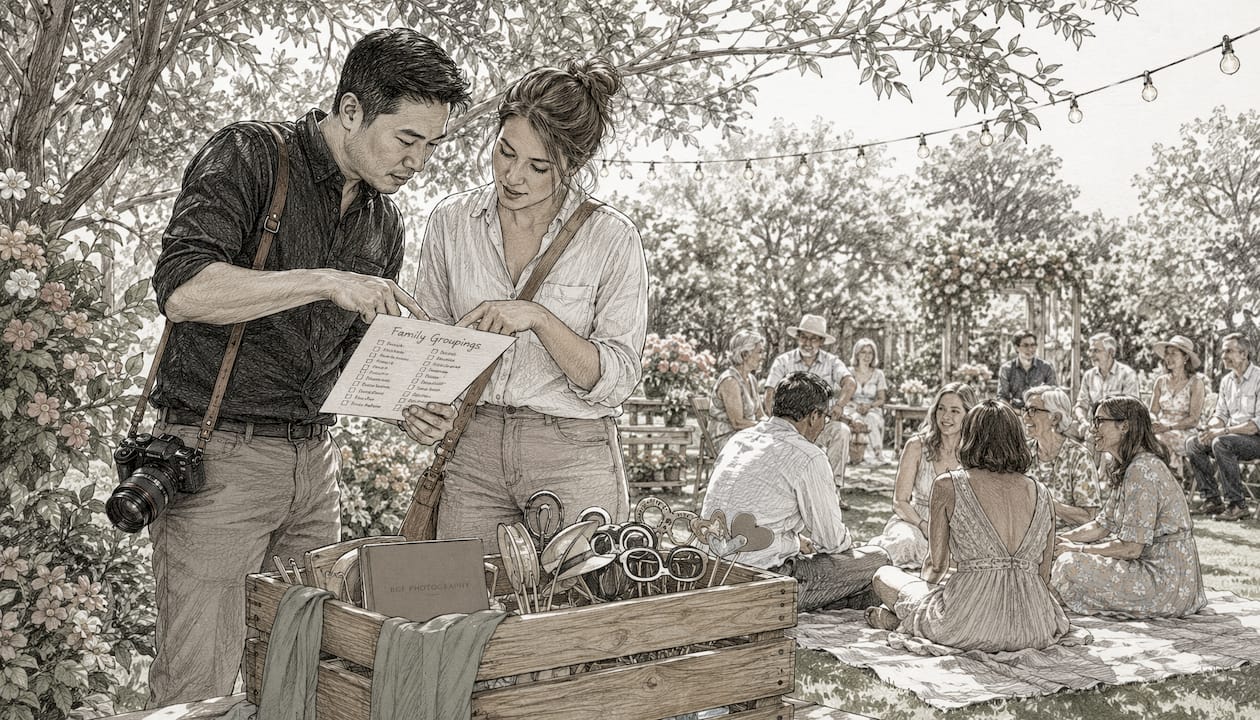
The formal portrait block runs smoothly when everyone has a job. The photographer’s job is to shoot. The wrangler’s job is to call names and move people. Your job, as the couple, is to stay in position and let those two roles do the work.
Assigning one wrangler per family side who knows names and relationships cuts down on the “where’s Uncle Dave?” delays that quietly eat 10 minutes out of a 30-minute block. Give each wrangler a printed copy of the list with first names filled in, a pen to check off completed shots, and a phone number for the photographer.
Day-of flow, step by step:
-
Gather everyone in the portrait location before the ceremony ends, if possible.
-
Wrangler calls the first (largest) group by first name.
-
Photographer positions, shoots, confirms the shot.
-
Wrangler releases the people who aren’t in the next grouping.
-
Repeat until the list is done — no backtracking, no rebuilding groups from scratch.
On phones: Guest smartphone photos slow the session and split subjects’ attention between the professional camera and Aunt Linda’s iPhone. Ask your officiant or MC to announce a phone pause before formals begin. One sentence is enough: “Please hold your phones while the photographer works — you’ll get the photos from the couple soon.”
For late or out-of-town family members, flag two or three reception-time slots on the list in advance. Don’t hold the formal block for anyone who isn’t there yet.
Pro Tip: Share the name-filled checklist via group text to both wranglers the night before, ideally at the rehearsal dinner. A wrangler who has already read the list once will call names faster and with more confidence.
How long does the family portrait session actually take?
The honest answer: it depends on your list length and how prepared your wranglers are. With a focused list and names pre-filled, each grouping runs about 2–3 minutes. Add a minute or two for transitions between groupings, and the math becomes predictable.
The estimated total time varies based on the number of groupings; smaller numbers fit within about half an hour, while more groupings can extend the session significantly, requiring careful planning.
Tight 20-minute plan (8–10 groupings): Works for smaller families or when cocktail hour time is limited. Stick to immediate family only on each side, plus both-sides-together shots. No extended family, no cousins.
Relaxed 35–45 minute plan (15–20 groupings): Fits larger families with grandparents on multiple sides, step-parents, and a blended-family grouping. Requires two wranglers and a venue with a single, consistent portrait spot.
Start with grandparents and small children early in the block, before energy dips. A grandparent who has been standing for 40 minutes will look tired; one who was photographed in the first five minutes will look relaxed. Same goes for toddlers in the wedding party.
A few scheduling principles worth locking in:
-
Schedule formals immediately after the ceremony if the portrait location is on-site.
-
If travel is involved, build a separate portrait block into the timeline rather than rushing.
-
Keep the wedding day timeline visible to both wranglers so they know when the block ends.
How do you handle divorced parents, blended families, and other sensitive situations?
Sensitive family dynamics are common, and the formal portrait block is not the place to figure them out on the fly. Handle the planning privately, before the wedding day.
Divorced parents: Plan separate parent shots and list them explicitly on the checklist. Ask the couple privately whether they want both parents in the same frame at all. If yes, shoot the separate shots first, then combine. If no, the list simply has two separate lines.
-
Couple + bride’s mother (and her partner, if applicable)
-
Couple + bride’s father (and his partner, if applicable)
Step-parents and blended families: Add one or two dedicated blended-family groupings rather than trying to work them into every shot. Keep it simple: one shot with the parent and their partner, one with the full blended unit if the couple wants it.
Elderly or mobility-limited relatives: Shoot them early, keep them near seating, and offer a seated pose option. A chair or bench in the portrait area is worth requesting from the venue in advance. Don’t make an elderly grandparent stand through 12 groupings waiting for their turn.
Late or out-of-town arrivals: Flag two or three reception-time slots on the checklist for anyone who won’t make the formal block. A quick portrait near the reception entrance or during cocktail hour works well and doesn’t require the full group.
Memorial tributes: A framed photo, a bouquet charm, or a single flower placed in the frame works quietly and meaningfully. Keep it to one grouping — a couple holding a framed portrait of someone who passed, or a single shot with the tribute item visible. No need to announce it to the group.
Pro Tip: Ask the couple about any family tension during the wedding photography consultation, not on the wedding day. A quick “are there any family dynamics we should know about?” in the planning meeting prevents awkward pauses in front of 30 relatives.
Extended family groupings — cousins, large aunt/uncle branches — are almost always better moved to cocktail hour. The formal block isn’t the right time for them, and most couples don’t miss them there.
What posing tips actually make family portraits look better?
Good posing for family groups isn’t about perfection. It’s about avoiding the things that make photos look stiff or unflattering, and doing it fast enough that the session keeps moving.
Composition basics:
-
Stagger heights: don’t line everyone up at the same level. Seat some, stand others, have taller people step back.
-
Create visual triangles with the group rather than straight rows. A slight arc or diagonal reads better in photos than a flat line.
-
For large groups, use a slight incline, steps, or a bench to add natural height variation.
Quick pose fixes:
-
Chin slightly forward and down — prevents double chins and sharpens the jawline.
-
Weight on the back foot, slight angle to the camera — more flattering than standing square-on.
-
Hands: hold something (bouquet, jacket lapel, each other) or let them hang naturally. Pressed flat against the body looks awkward.
-
For natural smiles, have the photographer count to three and shoot on the exhale, not the peak of the laugh.
Lighting:
-
Place groups in even open shade rather than direct sun. Dappled light under trees creates uneven shadows across faces.
-
If shooting in sun, face the group toward soft light, not away from it. A backlit group without fill flash looks muddy.
Pro Tip: Pick one consistent spot for all formal portraits and don’t move it. Repositioning the group for every shot costs two minutes each time. A single location with good light and a clean background handles every grouping on the list.
For a deeper look at how posing intersects with wedding photography styles, the BGF Photography blog covers the full range.
Printable family portrait checklist you can hand to your photographer
Copy the template below, fill in first names, mark must-haves with an asterisk, and share it as a screenshot or PDF with your photographer and both wranglers at least a week before the wedding.
Fill-in template:
| Shot | Names | Must-have? | Notes |
|---|---|---|---|
| Couple alone | [Your names] | Yes | First shot |
| Couple + bride’s parents | [Names] | Yes | |
| Couple + bride’s immediate family | [Names] | Yes | |
| Couple + bride’s grandparents | [Names] | Yes | Seat grandma |
| Couple + groom’s parents | [Names] | Yes | |
| Couple + groom’s immediate family | [Names] | Yes | |
| Couple + groom’s grandparents | [Names] | Yes | |
| Couple + both sets of parents | [Names] | Yes | |
| Couple + all immediate family | [Names] | Yes | |
| Bride’s mother + her partner | [Names] | If divorced | Separate shot |
| Bride’s father + his partner | [Names] | If divorced | Separate shot |
| Blended family grouping | [Names] | Optional | |
| Full family group | [Names] | Optional | One shot only |
| Extended family (cocktail hour) | [Names] | Optional | Move to reception |
How to use it:
-
Replace every relationship label with actual first names.
-
Mark must-haves clearly so the wrangler knows which shots to protect if time runs short.
-
Add a “Notes” entry for anything unusual: a seated pose, a memorial tribute, a late arrival.
-
Send the completed version to your photographer, both wranglers, and your planner.
Using first names instead of role labels is the single fastest way to speed up wrangling. “Maria and James” gets a faster response than “the bride’s parents” every time.
Short version for a single text message:
Couple alone → Couple + bride’s parents → Couple + bride’s fam → Couple + groom’s parents → Couple + groom’s fam → Couple + bride’s grandparents → Couple + groom’s grandparents → Both sets of parents → All immediate family → Full group (optional). ~2–3 min per shot. Wrangler: call names from the list.
Pro Tip: Coordinate your checklist with your photographer during the wedding photography consultation, not the morning of the wedding. A clear vision shared early means the photographer arrives already knowing the list, the names, and any sensitive dynamics.
Why shorter lists get better photos: a photographer’s perspective
The couples who hand me a 30-grouping list almost always end up with fewer usable photos than the ones who hand me 12. That’s not a paradox — it’s physics. More groups mean more time standing in the same spot, more fatigue, more forced smiles, and less light to work with by the end.
Shorter lists also give the photographer room to notice a genuine moment — a grandmother tearing up, siblings laughing between shots — and capture it. A bloated list turns the photographer into a traffic cop. A focused list lets them actually shoot.
A few things that consistently improve the formal block:
-
One portrait location, used for every grouping, keeps light and background consistent.
-
Wranglers who have read the list the night before move people in half the time.
-
Couples who organize family portraits in advance with their photographer arrive calmer and finish faster.
Planning intentional, meaningful portraits together is one of those shared experiences that makes the wedding day feel collaborative rather than chaotic — and the photos reflect that.
Pro Tip: Use one fixed spot for all formals. Moving the group to a new location for every third shot adds 10–15 minutes to the session and creates inconsistent light across the gallery.
Key Takeaways
A focused wedding family photo checklist of 10–15 named groupings, handed to two wranglers and the photographer at least one week before the wedding, is the most reliable way to get every must-have portrait done in about half an hour.
| Point | Details |
|---|---|
| Cap the list at 10–15 groupings | More than 15 groupings risks fatigue, forced smiles, and a session that runs over time. |
| Use first names, not just roles | Writing “Maria & James” instead of “bride’s parents” speeds wrangling and cuts confusion. |
| Assign one wrangler per side | Two wranglers who know the family move the session twice as fast as one coordinator. |
| Prioritize grandparents and kids early | Schedule elderly relatives and small children in the first five minutes, when energy is highest. |
| BGF Photography handles the coordination | BGF Photography builds the formal portrait block into your full-day timeline and manages transitions so you don’t have to. |
A note from Billy
Wedding photography is where I spend most of my time thinking about what actually matters to a couple 10 years from now. The answer is almost never the 28th grouping on an over-ambitious list. It’s the shot of the couple with the grandparent who passed away two years later, or the one where the siblings are genuinely laughing between takes.
At BGF Photography, the approach to family formals is straightforward: keep transitions smooth, mix a few candid moments into the formal block, and protect the must-haves above everything else. The checklist is a tool, not a script. If the light is perfect and the group is relaxed, a good photographer will notice and use it.
If you have questions about your specific family situation, or you want to talk through your must-have groupings before booking, reach out directly. The family portrait guide on the BGF blog is also a good starting point for couples who want more detail on what to expect from the session itself.
BGF Photography covers the whole day, formals included
Formal portraits are one piece of a wedding day that BGF Photography covers from start to finish. The hybrid photo and video approach means your family portraits, ceremony, and reception are all documented under one consistent style, with no handoff between a photographer and a separate video crew.
BGF Photography serves couples in Buffalo, Rochester, and the Finger Lakes region of New York, with full-day coverage that includes timeline planning, wrangler coordination support, and the option to add film photography for a nostalgic finish alongside digital files. The formal portrait block is built into the day’s schedule from the start, not squeezed in as an afterthought.
If you’re ready to talk through your family checklist and lock in your date, view packages and pricing to see what full-day coverage looks like and reach out to check availability.
Useful sources
-
How to Create a Wedding Family Photo List (Without the Chaos) — Sarah Jane Hardt: practical guidance on grouping count, wrangler roles, and sequencing.
-
Family Formals Shot List Template — Photo-Logica: timing estimates, naming conventions, and template structure.
-
The Family Wedding Photos Shot List to Show Your Photographer — The Knot: divorced-parent etiquette and priority scheduling for grandparents and children.
-
How to Organize Family Portraits on Your Wedding Day — BGF Photography blog: operational tips for running the formal block smoothly.
-
Why Your Wedding Day Timeline Matters for Photography — BGF Photography blog: scheduling context for the portrait block within the full day.
FAQ
How many family groupings should you plan for a wedding?
Most photographers recommend 10–15 groupings as the practical limit for formal portraits. That range covers both immediate families, grandparents, and a combined shot without running over the allotted time block.
What family photos are must-haves at a wedding?
The non-negotiables are: couple alone, couple with each set of parents, couple with each immediate family, couple with grandparents on each side, and couple with both sets of parents together. Everything beyond that is optional.
What are the most common mistakes in family wedding photography?
The two biggest are an over-long list with no names filled in, and no designated wrangler. Both cause delays, repeated calls for the same people, and a session that runs 20 minutes over schedule.
What is the “30-5 rule” for weddings?
The 30-5 rule is a general planning guideline suggesting you allow 30 minutes for family formals and 5 minutes per additional location or setup change. It aligns with the 2–3 minutes per grouping estimate when the list stays at 10–15 shots.