
TL;DR:
- Organizing family portraits involves careful sequencing, a prioritized shot list, and a dedicated coordinator to stay within time. Proper planning ensures efficient sessions, reduces stress, and results in quality photos without delaying the wedding timeline. Assigning a knowledgeable wrangler and communicating early with family members are essential to smooth and successful family portrait sessions.
Organizing family portraits on your wedding day is defined as the deliberate sequencing, grouping, and coordination of all family photo sessions within a fixed time window. Done well, it protects your timeline, reduces stress, and produces images you will actually love. Done poorly, it eats into your cocktail hour and leaves guests frustrated. The industry term for this process is "family formals," and the best results come from three things: a prioritized shot list, a designated coordinator, and a proven posing sequence.
How to organize family portraits on your wedding day with a shot list
A prioritized family photo list is the single most important document you will create before your wedding day. Without it, your photographer spends time asking who belongs in each shot instead of shooting. That delay compounds fast.
Build your list from largest to smallest
Start with the largest grouping, both families together with the couple, and work down to individual family units. A typical hierarchy looks like this:
- Both families together (all parents, siblings, grandparents)
- Bride's immediate family (parents and siblings only)
- Groom's immediate family (parents and siblings only)
- Bride with her parents
- Bride with her mother
- Bride with her father
- Groom with his parents
- Groom with his mother
- Groom with his father
- Couple with all grandparents
- Couple with bride's grandparents
- Couple with groom's grandparents
- Wedding party with couple
- Bridesmaids with bride
- Groomsmen with groom
Couples should allocate 30–45 minutes for family portraits, targeting 10–15 core groupings. Each grouping takes roughly 3–5 minutes to gather, pose, and shoot. That math leaves no room for an exhaustive list of 30 combinations.
Keep the list focused
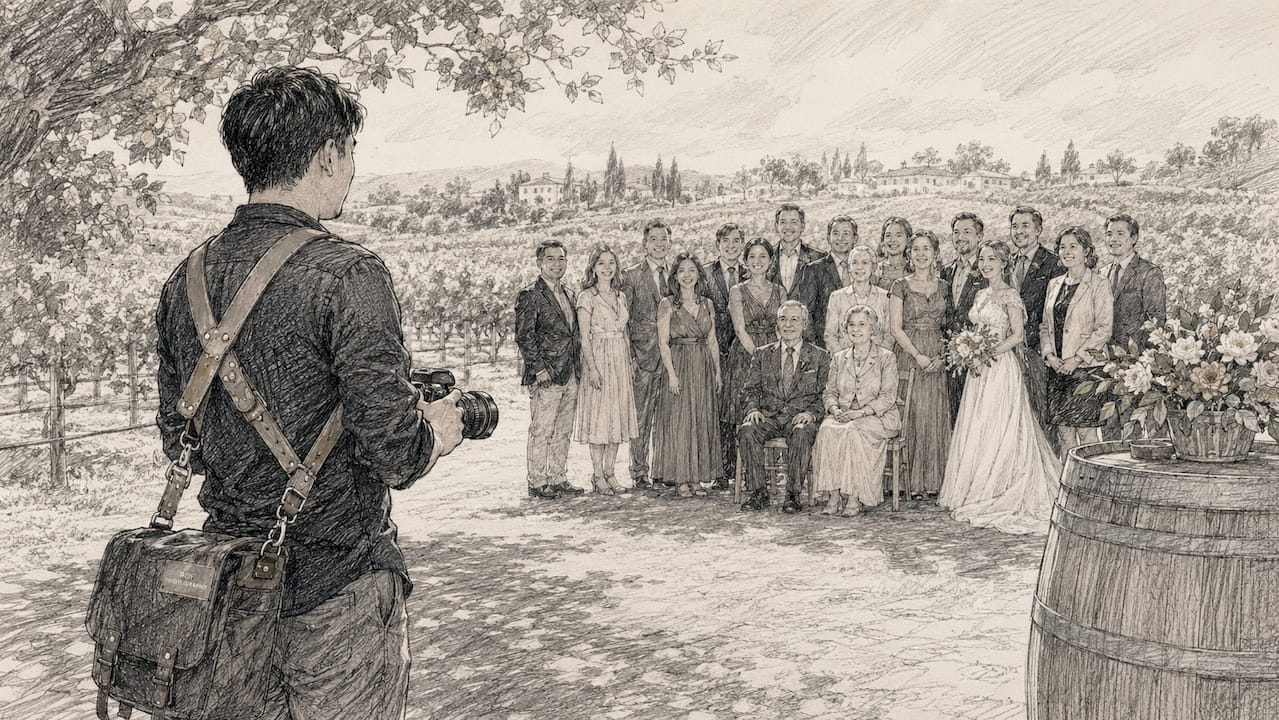
A shorter priority list produces better experiences and higher-quality photos than an exhaustive one. Experienced photographers recommend covering immediate family first, then extending outward only if time allows. If you have 12 groupings on your list and finish early, you can always add one more. If you have 25 groupings and run late, you cannot get that time back.
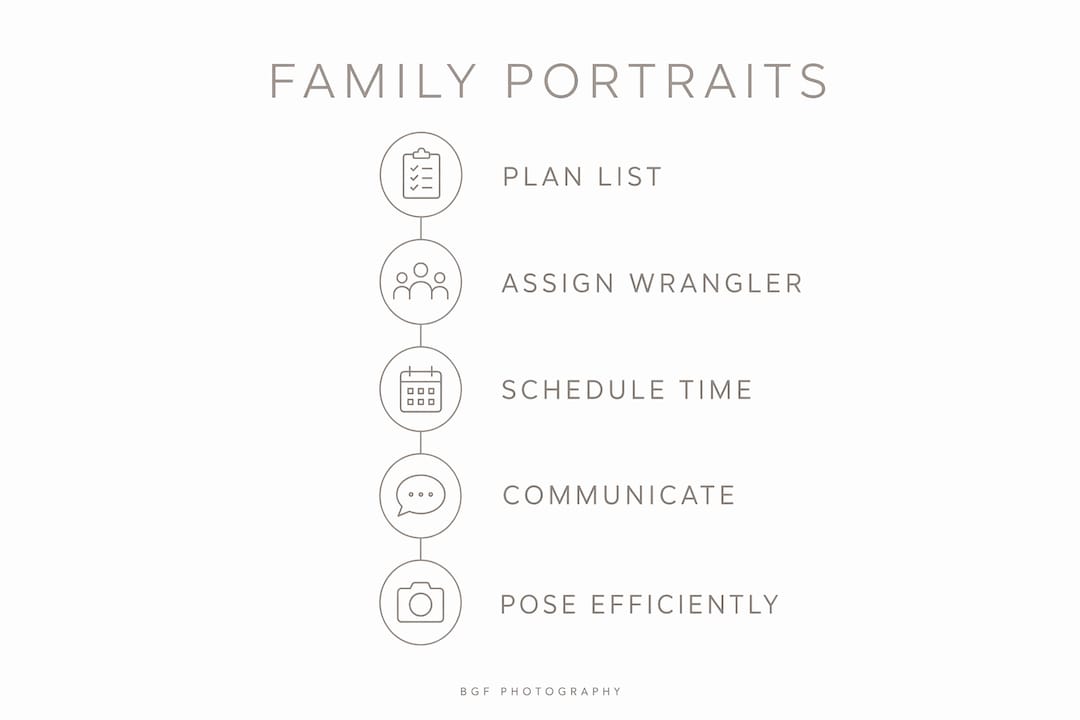
Pro Tip: Build your list in a shared Google Sheet and give your photographer, your wrangler, and your wedding planner access at least two weeks before the wedding. Everyone works from the same document, and last-minute additions get flagged before the day.
Address sensitive family dynamics early
Sensitive family relationships require a private conversation with your photographer before the wedding day. Divorced parents, estranged relatives, and blended family configurations all need a plan. Your photographer cannot navigate those dynamics in real time without prior context. A five-minute call before the wedding prevents a five-minute standoff during portraits.
Who should coordinate your family portrait session?
Your photographer's job is to take great photos. Gathering your aunt from the cocktail hour bar is not part of that job. The two roles are incompatible, and expecting one person to do both guarantees delays.
What a wrangler actually does
A family wrangler is a trusted friend or family member who knows your guests by face and name. Their sole job during the portrait session is logistics. Assigning a knowledgeable family wrangler increases session efficiency by 25%. That number reflects a real operational difference: the photographer stays in position while the wrangler moves people.
A good wrangler handles all of the following:
- Calling out names for the current and next grouping simultaneously
- Physically locating guests who have wandered to the cocktail hour
- Managing children and keeping them calm between shots
- Keeping the group quiet while the photographer gives direction
- Tracking who has been photographed and who is still needed
"The lack of a knowledgeable family wrangler dramatically delays sessions. Photographers cannot identify guests by name, so every transition requires someone else to do the gathering. Without that person, the session stalls."
Assign two wranglers if your guest list exceeds 150 people or if your families are spread across multiple locations at the venue. One wrangler handles the bride's side, the other handles the groom's side.
Pro Tip: Brief your wrangler with a printed copy of the shot list and a numbered order. They should know which group comes next before the current shot is finished. That overlap eliminates the dead time between setups.
Communicate the schedule to your family before the day
Sending digital notifications at least one week before the wedding improves attendance and punctuality at the portrait session. Use your wedding website, a group text, or a direct email to tell family members exactly where to be and when. The message should include the location, the expected start time, and a clear instruction to stay near the ceremony space after the vows.
Communicating your vision to your photographer before the day also matters. Share the shot list, flag any family sensitivities, and confirm the portrait location together. That conversation turns a chaotic session into a coordinated one.
When and where should you schedule family portraits?
Timing is the variable most couples underestimate. The best photo list in the world fails if it is scheduled at the wrong moment.
Schedule portraits immediately after the ceremony
68% of delays in family portrait timelines happen because relatives leave the ceremony area and need to be located again. The fix is simple: start portraits the moment the ceremony ends, before guests disperse. Your wrangler announces it during the recessional or immediately after. Guests are already gathered, already dressed, and already in a celebratory mood.
The two best timing windows are:
- Immediately after the ceremony. Guests are present and the light is consistent with ceremony conditions.
- Before the ceremony with a First Look. The couple sees each other privately before the ceremony, which frees up the post-ceremony window entirely for family portraits without emotional pressure.
Both approaches work. The right choice depends on your venue, your timeline, and whether you want a First Look. Discuss the wedding day timeline with your photographer at least a month before the wedding to lock in the approach.
Choose a location that works for everyone
Pick a portrait location within 100 feet of the ceremony exit. Every extra minute of walking is a minute of portrait time lost. The location should offer:
- Consistent, even light (open shade is ideal; avoid harsh midday sun)
- Enough space for your largest group to stand without crowding
- A clean background that does not compete with the subjects
- Easy access for guests with mobility limitations
Avoid locations that require a shuttle, a long walk, or a change of venue. The more friction you add to the transition, the more guests drift away.
Build in a contingency buffer
Add 10 minutes of buffer to your portrait block. If a key family member is missing or a grouping takes longer than expected, that buffer absorbs the delay without pushing into your cocktail hour. If everything runs on time, use the buffer for a few extra candid shots or a quiet moment with your partner.
What posing techniques keep family portraits moving?
Efficient posing is not about rushing. It is about removing the decisions that slow everything down.
Use the couple as an anchor
Standardizing poses around the couple as a stable anchor saves roughly 45 seconds per group photo. The couple stays in position throughout the entire session. Family members rotate in and out around them. The photographer never needs to reset the lighting or reframe the shot from scratch.
The anchor method works like this:
- Place the couple in the center of the frame.
- Shoot the largest group with everyone surrounding them.
- Dismiss the outer family members and bring in the next group.
- The couple never moves. Only the surrounding people change.
This approach is the foundation of the peel-away method, which starts with the most inclusive group and progressively removes people to create smaller groupings. It reduces total waiting time because guests are dismissed as soon as their photos are done rather than standing by for the entire session.
Announce the current and next group simultaneously
The most effective verbal technique during a portrait session is the double announcement. While shooting group five, the wrangler calls out group six. By the time the photographer finishes group five, group six is already assembled and ready. This overlap eliminates the 30-to-60-second gap that typically occurs between setups.
The table below shows how this technique affects a 15-grouping session:
| Approach | Average transition time | Total session time for 15 groups |
|---|---|---|
| Single announcement (one group at a time) | 90 seconds | ~60 minutes |
| Double announcement (current + next called simultaneously) | 30 seconds | ~40 minutes |
That 20-minute difference is your cocktail hour.
Handle common problems without breaking flow
Photographers make roughly 12 small adjustments per photo, covering posture, spacing, eye direction, and expression. Rushing groups through before those adjustments are made reduces image quality. The solution is not to rush. It is to remove every other source of delay so the photographer's adjustment time is the only variable.
Common problems and their fixes:
- Missing relative: Skip the grouping and return to it at the end. Do not hold the entire session for one person.
- Family tension: Your photographer should already know about it. They position people to minimize interaction without drawing attention to the arrangement.
- Photo fatigue in children: Schedule any groupings with young children first. Children are most cooperative at the start of a session.
- Overrunning the timeline: Cut the last two groupings on your list, not the first two. Your priority groupings are at the top for exactly this reason.
Pro Tip: Print two copies of your shot list. Give one to your wrangler and tape one to the back of your photographer's camera bag. When the session gets chaotic, both people can reference the same document without asking each other for direction.
Key Takeaways
A well-organized family portrait session requires a prioritized shot list, a dedicated wrangler, and strategic timing built around the ceremony's natural gathering moment.
| Point | Details |
|---|---|
| Limit groupings to 10–15 | More than 15 groupings sacrifices quality and overruns your timeline. |
| Assign a dedicated wrangler | A knowledgeable coordinator keeps transitions fast and the photographer focused on shooting. |
| Start portraits right after the ceremony | Guests are already gathered, which eliminates the most common source of delay. |
| Use the couple as an anchor | Keeping the couple stationary saves roughly 45 seconds per group transition. |
| Communicate the schedule one week out | Digital notifications to family members before the wedding reduce confusion and late arrivals. |
What I have learned from shooting family formals
Most couples come to me worried about the wrong thing. They stress over poses and backgrounds when the real risk is timing. A beautiful location means nothing if you spend 20 minutes chasing down a grandmother who wandered to the cocktail hour.
The single best investment you can make in your family portrait session is choosing the right wrangler. Not the most organized person you know. The person who can tell your Aunt Carol to put down her champagne and get in position without offending her. That is a specific skill, and not everyone has it. When couples pick someone with genuine social authority in their family, the session runs itself.
I also push back on long shot lists every time. Couples often arrive with 25 or 30 groupings because they are afraid of leaving someone out. What they do not realize is that a 30-grouping session produces tired faces, stiff smiles, and a cocktail hour that starts 45 minutes late. A 12-grouping session produces relaxed, genuine expressions and a couple that actually enjoyed the process. The family portrait session should feel like a brief, organized celebration, not a military drill.
The other thing I tell every couple: trust your photographer's leadership during the session. You hired them for their judgment. When they call a grouping done, it is done. When they say the light is changing and you need to move, you move. The couples who get the best family photos are the ones who planned thoroughly beforehand and then let go of control on the day.
— Billy
BGF Photography's approach to family portrait planning
Family portrait sessions at BGF Photography are built into every wedding package from the start, not treated as an afterthought.
BGF Photography works with couples in the Buffalo and Rochester, NY areas to build a complete shot list, identify the right wrangler, and integrate the portrait block into the full wedding day timeline. Every consultation covers grouping priorities, sensitive family dynamics, and location scouting so nothing is left to chance on the day. BGF Photography's hybrid photography and videography coverage means the portrait session is captured in both formats under one consistent style. If you are ready to plan your session with a team that treats family formals as a craft, view our packages to see how BGF Photography structures coverage for your day.
FAQ
How many family groupings should I plan for?
Plan for 10–15 groupings to stay within a 30–45 minute window. More than 15 groupings typically overruns the timeline and reduces photo quality.
When is the best time for family portraits on a wedding day?
Immediately after the ceremony is the most efficient window, since guests are already gathered in one place. A pre-ceremony First Look is a strong alternative if you want to keep the post-ceremony period free.
Do I need a family wrangler if I have a wedding planner?
A wedding planner manages the overall event logistics. A family wrangler handles the specific task of identifying and gathering guests by name during the portrait session. The two roles are different, and both are worth filling.
How do I handle divorced or estranged family members in portraits?
Discuss the situation with your photographer at least one week before the wedding. Early communication allows the photographer to plan positioning that keeps everyone comfortable without drawing attention to the arrangement.
What happens if the family portrait session runs over time?
Cut groupings from the bottom of your shot list, not the top. Your highest-priority groupings are listed first for exactly this reason, so the most important photos are always captured even if time runs short.