
TL;DR:
- Scheduling 20 to 45 minutes of sunset portraits before golden hour ensures the best, most flattering wedding photos.
- Building your timeline backward from sunset helps you protect this crucial portrait window and avoid common scheduling mistakes.
Yes, sunset wedding photos are worth it. Reserve a focused 20–45 minute portrait block during golden hour — 45–60 minutes before sunset, peaking in the final 20 minutes — and you will walk away with the most cinematic, emotionally resonant images of the entire day.
TLDR:
- Golden hour light is warm, soft, and flattering in a way no studio setup can replicate.
- Reserve an appropriate amount of time for portraits; do not schedule your ceremony during golden hour — save that window for just the two of you.
- Build your timeline backward from your venue's sunset time, not forward from the ceremony.
Before your next vendor call, do these four things:
- Look up your venue's sunset time for your wedding date using a tool like PhotoPills or SunCalc.
- Block 20–45 minutes before sunset on your timeline and mark it as non-negotiable.
- Walk your venue's western side to confirm the view is unobstructed.
- Assign one person (coordinator, MOH, or best man) to gather the wedding party when the portrait block starts.
Table of Contents
- How to schedule sunset photos into your wedding timeline
- Practical tips for getting great sunset portraits
- How weather and season affect your sunset portraits
- How BGF Photography approaches sunset portraits
- Key Takeaways
- The light does not wait
- BGF Photography covers golden hour portraits in Buffalo, Rochester, and the Finger Lakes
- Useful sources and planning tools
- FAQ
How to schedule sunset photos into your wedding timeline
The single most common timeline mistake is building forward from the ceremony and hoping golden hour fits somewhere at the end. It rarely does. The method that actually works: start with golden hour and work backward through cocktail hour, ceremony, and prep times.
The work-backward method
- Find your venue's sunset time for your wedding date.
- Subtract 45–60 minutes — that is the start of your golden hour window.
- Block 20–45 minutes within that window for couple portraits. Focused sessions (just the two of you) need 20–30 minutes; add family and wedding party shots and you need the full 45. Golden hour typically peaks in the final 20 minutes before sunset.
- Place cocktail hour immediately before the portrait block so guests are occupied while you are away.
- Set ceremony end time so it finishes at least 15 minutes before portraits begin, leaving a buffer for transitions.
Timeline templates
With a first look (most flexible): Ceremony ends 2.5 hours before sunset. Family formals follow immediately. Cocktail hour runs 60–75 minutes. Couple portraits begin 45 minutes before sunset.
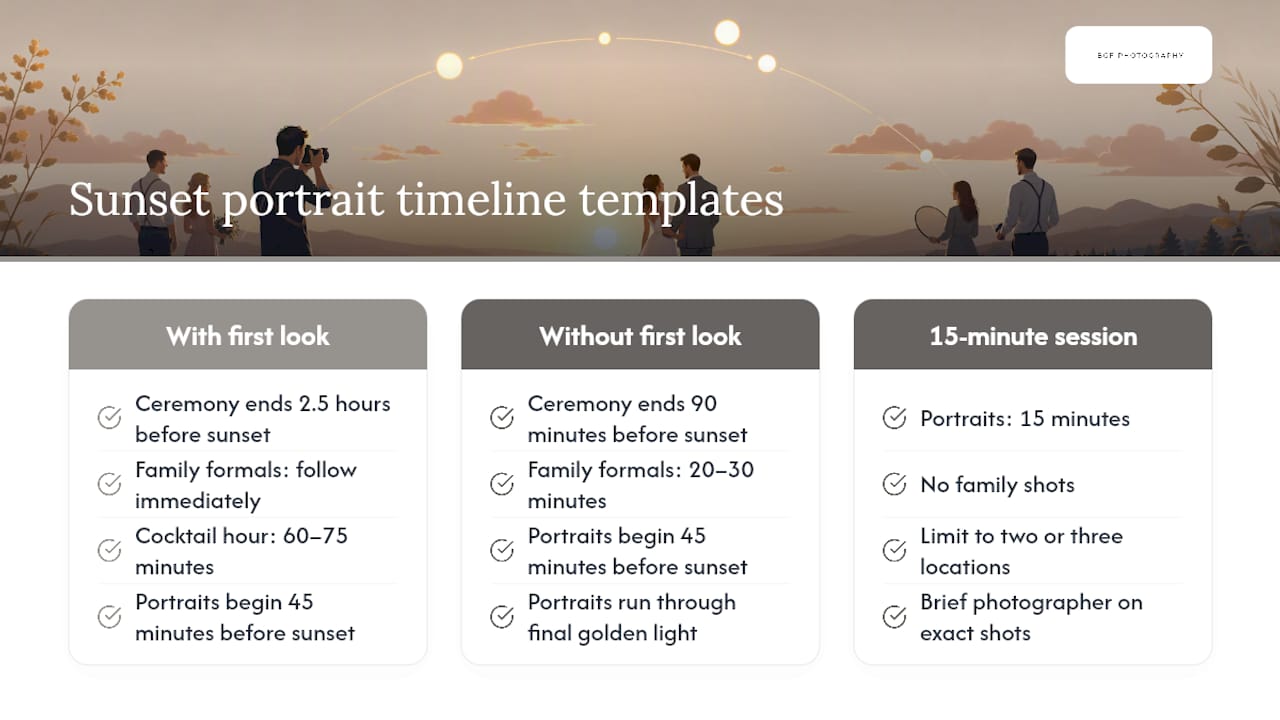
Without a first look: Ceremony ends 90 minutes before sunset. Family formals run 20–30 minutes. Couple portraits begin 45 minutes before sunset, running through the final golden light.
Short 15-minute session (tight schedule): Not ideal, but workable. Limit to two or three locations, no family shots, and brief the photographer in advance on the exact shots you want.
Reserve 20–45 minutes for the portrait block and protect it the same way you protect ceremony time. Once cocktail hour runs long or toasts start early, that window disappears fast.
Pro Tip: Tell your coordinator the portrait block is a hard stop — not a "we'll get to it if we can." Put it in the written timeline with start and end times, and ask the venue to hold any reception announcements until you return.
Practical tips for getting great sunset portraits
Location scouting checklist
Good sunset portrait locations share a few traits: a clear western view with no major obstructions, some foreground interest (a field, a dock, a stone wall), and at least one shaded fallback nearby for overcast days. When scouting:
- Stand at your planned portrait spot and face west. Note what blocks the horizon.
- Check wind exposure — open fields can turn a veil into a sail.
- Identify a secondary spot within 10–15 minutes of the primary. If the main site is blocked by terrain or buildings, add that travel buffer to your timeline now, not on the wedding day.
- For Buffalo, Rochester, and the Finger Lakes, check the local golden hour guide for region-specific scouting notes.
Hair, veil, and outfit notes
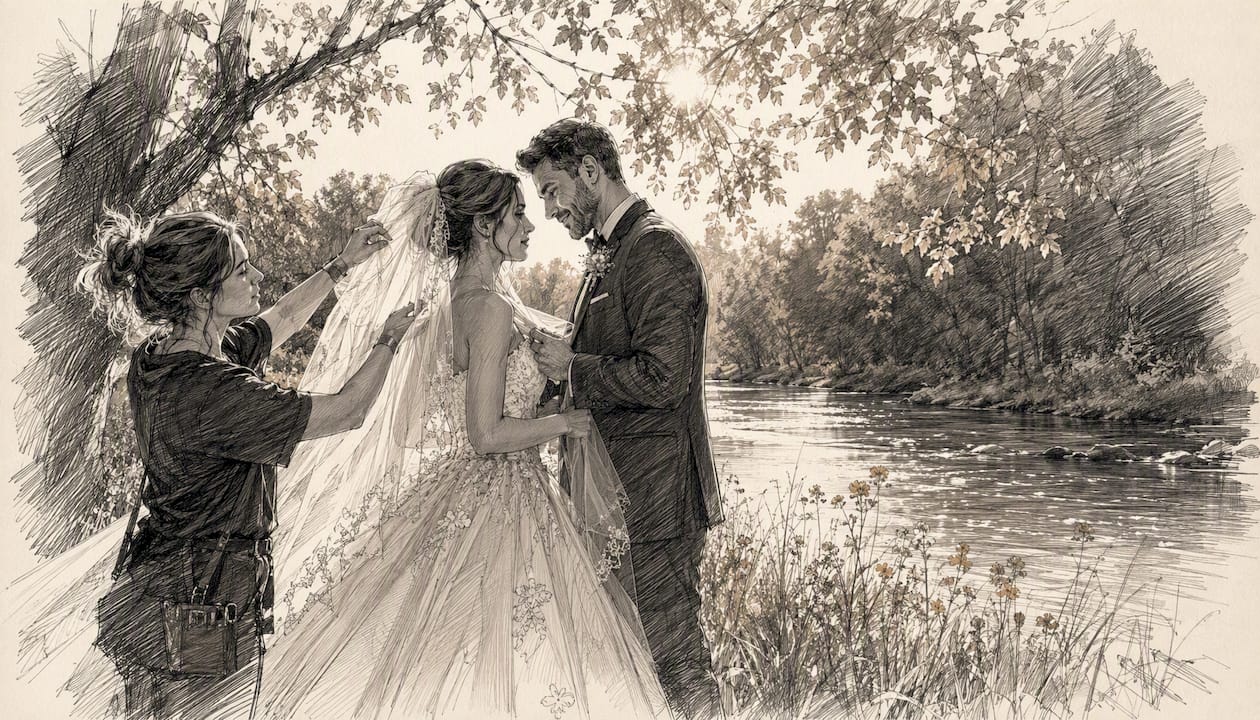
Loose veils photograph beautifully in backlight but need wind management. A cathedral veil in a strong breeze can obscure faces entirely. Talk to your stylist about a secondary veil option or a secured style for outdoor portraits. Light-colored dresses hold detail in backlight; very dark gowns can lose texture. For natural light bridal portraits, the silhouette of the dress matters as much as the fabric detail.
How weather and season affect your sunset portraits
Clear skies produce saturated color but also high contrast. On a cloudless day, the sun can be blinding for the couple and create harsh shadows right up until the final minutes. Thin cloud layers often create a diffusion that many photographers actually prefer — softer shadows, more even skin tones, and a longer usable window because the light stays flattering longer.
Heavy overcast is the real challenge. The warm color disappears, replaced by flat gray light. The fix is not to skip portraits but to shift the approach: window light inside the venue, creative use of venue architecture, or leaning into the moody blue-hour look with some supplemental lighting.
Seasonal notes for the Northeast:
- June and July: Golden hour starts late (8:00–8:30 PM in Buffalo), which means evening receptions work well. The window is long, sometimes close to an hour.
- September and October: Earlier sunsets (7:00–7:30 PM), shorter golden hour, but often the most dramatic cloud and color combinations of the year.
- November through February: Sunset can arrive before 5:00 PM. Plan portraits before the reception, not after.
For a deeper look at how Buffalo's seasons shift the light, the Buffalo wedding season guide covers month-by-month timing.
Blue hour follows sunset and can produce a moody editorial look, but it brings a 10–15 degree temperature drop. If you plan to shoot into blue hour, have wraps or pashminas ready, and coordinate with your venue to trigger reception lighting right as the session ends.
Backup options when golden hour disappears:
- Earlier portrait slot during soft pre-sunset light (1–2 hours before sunset)
- Indoor window light with a western exposure
- Venue architecture with string lights or uplighting
- Creative flash work to simulate warm backlight
How BGF Photography approaches sunset portraits
BGF Photography's approach to golden hour portraits is built around one principle: protect the window before the day starts, not after it gets away from you. That means timeline coordination happens during the planning process, not as an afterthought on the wedding day.
What the coverage includes:
- Candid hybrid photo and video coverage under one cohesive style, so the sunset portraits look and feel consistent across both mediums.
- Optional film photography for a nostalgic, grain-rich quality that pairs particularly well with warm golden hour light.
- Drone/aerial coverage for environmental wide shots during the golden hour window (subject to venue permits).
- Full-day documentation from prep through reception, with the portrait block treated as a scheduled priority, not a bonus.
The technical approach:
BGF Photography favors natural backlight as the primary source during golden hour, using selective fill (reflector or off-camera flash) to balance faces without killing the warmth of the ambient light. Venue scouting and timeline coordination happen before the wedding day so the couple is not problem-solving on the fly.
BGF Photography serves couples in Buffalo, Rochester, and the Finger Lakes region of New York. The portrait and wedding photography styles guide covers how golden hour portraits fit different aesthetic approaches if you want to explore styles before your consultation.
Key Takeaways
Golden hour portraits are the most reliably cinematic images of a wedding day, and they require one thing above all else: protected time on the timeline.
| Point | Details |
|---|---|
| Reserve the right block | Block 20–45 minutes for sunset portraits within the last 45–60 minutes before sunset and treat it as non-negotiable on the written timeline. |
| Work backward, not forward | Start from your venue's sunset time and build the ceremony and cocktail hour around that window. |
| Scout before the day | Confirm a clear western view at your portrait spot and identify a backup location with a 10–15 minute travel buffer. |
| Assign a liaison | One person (coordinator, MOH, or best man) should gather the wedding party so the couple does not lose portrait time directing traffic. |
| BGF Photography | BGF Photography handles timeline coordination, venue scouting, and hybrid photo/video coverage for golden hour portraits in Buffalo, Rochester, and the Finger Lakes. |
The light does not wait
Most couples spend months choosing a venue and a dress, then leave the portrait timing to chance. That is the one decision that actually determines whether golden hour shows up in the final gallery.
The photographers who consistently deliver stunning sunset portraits are not the ones with the best gear. They are the ones who treated the timeline as seriously as the shot list. A 20-minute portrait block during the final part of golden hour, at the right spot, with a couple who is actually present — that produces the images people print and frame. A 45-minute block that starts 20 minutes late, at a location facing east, produces nothing.
The light is predictable. The schedule is controllable. The only variable is whether you decided in advance to protect both.
BGF Photography covers golden hour portraits in Buffalo, Rochester, and the Finger Lakes
Couples in Western and Central New York who want sunset portraits handled as a planned priority — not a last-minute scramble — can book BGF Photography for hybrid photo and video coverage that treats golden hour as the centerpiece of the day.
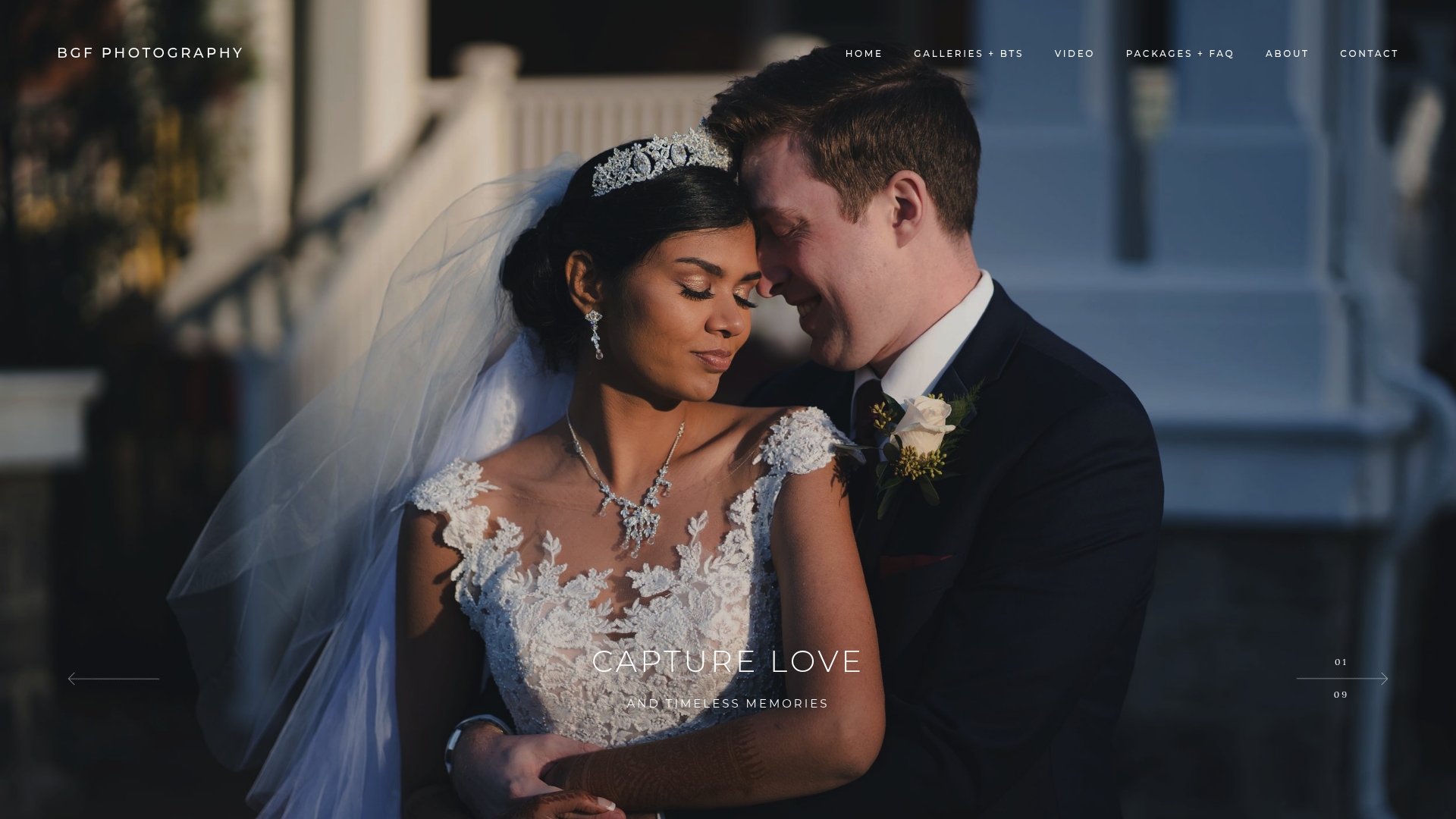
BGF Photography builds the portrait timeline during the planning process, scouts the venue in advance, and coordinates with your coordinator so the golden hour block starts on time. Packages include candid hybrid photo/video coverage, optional film photography, and drone aerials where permitted. Every package is built around one cohesive style across both photo and video, so the final gallery feels unified rather than assembled from two separate vendors.
Ready to lock in your golden hour coverage? Review packages and pricing and reach out to check availability for your date.
Useful sources and planning tools
Sun and lighting tools:
- How to Plan Your Wedding Timeline Around Golden Hour — Samuel Cedars
- Master Golden Hour Photos: Ultimate Wedding Photography Guide
- How to Schedule Sunset Wedding Photos for Perfect Golden Hour Portraits — Sortra
- How to Build a Wedding Day Timeline That Protects the Golden Hour | FindMe Photo Blog
- How to plan golden hour wedding photos — Plana Wedding
- Sunset wedding timeline guidance — OurVows
- Why You Shouldn’t Skip Sunset Photos on Your Wedding Day — Shalyn O'Neal Photography
BGF Photography resources:
- Golden Hour Wedding Photography: What You Need to Know
- Why Your Wedding Day Timeline Matters for Photography
- How to Build Your Photographer Relationship Before the Wedding
For outdoor ceremony logistics and keeping the timeline intact: Outdoor Wedding Ceremony Tips for Officiants covers practical ways to run an outdoor ceremony without delays that eat into the portrait window.
FAQ
Are sunset wedding photos worth it?
Yes. Sunset portraits consistently produce the most-shared and most-treasured images from a wedding gallery, combining flattering warm light with a private, emotional moment between the couple.
When should you do wedding sunset photos?
Start the portrait block 45–60 minutes before sunset and run it through the final minutes of golden hour. Schedule your ceremony to end at least 15 minutes before that window begins.
How much time should you reserve for sunset portraits?
Reserve 20–45 minutes depending on scope: 20–30 minutes for couple-only portraits, up to 45 minutes if you are adding family and wedding party shots.
What is the 30-5 minute rule for weddings?
It refers to wrapping up outdoor portraits roughly 30 minutes before sunset for wider shots, then moving to tighter backlit frames in the final 5–10 minutes as the sun drops to the horizon and the color peaks.
Does cloud cover ruin sunset wedding photos?
Not necessarily. Thin cloud layers create soft, diffused light that many photographers prefer over harsh direct sun. Heavy overcast removes the warm color, but window light, venue architecture, and supplemental flash can still produce strong portraits.