
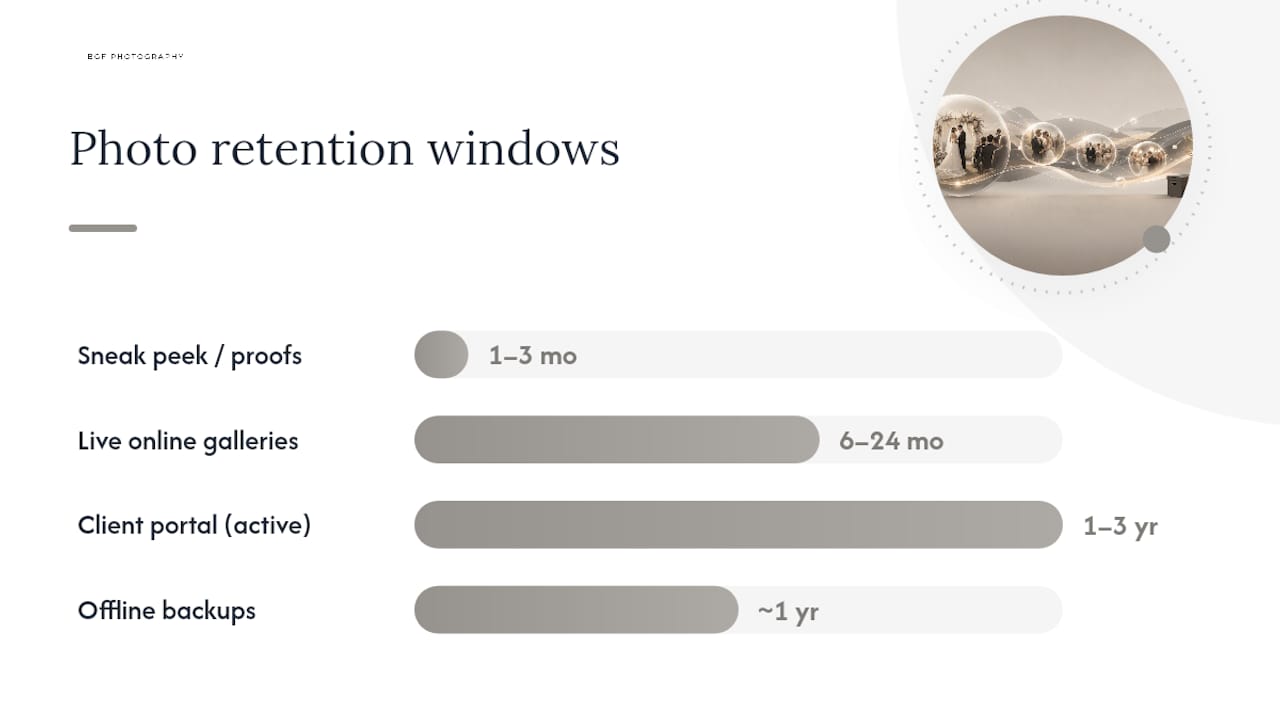
Most wedding photographers keep your finished gallery live and accessible for a varying period, with many settling on a one to two year window before archiving or deleting it, according to industry data on wedding photo retention. Offline backups often last longer, sometimes one to five years or indefinitely for wedding work specifically, but that’s not a guarantee you can access those files easily or for free.
The action that matters more than any timeline: download your full-resolution files the moment your gallery goes live, then make two backups of your own.
-
Public gallery: often gone in 90 days to a year
-
Client portal: usually live for 1 to 2 years
-
Studio archive: variable, sometimes indefinite, rarely free to retrieve
Pro Tip: Set a calendar reminder for 30 days after delivery to download everything. Don’t wait for a “just in case” moment that never comes.
Key Takeaways
Retention windows vary by studio, but the responsibility for long-term safekeeping ultimately falls on the couple, not the photographer.
| Point | Details |
|---|---|
| Typical gallery window | Live galleries commonly stay up for 6 months to 2 years before archiving or deletion. |
| Download immediately | Save full-resolution files within days of delivery, not months. |
| Contract clarity matters | Get retention length, deletion notice, and RAW file terms in writing before signing. |
| Build your own backup stack | Use one cloud copy and one physical drive stored in a separate location. |
| BGF Photography’s approach | Offers defined retention windows plus archival upgrades and hand-off options for couples who want extended access. |
Resources Worth Bookmarking
For more on contract language, check the 15-clause contract checklist. For portal retention norms, see client portal SLA guidance. For a real-world example of clear retention wording, review this photographer FAQ page.
Table of Contents
How Long Do Photographers Keep Wedding Photos? The Timeline Breakdown
Retention isn’t one number. It’s a stack of different windows depending on what kind of file you’re asking about and where it lives.
Your public online gallery, the shareable link you send to family, usually disappears fastest. Sneak peeks and proofs get replaced by final images and are often deleted within one to three months since nobody needs two versions floating around. The client portal, where your actual final edited photos live for download, tends to stay active longer. Industry guidance on portal design points to a 1 to 3 year active retention window as the norm, after which studios either archive the files, delete them, or offer a paid extension.

Offline backups are a different story entirely. Many studios keep server or off-site copies for roughly a year past delivery before clearing local drives, once they’ve confirmed the off-site copy is intact. Weddings specifically often get treated as legacy projects, with some studios holding archives for years or indefinitely.
RAW files (the unedited originals) are the least predictable of all. Plenty of photographers never hand these over and don’t retain them past editing. If you want raw files preserved, that needs to be written into your contract or purchased as an archival add-on.
Pro Tip: Ask specifically about RAW file retention before you sign anything. Most contracts are silent on this, and silence usually means “not kept.”
Why Photographers Can’t Keep Every Wedding Forever
It’s not neglect. It’s math. A single wedding can generate 60 to 100 gigabytes of images and video before editing even starts, and multiply that across dozens of weddings a year and storage costs stack up fast for any studio, no matter the size.
There’s also the operational side: server cleanup, portfolio management, and simply making room for new clients matter as much as cost. And privacy law adds another layer. Studios serving international clients face deletion requests and data protection rules that make indefinite storage a liability, not a perk.
-
Cloud and drive storage costs scale with every wedding booked
-
Server space needs regular cleanup to stay functional
-
Data privacy rules can require deletion, not just permit it
A practical compromise many studios land on: 1 to 2 years of active retention with a 30 to 60 day deletion notice, plus an archival hand-off option for clients who want more who want it.
What Your Photography Contract Should Say
Your contract is the only document that actually settles how long your photos stick around. Verbal promises don’t count once the gallery link expires.
Look for a clause that states the exact retention period for your live gallery, whether an archival copy exists afterward, and whether you’ll get advance notice before anything is deleted. A 15-point contract checklist for wedding clients flags gallery deletion timing as one of the most commonly overlooked terms, since many studios clear files after 60 or 90 days without much warning.
Before you book, or before final payment, ask directly:
-
“How long will my gallery stay live, and what happens after that?”
-
“Do you keep an offline backup, and can I request it later?”
-
“Is there a fee to retrieve files after the retention window closes?”
-
“Will I get written notice before anything is deleted?”
Two clause snippets worth requesting: “Photographer will provide 30 days’ written notice prior to deletion of client gallery” and “Client may request archival transfer of original files for a fee not to exceed [amount], available for [X] years post-delivery.” Reviewing how you build a relationship with your photographer before the wedding makes these conversations far less awkward.
| Point | Details |
|---|---|
| Retention period | Confirm the exact number of months or years your gallery stays live in writing. |
| Deletion notice | Request 30 to 60 days’ written warning before any files get removed. |
| RAW file clause | Specify whether unedited originals are retained or available as a paid add-on. |
| Archival fee cap | Get a maximum dollar figure for any future file retrieval, in the contract itself. |
Pro Tip: If a photographer hesitates to put retention terms in writing, treat that as information. A studio confident in its process will document it without pushback.
How You’ll Actually Receive Your Wedding Photos
Delivery usually comes through a client portal (platforms like Pic-Time, Pixieset, Cloudspot, and ShootProof are the most common in the industry) where you can view, download, and sometimes share your gallery. From there, expect one or more of these formats:
-
A downloadable ZIP file of full-resolution JPEGs
-
Direct download links through the online gallery itself
-
A USB drive or external hard drive, often for an added fee
-
Cloud-transfer to a service of your choosing, on request
Fees vary by studio, but the most common ones are archival extension fees for keeping your gallery live past the standard window, USB or physical drive fees, rush delivery charges if you need images faster than the standard timeline, and album design fees for printed keepsakes.
When your gallery arrives, request full-resolution JPEGs (not web-compressed versions), confirm whether metadata is intact, and ask for print-ready files if you plan to order enlargements. Understanding the different package types available helps you know upfront what’s included versus what costs extra.

How Long Should It Take to Get Your Wedding Photos Back?
Standard turnaround for a full wedding gallery runs 4 to 8 weeks, with many studios committing to 4 to 6 weeks in their contracts. Sneak peeks or proofs usually arrive much faster, within 1 to 3 weeks of the wedding.
Peak season bookings, complex editing requests, illness, or equipment failure can all push delivery later. If you’re past your contracted window with no update, send a short, direct message: “Hi, just checking in on the status of our gallery since we’re now past the [X week] mark in our contract.”
Pro Tip: Ask about turnaround time before booking, not after. Studios booked solid during peak wedding season sometimes run behind, and knowing that upfront sets fair expectations.
What to Do If Your Photographer Closes or Loses Your Files
Studios close. Drives fail. Hard truths, but ones you can prepare for.
-
Request your delivered files immediately if you sense a studio is winding down, and ask for written confirmation of what’s been backed up and where.
-
If data loss has already happened, document every email and text, and ask specifically for the name of the backup provider and a realistic recovery timeline or fee estimate.
-
If the studio has closed entirely, ask any remaining contact or successor business for a transfer of archives, or for the name of the third-party storage provider (like a cloud gallery host) that might still hold copies.
-
Keep every communication in one folder. If this becomes an insurance or legal matter, a clear paper trail of who said what and when will matter more than memory.
Pro Tip: Never rely on a single point of contact for file recovery. Get provider names and account details in writing whenever possible, not just verbal assurances.
Best Practices for Storing Your Wedding Photos for Decades
The studio’s archive is not your archive. Treat delivery day as the starting line for your own preservation plan, not the finish line.
-
Download every file the day your gallery arrives, not “sometime this month”
-
Verify the file count matches what your contract promised
-
Store one copy in cloud storage (a consumer service like Google Drive, Dropbox, or Backblaze) and one on a physical external drive
-
Keep that physical drive in a different location than your home, at a relative’s house or a safe deposit box
-
Confirm file counts against your contract before you consider the delivery complete.
-
Refresh physical drives every 3 to 5 years, since hard drives degrade even sitting unused.
-
Keep full-resolution JPEGs as your baseline. They’re universally accessible for decades. RAW files require specific software and are worth keeping only if you have a genuine reason to re-edit later.
BGF Photography maintains its own studio backups for operational reasons, redundancy during editing, insurance against equipment failure, quality control. But that’s a business safeguard, not a substitute for your personal archive. Guidance on preserving wedding memories for family walks through exactly how to build that personal system.
Pro Tip: Print at least a handful of your favorite images. Digital files can corrupt, get orphaned in old cloud accounts, or become unreadable as formats change. Paper doesn’t have that problem.
A Studio’s Take on Fair Retention Windows
At BGF Photography, we keep client galleries active for a defined window and offer archival upgrades rather than pretending we can store everything forever for free. It’s about being upfront: tell your photographer what long-term access matters to you, and get it in writing before your wedding day, not after.
Where BGF Photography Fits Into Your Storage Plan
BGF Photography builds retention terms directly into every contract, so you’re never guessing when your gallery expires or what happens after. Couples booking hybrid photo and video coverage get clear archival upgrade options, including transfer to your own cloud storage or a physical drive, so long-term access is a documented choice rather than an afterthought.
If extended studio storage or a physical hand-off matters to you, ask about it before you book. Details on archival add-ons and full package options are outlined on the packages and pricing page, where you can also reach out with specific storage questions before your wedding date is locked in.
Sources
-
Client Portal SLA Design Photographers Guide (2026) - Tov Studio Photo
-
Wedding Photography Contract: 15 Clauses to Check Before You Sign (2026)
-
How long should you keep your clients’ images - Photo Aspects
FAQ
How Long Is Too Long to Get Wedding Photos Back?
Anything past 8 weeks without an update from your photographer is worth a direct follow-up message, since most contracts commit to 4 to 8 week turnaround for final galleries.
How Should I Store 30 Years of Photos?
Keep full-resolution JPEGs in at least two separate locations, one cloud service and one physical external drive, and refresh that physical drive every 3 to 5 years since hard drives degrade over time even unused.
Will My Photographer Keep My Wedding Photos Forever?
Not automatically. Many studios keep active galleries for 1 to 2 years and offline archives longer, but indefinite free storage isn’t standard, which is why downloading and backing up your files yourself matters.