
TL;DR:
- Clear ceremony audio is crucial for capturing emotional vows and speeches that couples will cherish over time. Professional Rochester wedding videographers use multiple microphones, early setup, and advanced recording formats to ensure high-quality sound amid venue challenges. Couples can improve their audio outcome by coordinating with venues, choosing suitable locations, and discussing backup plans with their videographers.
Clear, intelligible ceremony audio is the single most important element in any Rochester wedding video, outranking camera resolution, color grading, and editing style. The role of ceremony audio in a Rochester wedding video is to preserve the voices, vows, and emotional exchanges that make your film worth watching years from now. Audio quality is the #1 complaint in negative wedding film reviews at 41%, nearly double the rate of complaints about missing moments. Films with excellent audio are rewatched 3.9 times more after three years. That gap tells you everything about what couples actually value when they sit down to relive their wedding day.
Why is ceremony audio more important than video quality in wedding films?
Sound anchors autobiographical memory more powerfully than visuals. When you hear your partner's voice cracking on a vow, or your father stumbling through a speech he rehearsed a hundred times, that audio triggers emotional recall in a way that a beautiful wide shot simply cannot. Neuroscience has long recognized the auditory system as the brain's primary route to emotional memory. Your wedding film is not a movie. It is a memory device.
"Films with excellent audio are rewatched 3.9 times more after three years than films with poor audio. That is not a marginal difference. It is the difference between a film you treasure and one you forget exists on a hard drive."
Poor audio does not just make a film harder to watch. It actively erases the most intimate moments of your ceremony. When vows are buried under reverb or wind noise, the emotional weight of those words disappears. The father of the bride speech becomes background noise. The officiant's words, which frame the entire ceremony, turn into an unintelligible murmur. What remains is footage that looks fine but feels hollow.
Clear ceremony audio also shapes how professional your wedding film appears to everyone who watches it. Guests who were not at the ceremony, family members watching from overseas, and your own children watching decades from now will all judge the film partly by whether they can hear and understand what was said. High audio quality signals that the production was handled with care. It builds trust in the entire film.
The practical takeaway is direct: if you are choosing between spending more on a higher camera resolution or investing in a videographer with a strong audio setup and protocol, choose audio every time.
What are the common challenges of recording ceremony audio in Rochester wedding venues?
Rochester wedding venues present a specific set of acoustic problems that couples rarely anticipate. The city's mix of historic churches, stone chapels, and outdoor waterfront spaces each creates distinct recording challenges that require different solutions.
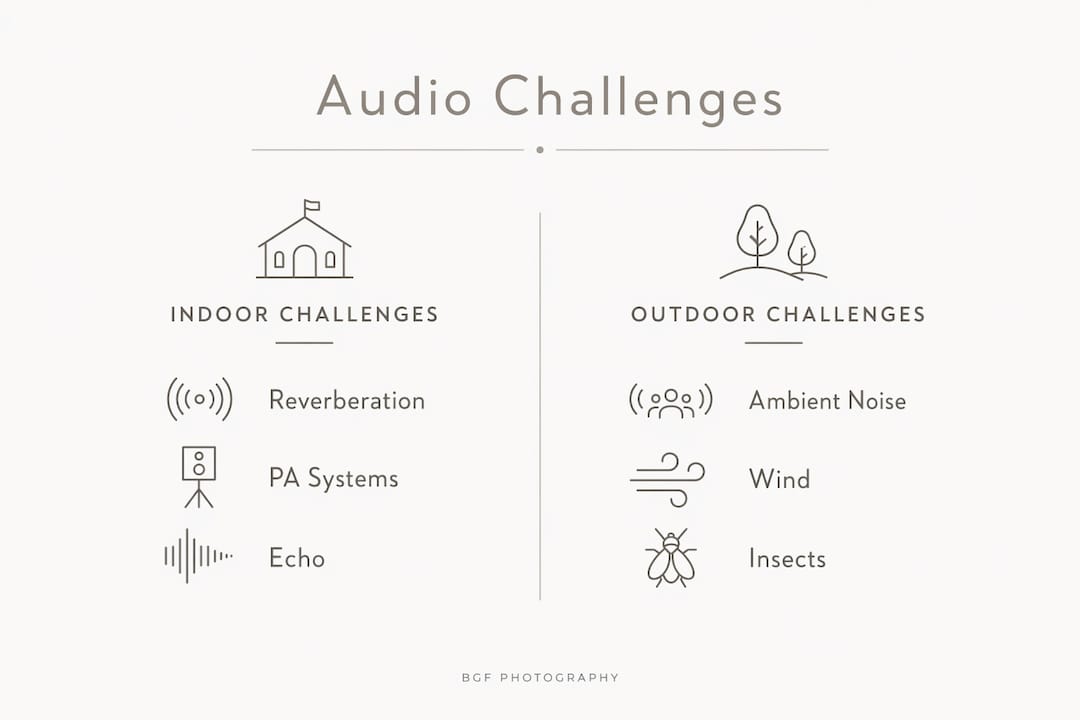
Stone churches and reverberant interiors are among the most common obstacles in Rochester wedding videography. Buildings like Sacred Heart Cathedral or older stone chapels generate long reverb tails, meaning sound bounces off hard surfaces for one to three seconds after it is produced. Camera microphones placed 20+ feet away in these spaces capture a wash of overlapping echoes rather than clean speech. The result is audio that sounds distant and muddy even when the ceremony itself was loud and clear to guests in the room.
Outdoor venues introduce a different category of problems:
- Wind noise from Lake Ontario or the Genesee River corridor can overwhelm a microphone within seconds, especially during spring and fall ceremonies.
- Ambient traffic from downtown Rochester streets bleeds into recordings during quiet moments like ring exchanges and silent prayers.
- Birds, fountains, and outdoor PA systems create unpredictable noise floors that shift throughout the ceremony.
- Temperature and humidity changes between seasons affect how sound travels, making outdoor audio harder to predict than indoor audio.
Venue PA systems add another layer of complexity. Some Rochester venues have professional installed sound systems with accessible board outputs. Others rely on portable Bluetooth speakers or aging analog systems that a videographer cannot tap into directly. When a videographer cannot access the board feed, they lose one of the most reliable sources of clean audio.
Pro Tip: Ask your venue coordinator before the wedding whether your videographer can plug directly into the sound board. This single step can be the difference between capturing clean audio and spending hours in post-production trying to salvage reverb-heavy recordings.
Seasonal factors matter too. Outdoor ceremonies in june and july in Rochester deal with high ambient noise from insects and lawn equipment. October ceremonies face wind and the acoustic unpredictability of falling leaves and rustling trees near microphones. None of these challenges are insurmountable, but they require a videographer who has planned for them specifically.
How do professional Rochester wedding videographers capture clean ceremony audio?
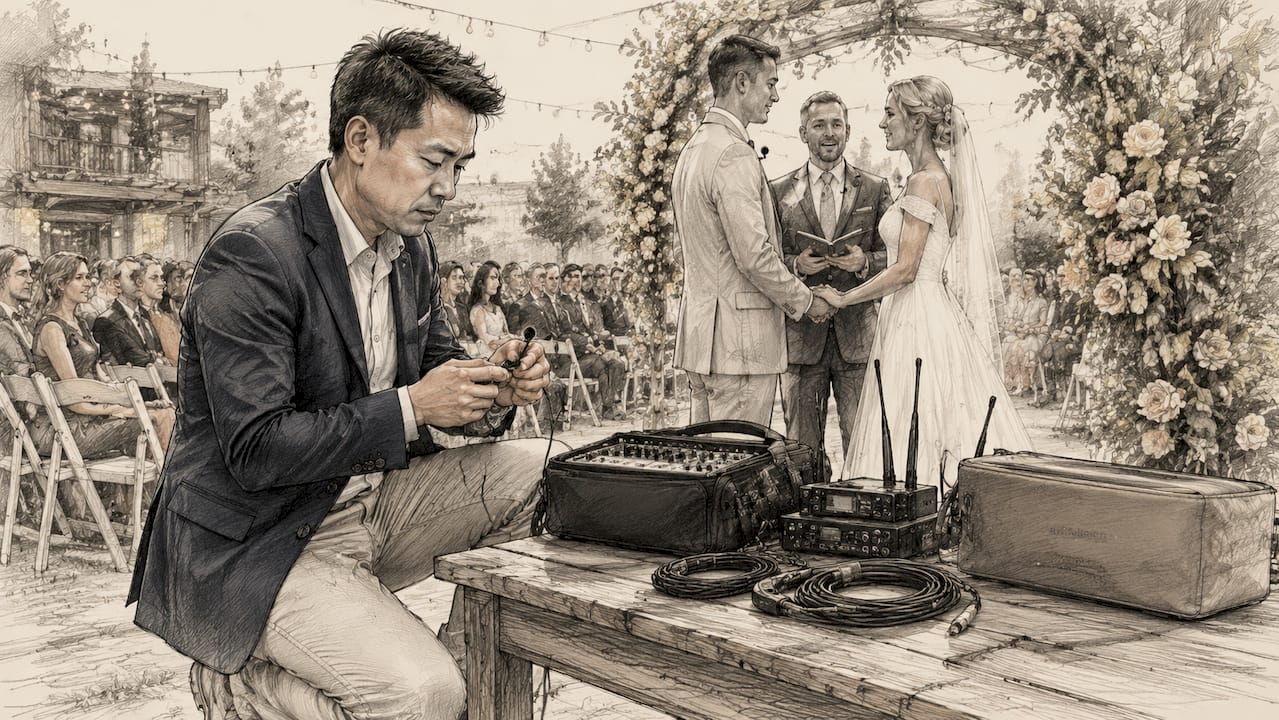
Professional Rochester wedding videographers use a multi-source audio strategy. No single microphone is trusted to carry the entire ceremony. Instead, several independent recording sources run simultaneously so that if one fails or picks up interference, others cover the gap.
The multi-microphone setup
The standard professional setup for ceremony audio includes:
- Lavalier microphone on the groom or partner wearing the transmitter. This is the primary source for vow audio. The lav sits close to the mouth and captures intimate speech clearly even in reverberant spaces.
- Lavalier microphone on the officiant. The officiant speaks throughout the entire ceremony, so their mic anchors the structure of the film.
- Soundboard feed from the venue's PA system. When accessible, this provides a clean, processed signal that the venue's own sound engineer has already optimized.
- Ambient or room microphone. Placed at a distance to capture the natural sound of the space, including congregation responses, music, and applause.
- Hidden backup recorders near the altar or speaker positions. These run independently and provide a failover source if primary mics experience interference or dropout.
Some videographers manage up to nine lavalier microphones for comprehensive coverage, placing them on parents, readers, and additional speakers. That level of coverage is not always necessary, but it reflects the professional standard for high-stakes ceremonies where every word matters.
Pre-ceremony setup and testing
Professional videographers arrive 1–2 hours before the ceremony to set camera positions, coordinate with the officiant and DJ, and test every microphone live before guests arrive. This window is not optional. It is the only time a videographer can walk the space, identify acoustic problem areas, and confirm that every recording source is functioning correctly.
During setup, a good videographer will speak into each microphone at the volume and distance it will be used during the ceremony. They check for interference from other wireless systems in the venue, confirm that the soundboard feed is clean, and position backup recorders in locations that will not be disturbed by guests or venue staff.
Recording format and post-production safety
Recording in 32-bit WAV format significantly improves the chances of salvaging audio that was recorded at the wrong level. Traditional 16-bit or 24-bit recordings clip permanently when a signal is too loud. A 32-bit float recording captures the full dynamic range of the signal, which means a post-production engineer can recover audio that would otherwise be destroyed. For a ceremony where the groom unexpectedly raises his voice during vows, or where a speaker steps too close to a microphone, 32-bit recording is a genuine safety net.
| Audio source | Primary use | Backup role |
|---|---|---|
| Groom lavalier | Vow capture | Primary source for intimate speech |
| Officiant lavalier | Ceremony structure | Covers all spoken transitions |
| Soundboard feed | Clean processed signal | Replaces room mic in reverberant spaces |
| Ambient room mic | Natural sound and music | Fills gaps when lavs are off |
| Hidden backup recorder | Failover source | Covers primary mic failure |
Real-time monitoring during the ceremony is the final layer of protection. A videographer wearing headphones and watching audio levels can catch a dropout, a battery failure, or a sudden interference spike within seconds. Catching a problem at 2:15 PM during the ring exchange is far better than discovering it during editing two weeks later.
What steps can couples take to ensure their ceremony audio is captured flawlessly?
Couples have more influence over ceremony audio quality than most realize. The decisions you make in the weeks before your wedding directly affect what your videographer can capture on the day.
- Talk to your videographer early about the officiant's microphone. Some officiants use handheld mics, others use lavs, and some use no amplification at all. Your videographer needs to know this before the wedding day so they can plan the right recording approach.
- Confirm soundboard access with your venue. Ask your venue coordinator whether your videographer can receive a direct feed from the PA system. Including your videographer early in audio planning to confirm DJ audio output availability prevents last-minute surprises.
- Choose your ceremony location with acoustics in mind. If you have flexibility, favor spaces with soft furnishings, carpeting, or natural sound dampening over bare stone or tile interiors. For outdoor ceremonies, orient the ceremony space so that prevailing winds blow away from the microphones rather than into them.
- Ask your videographer directly about their backup audio plan. A professional should be able to describe at least two independent recording sources and explain what happens if the primary mic fails.
- Consider text overlays for private vow exchanges. If you plan to whisper your vows privately before the ceremony, discuss with your videographer how to handle this. Some couples choose to capture vows on video with a close-up lav setup, while others prefer text overlays in the final film.
Pro Tip: During your final venue walkthrough, bring your videographer along. Thirty minutes of walking the space together before the wedding day is worth more than any amount of post-production work trying to fix audio problems that could have been avoided.
The questions you ask your videographer before booking matter as much as the questions you ask on the wedding day. Ask specifically about their microphone setup, their recording format, and how they handle venues with difficult acoustics. A videographer who can answer these questions in detail has done this before and planned for it.
Key Takeaways
Ceremony audio is the emotional foundation of a Rochester wedding video, and the quality of that audio determines whether couples treasure or ignore their film over time.
| Point | Details |
|---|---|
| Audio outranks video quality | Poor audio is the #1 complaint in wedding film reviews, cited more than missing moments. |
| Sound drives emotional memory | Clear vow audio triggers emotional recall more powerfully than visuals alone. |
| Multi-source recording is standard | Professional setups combine lavaliers, board feeds, and backup recorders to prevent failure. |
| Couples control more than they think | Early coordination with venue and videographer on mic access prevents most audio problems. |
| 32-bit WAV recording adds safety | This format allows post-production recovery of audio that would otherwise be permanently lost. |
What I've learned about audio after years of Rochester wedding films
Most couples come into their wedding planning focused on visuals. They want beautiful light, a cinematic edit, and stunning venue shots. That is completely understandable. But after filming weddings across Rochester, I can tell you with confidence that the couples who cry watching their film back are almost always reacting to something they heard, not something they saw.
The vows are the ceremony. Everything else is context. When a couple watches their film three years later and hears their partner's voice exactly as it sounded in that moment, the emotional response is immediate and physical. When the audio is muddy or distant, that connection breaks. The film becomes a record of an event rather than a reliving of it.
Rochester venues are genuinely challenging. Sacred Heart Cathedral, the George Eastman Museum, and outdoor venues along the Genesee River each require a different audio approach. I have filmed ceremonies where the PA system was inaccessible, where wind made outdoor lavs nearly unusable, and where a battery died mid-ceremony. The reason those films still came out with clean audio is preparation and redundancy, not luck.
The misconception I hear most often is that audio problems can be fixed in post-production. Some can. But reverb cannot be removed cleanly from speech without artifacts. Wind noise that overwhelms a signal cannot be recovered. The time to solve audio problems is before the ceremony starts, not after it ends.
My honest recommendation: when you are reviewing cinematic videography examples from Rochester videographers, close your eyes and listen. If the vows are clear, the speeches are intelligible, and the ceremony sounds like you are standing in the room, that videographer has their audio workflow figured out. That is the standard worth paying for.
— Billy
How BGF Photography handles ceremony audio for Rochester couples
BGF Photography builds every wedding video package around a multi-source audio setup designed for Rochester's specific venues and conditions.
BGF Photography arrives early, coordinates directly with your officiant and DJ, and runs independent recording sources throughout your ceremony so that no single point of failure can compromise your film. The team handles everything from soundboard access requests to hidden backup recorder placement, and tests every microphone before a single guest walks in. Couples who want to understand exactly what is included can review audio and video packages in detail before booking. Whether your ceremony is at a stone church downtown or an outdoor venue along the Genesee, BGF Photography has the setup and the plan to capture it clearly.
FAQ
Why does ceremony audio matter more than video resolution?
Sound is the brain's primary anchor for autobiographical memory, making clear vow audio more important to emotional connection than visual sharpness. Couples rewatch films with excellent audio nearly four times more often over the years.
How do videographers capture audio in reverberant Rochester churches?
Professional videographers use lavalier microphones placed directly on the couple and officiant, combined with a soundboard feed and hidden backup recorders, to bypass the room's reverb and capture clean speech directly at the source.
What is 32-bit WAV recording and why does it matter?
32-bit WAV recording captures a wider dynamic range than standard formats, allowing post-production engineers to recover audio that was recorded too loud or too soft. It is a critical safety net for live ceremony environments.
What should couples ask their videographer about audio?
Ask how many independent recording sources they run, whether they can access the venue soundboard, and what their backup plan is if a primary microphone fails. A prepared videographer answers all three without hesitation.
Can poor ceremony audio be fixed after the wedding?
Some audio issues can be improved in post-production, but reverb, wind noise, and signal clipping have hard limits. The most reliable fix is a proper multi-source setup before the ceremony begins.