
TL;DR:
- Clear audio is essential for capturing wedding vows accurately and emotionally on video.
- Professional equipment, multiple recorders, and preparation guarantee reliable vow recordings.
Crystal-clear audio is the single most important factor in capturing wedding vows on video. Without it, the most emotional words of your ceremony become muffled, lost, or unusable in your final film. The best wedding vows video capture tips all point to the same foundation: professional microphone setups, redundant recording sources, and deliberate preparation before the ceremony begins. This guide covers everything you need to know, from microphone placement and vow delivery to filming angles and editing, so your vows are preserved with the emotional weight they deserve.
1. What are the best audio equipment and microphone techniques for capturing vows?
Audio quality defines the emotional power of your vow video. A beautiful camera shot means nothing if your words are inaudible or distorted. Professional setups include 3–7 distinct recorders capturing audio simultaneously, which means no single point of failure can ruin your recording.
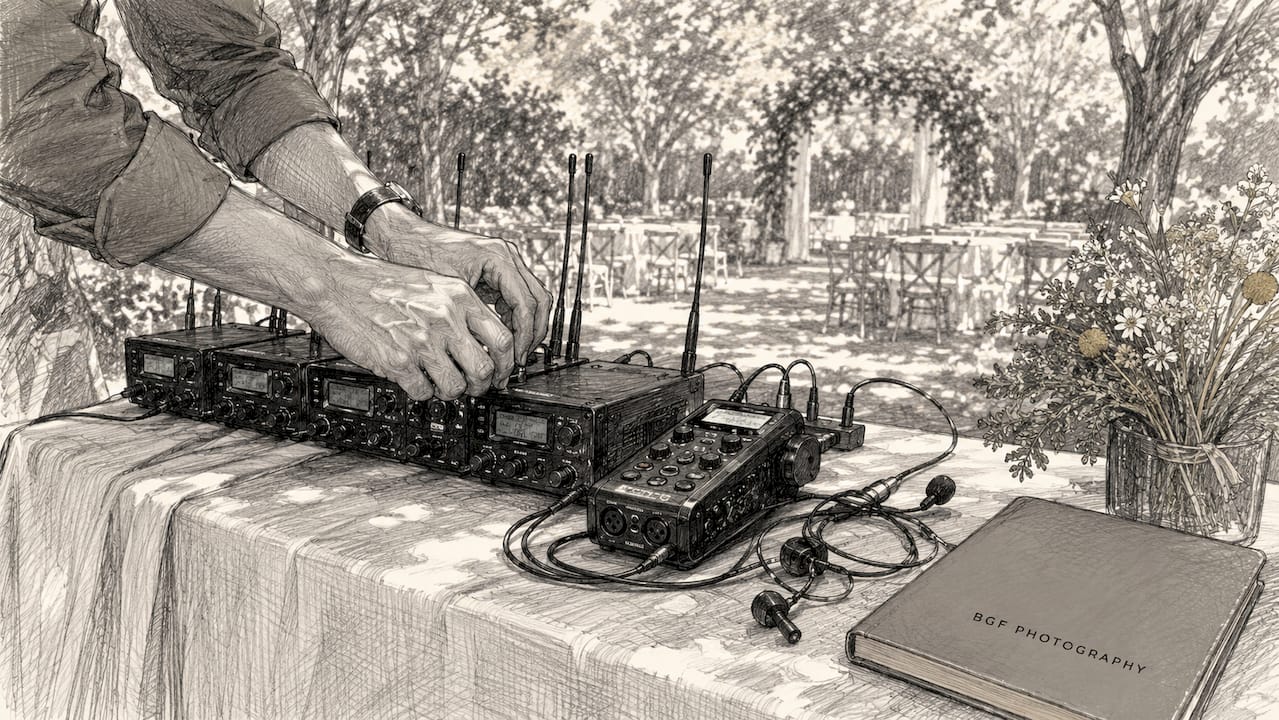
The standard approach in professional wedding videography uses multiple lavalier microphones placed on the groom and the officiant. A lavalier, or lav mic, is a small clip-on microphone that picks up voice audio from close range. Multiple simultaneous audio sources including lavaliers, a direct soundboard feed, and camera audio provide crucial backup so every word is captured reliably.
Here is what a complete audio setup looks like in practice:
- Lavalier on the groom: Placed under the jacket lapel to shield from wind while maintaining clarity
- Lavalier on the officiant: Captures the ceremony script and any call-and-response vow prompts
- Lavalier on the bride: Placed discreetly inside the dress near the neckline when the bride is also speaking vows
- Direct soundboard feed: A clean audio signal pulled directly from the venue's PA system, bypassing room acoustics
- Camera-mounted audio: A backup layer that captures ambient sound and serves as a reference track
- Additional recorder for readers or speakers: Placed near anyone else delivering words during the ceremony
One technical detail that separates professional from amateur setups is 32-bit float recording. This recording format captures an extremely wide dynamic range, which means it handles both a whispered "I do" and a booming officiant voice without distortion. You do not need to understand the technology, but you should ask your videographer whether they use it.
Pro Tip: Ask your videographer how many separate audio recorders they bring to a wedding. A professional answer is at least three. Anything less puts your vow audio at risk.
2. How can you prepare your vows and delivery to improve video capture?
Vow preparation directly affects audio quality and emotional impact on camera. Couples who rehearse their delivery produce cleaner audio, more natural pacing, and stronger emotional moments in the final film. The technical side of recording can only do so much if the delivery itself is rushed, whispered, or stumbling.
Experts recommend keeping personal vows around 2 minutes, which equals roughly 250–300 words at a natural speaking pace. That length keeps guests engaged and gives your editor a manageable, focused audio segment to work with. Vows that run longer than four minutes often lose emotional momentum in the final cut.
Follow these steps to prepare your delivery for the camera:
- Write your vows at 250–300 words. Time yourself reading aloud. Adjust until you hit the 2-minute mark naturally.
- Practice aloud at least three times. Practicing vows aloud helps you identify awkward phrasing and improves vocal clarity on camera.
- Keep your chin level. Looking down at a paper drops your voice away from the microphone and creates a muffled recording.
- Never whisper. Whispering degrades audio quality even with a lav mic attached. Speak at your normal conversational volume.
- Mark your pauses. A deliberate pause after a meaningful line gives your editor a natural cut point and adds cinematic weight to the moment.
- Read to your partner, not the paper. Memorize the first and last lines so you can make eye contact at the most emotional moments.
Pro Tip: Record yourself on your phone during a rehearsal and play it back. If you struggle to hear your own words clearly, your videographer's microphone will too.
3. What filming techniques and positioning optimize vow capture?
Camera positioning during vows requires planning, not improvisation. A single camera placed at the wrong angle misses facial expressions, reaction shots, and the visual storytelling that makes vow footage emotionally powerful. The best wedding oath filming techniques use multiple cameras working together.
Here are the core positioning principles that professional videographers follow:
- Two-camera minimum: One camera captures a wide shot of both partners and the officiant. The second captures tight close-ups of faces and hands.
- Shoot from the side, not the back: A camera positioned at a 45-degree angle to the couple captures both partners' expressions without shooting over guests' heads.
- Maintain a clear sightline: The videographer should never block the photographer or obstruct guests. Coordination between photo and video teams prevents this.
- Capture reaction shots: A camera pointed toward the guests during vows captures tears, laughter, and emotional reactions that add texture to the final film.
- Use natural light when possible: Positioning the couple so window light or open sky falls on their faces avoids harsh shadows without needing artificial lighting.
| Camera position | What it captures | Why it matters |
|---|---|---|
| Wide shot, front-facing | Both partners and officiant | Establishes ceremony context |
| Close-up, 45-degree angle | Facial expressions and tears | Delivers emotional impact |
| Guest-facing angle | Audience reactions | Adds depth and storytelling |
| Overhead or elevated | Hands, rings, and gestures | Cinematic detail shots |
Lighting deserves its own attention. Backlit ceremonies, common in outdoor venues with the sun behind the couple, create silhouettes that hide expressions. A skilled videographer positions themselves to use the available light rather than fight it. If your ceremony is indoors, ask your venue coordinator whether the overhead lighting can be dimmed slightly to create a warmer, more cinematic look.
4. How to manage common challenges when recording wedding vows on video
Outdoor ceremonies and large venues create audio problems that no amount of post-production can fully fix. The best approach is prevention. Wind causes low-frequency distortion that is extremely difficult to remove in editing, which makes windscreen protection on lav mics a non-negotiable for any outdoor ceremony.
Common challenges and their solutions:
- Wind noise outdoors: Use foam or furry windscreens on all lav mics. Position the ceremony so the couple faces away from the prevailing wind direction.
- Venue echo and reverb: Large stone churches and open halls create echo. A direct soundboard feed bypasses room acoustics entirely and delivers a clean signal.
- Clothing rustle: Lav mics placed against fabric pick up movement noise. Proactive sound-checking and coordination with venue staff before the ceremony catches this problem early.
- Officiant mic type mismatch: Some officiants use handheld mics, others use headsets. Coordinating with the officiant about their mic type before the ceremony allows the videographer to place backup mics correctly.
- Sudden volume changes: A nervous speaker may start quietly and then get louder. Multiple recording devices at different input levels capture both extremes without clipping.
- Interrupted vows: If a line is disrupted by a passing airplane, a crying child, or a dropped item, quiet retakes can be recorded after the ceremony to fill gaps in the final edit.
Pro Tip: Ask your videographer to do a full sound check at least 30 minutes before guests arrive. Walk through the ceremony space with all mics active and listen back. Problems caught early are problems solved.
5. Why a wedding vow filming checklist prevents costly mistakes
A vow filming checklist is the difference between a flawless recording and a film with a 10-second gap where the most important words should be. Professionals use checklists because weddings move fast and memory alone is not reliable under pressure.
Your videographer should confirm the following before the ceremony starts:
- All lav mics are charged, tested, and transmitting cleanly
- Backup recorders are rolling and labeled
- The soundboard feed is connected and levels are set
- Camera batteries are fully charged and memory cards have sufficient space
- Camera positions are confirmed and sightlines are clear
- The officiant's mic type is known and backup placement is adjusted accordingly
- Wind protection is in place for all outdoor mics
- A contingency plan exists for interrupted or inaudible lines
Couples can support this process by sharing their vow text with the videographer in advance. Knowing the approximate length and structure of the vows helps the videographer anticipate pauses, emotional peaks, and the moment each partner finishes speaking. That preparation translates directly into better editing decisions later.
6. How does cinematic editing enhance the emotional impact of vow videos?
Capturing great raw footage is only half the work. The editing process shapes how your vows feel when you watch them back years from now. Cinematic editing that weaves full vows with emotional reactions strengthens the storytelling and lasting impact of wedding films.
The most effective vow edits use a technique called multicamera source sequencing. This means the editor builds a timeline using all available camera angles and audio tracks simultaneously, then selects the best combination of image and sound for each moment. The result is a film that feels like it was shot by a full broadcast crew, even if only two cameras were present.
One insight that surprises many couples: highlight films are not full records. A two-minute highlight reel captures the feeling of your vows but not the words. Preserving the complete vow exchange requires a dedicated long-form edit, which is a separate deliverable from the highlight film. Ask your videographer whether their package includes both.
Vows video editing suggestions that improve the final product include cutting to guest reaction shots during emotional lines, using music that swells under the final vow exchange, and ending the vow segment on a close-up of the couple's hands or faces rather than a wide shot. These are small decisions with large emotional payoffs.
7. What questions should you ask your videographer about vow capture?
Choosing a videographer without asking specific questions about vow capture is a common mistake. Most couples focus on style and price, but the technical questions reveal whether a videographer can actually deliver what you need.
Ask these questions directly:
- How many audio recorders do you bring to a ceremony?
- Do you use lavalier microphones on both partners and the officiant?
- Can you connect to the venue's soundboard for a direct feed?
- Do you use 32-bit float recording devices?
- What is your contingency plan if a vow line is disrupted?
- Does your package include a full-length vow edit or only a highlight film?
- How do you handle outdoor ceremonies with wind?
A videographer who answers these questions confidently and specifically has thought through the technical side of vow capture. A videographer who gives vague answers may be relying on a single camera and hoping for the best. The questions to ask your wedding videographer go beyond style preferences and get into the technical details that determine whether your vow audio is usable.
Understanding cinematic wedding videography as a concept also helps you evaluate what you are being offered. Cinematic does not just mean beautiful images. It means deliberate storytelling, professional audio, and an editing approach that treats your wedding film as a narrative rather than a recording.
Key takeaways
The most effective approach to capturing wedding vows on video is professional multi-source audio combined with deliberate vow preparation and cinematic editing.
| Point | Details |
|---|---|
| Multi-source audio is non-negotiable | Use at least three simultaneous recorders including lavaliers, soundboard feed, and camera audio. |
| Vow length affects film quality | Keep personal vows at 250–300 words to maintain engagement and give editors a clean segment. |
| Rehearsal improves audio clarity | Practice aloud at least three times to fix pacing, chin position, and whispering habits. |
| Outdoor ceremonies need wind protection | Windscreens on all lav mics and a sheltered ceremony position prevent distortion that cannot be fixed in editing. |
| Highlight films do not replace full edits | Ask your videographer for a dedicated long-form vow edit as a separate deliverable from the highlight reel. |
Why audio is the detail most couples overlook until it's too late
I have filmed enough wedding ceremonies to know that couples spend months choosing flowers and minutes thinking about microphones. That imbalance shows up in the final film. The most heartbreaking feedback I hear is from couples who watched their wedding video and could not make out what they said to each other.
The uncomfortable truth about vow capture is that beautiful footage with bad audio feels worse than average footage with great audio. Your brain processes voice and emotion together. When the words are clear, the image does not need to be perfect. When the words are gone, no amount of slow-motion close-ups can bring back what was said.
The detail most couples miss is the officiant's microphone. Everyone thinks about the groom's lav mic. Almost no one asks what kind of mic the officiant is using until the day of the ceremony. I have arrived at ceremonies where the officiant had a handheld mic they were planning to share with the couple, which creates a logistical nightmare for audio capture. A five-minute conversation before the wedding day solves this completely.
Cinematic editing can do a lot, but it cannot manufacture emotion that was not captured. What it can do is take well-recorded, well-delivered vows and turn them into something that makes your family cry every time they watch it. That is the goal. And it starts with a microphone placed correctly on a Tuesday afternoon rehearsal, not on the wedding day itself.
— Billy
How BGF Photography captures your vows with professional audio and cinematic storytelling
BGF Photography brings a multi-source audio setup and a cinematic editing approach to every wedding ceremony in the Buffalo and Rochester, NY areas. The team uses redundant recording across multiple devices, coordinates with officiants and venue staff before the ceremony, and delivers both highlight films and full-length vow edits so nothing is lost.
Couples who book BGF Photography for hybrid photo and video coverage get one cohesive style across both deliverables, which means your vow footage and your photographs tell the same story. If you want to see what professional vow capture looks like in practice, the wedding packages and pricing page outlines every option available. BGF Photography also offers a consultative approach, so you can discuss your specific ceremony setup and vow length before the wedding day.
FAQ
How many microphones are needed to capture wedding vows clearly?
A professional setup uses at least three simultaneous audio sources: a lavalier on the groom, a lavalier on the officiant, and a direct feed from the venue's soundboard. Additional mics on the bride or other speakers add further redundancy.
How long should wedding vows be for the best video?
Keep personal vows at 250–300 words, which equals roughly 2 minutes of speaking time. That length maintains guest engagement and gives your video editor a clean, focused segment to work with.
Can wind ruin outdoor wedding vow audio?
Yes. Wind causes low-frequency distortion that is very difficult to remove in post-production. Windscreens on all lavalier mics and a sheltered ceremony position are the two most effective preventive measures.
What is the difference between a highlight film and a full vow edit?
A highlight film is a short, stylized summary of your wedding day, typically 2–5 minutes long. A full vow edit preserves the complete vow exchange with all words intact. Ask your videographer whether their package includes both deliverables.
How can couples help their videographer capture better vow audio?
Share your written vows with your videographer before the wedding day, practice your delivery aloud at least three times, keep your chin level while speaking, and avoid whispering. These steps directly improve the audio quality of your final film.