

TL;DR:
- Drone wedding photography adds visual scale and cinematic context when the venue is expansive outdoor scenery. It requires venue permission, FAA certification, insurance, weather contingencies, and proper coordination with the photographer. Drones are unsuitable indoors, city spaces, parks with restrictions, or near airports, so planning timing and location carefully is crucial.
Aerial coverage is worth it when your venue is the story. If you’re getting married at a vineyard, beachfront estate, lakeside property, or any expansive outdoor setting, drone wedding photography adds a layer of scale and cinematic context that no ground camera can replicate. If your reception is indoors, your venue sits in controlled urban airspace, or the landscape is unremarkable, skip it. Before you book any drone operator, confirm these five things:
-
Venue permission in writing
-
FAA Part 107 Remote Pilot Certificate from the operator
-
Proof of liability insurance (certificate of insurance, or COI)
-
Weather contingency policy in the contract
-
Coordination plan with your primary photographer
Pro Tip: Hire a photographer or videographer who already offers integrated drone coverage. You get one creative vision, one point of contact, and far smoother day-of logistics than coordinating a separate pilot.
Table of Contents
-
U.S. legal and safety requirements to confirm before booking
-
How to hire a drone operator: questions, contracts, and red flags
Why drone wedding photography changes what’s possible
The most obvious benefit is scale. A single sweeping aerial shot can show your venue, the surrounding landscape, and your guests in a way that takes thirty seconds of footage to establish what would otherwise take a paragraph to describe. For couples whose setting is central to their story — a Finger Lakes vineyard, a coastal estate, a mountain-view property — that context matters.
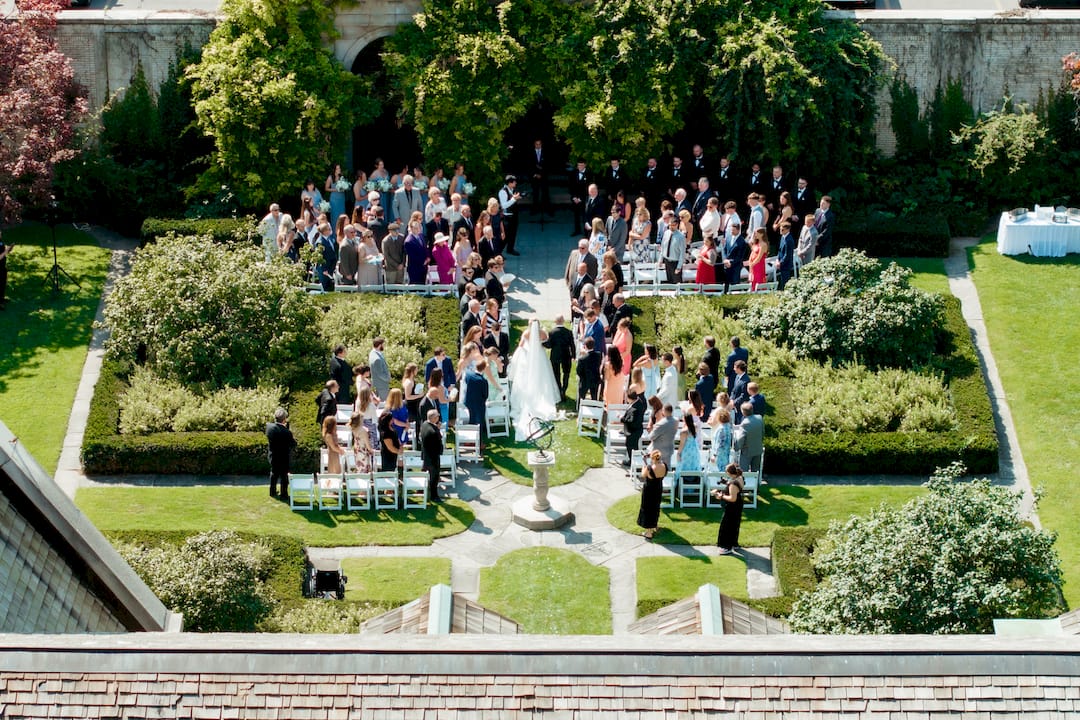
Beyond establishing shots, aerial coverage adds cinematic movement to wedding films. A slow pull-back from the couple during portraits, a wide orbit at golden hour, a top-down guest formation during cocktail hour: these are shots that appear in the films couples watch over and over. Drone footage adds scale and context that works best when the setting is visually important to the couple’s story.
Aerials complement ground photography rather than replace it. Ground cameras capture the intimate moments: a tear during vows, a laugh between bridesmaids, the first look. Drones capture context and grandeur. The two work together, and that’s exactly why the best results come from a team where both are coordinated under one creative direction.
When your venue is a good fit — and when it is not
Drones perform best at expansive outdoor venues where the landscape is part of the visual story: vineyards, beaches, large private estates, open fields, and waterfront properties. They are largely unsuitable for:
-
Indoor receptions (GPS signal loss, prop wash, and guest injury risk make standard multirotors dangerous inside)
-
City-center hotels or rooftop venues in Class B or C controlled airspace
-
National parks and many state parks, which have explicit drone bans
-
Historic estates with blanket no-fly policies
-
Venues near airports or heliports requiring airspace authorization
Before assuming a drone is possible, verify these constraints:
-
Venue policy: Ask the coordinator directly, in writing, whether drones are permitted on the property
-
Airspace class: Use the FAA’s B4UFLY app or LAANC system to check controlled airspace around the venue
-
National/state park rules: These are often categorical bans regardless of certification
-
Nearby airports or heliports: Even outside controlled airspace, proximity matters
Pro Tip: Ask your operator to include the specific venue address in their pre-flight risk assessment and to confirm permissions before you sign their contract, not after.
U.S. legal and safety requirements to confirm before booking
The FAA requires a Part 107 Remote Pilot Certificate for any commercial drone operation in the United States. That includes wedding photography. There are no exceptions for “small” jobs or “just a few shots.” Any operator who cannot produce a Part 107 certificate is flying illegally for hire, and you are exposed to liability if something goes wrong.
Here’s what to request and confirm before signing anything:
- Airspace authorization: — If the venue is in controlled airspace, the operator must obtain authorization through LAANC or FAA DroneZone before the flight
On weather: pilots typically apply a hard no-fly rule for rain and wind above roughly 20–25 mph, with batteries providing about 20–25 minutes of flight time per charge. Build a weather contingency clause into the contract so you know exactly what happens if conditions ground the drone on your wedding day.
How to hire a drone operator: questions, contracts, and red flags
Start with these interview questions before you commit:
-
Are you FAA Part 107 certified, and can I see your certificate?
-
Can you provide a COI and list the coverage limits?
-
Have you flown at this venue or a similar venue before?
-
How many weddings have you covered with drone footage?
-
How do you coordinate with the lead photographer on the day?
Your contract should specify:
-
Exact flight windows and number of flights
-
Deliverables: edited aerial stills, raw footage, edited video clips, and file formats
-
Image and video rights and usage
-
Cancellation policy and weather-triggered refund or rescheduling terms
-
Minimum liability insurance limits
-
Backup battery and pilot contingency plan
-
Coordination protocol with the primary photographer
Red flags to walk away from: an operator who hesitates to show certification or insurance, a portfolio made up entirely of hobby or landscape shots with no wedding work, or anyone who insists on flying during the ceremony without a pre-agreed, unobtrusive plan. Verify portfolio relevance to weddings specifically, not just general aerial photography.
What drone coverage typically costs in the U.S.

Pricing varies significantly by market, operator experience, and what’s included. Here’s a general picture:
| Tier | Typical Range | What’s Usually Included |
|---|---|---|
| Basic photo add-on | $200–$400 | A handful of edited aerial stills, short flight window |
| Standard video add-on | $400–$800 | Edited aerial clips integrated into a highlight film |
| Dedicated drone operator | $800+ | Full session, multiple flights, raw and edited deliverables |
| Destination/premium | $1200+ | Travel, extended coverage, cinematic post-production |
Prices shift based on travel distance, number of flights, post-production complexity, insurance or waiver work, and rush delivery. Standalone specialists often cost more than an integrated add-on from your primary photographer or videographer, and the creative result is usually less cohesive.
If you’re comparing quotes, ask each operator what post-production is included. Unedited raw footage delivered on a USB drive is not the same deliverable as a color-graded, music-synced aerial sequence cut into your film.
Where drone shots fit into your wedding-day timeline
Timing drone flights well is the difference between high-impact aerials and a logistical headache. Here’s a practical sequence:
-
Pre-ceremony arrival (1–2 hours before guests arrive): Venue-establishing shots, exterior sweeps, and landscape coverage with no crowd management needed
-
Couple portraits window: The most controlled moment for pull-back reveals and orbital shots; coordinate with the lead photographer so both are working the same location
-
Cocktail hour: Low ceremony risk, guests are contained, good light if timed near golden hour
-
Ceremony: Only with pre-approval, a clear unobtrusive flight path, and guest-notice in the program; many couples skip this entirely
Logistics to confirm in advance:
-
A clear launch and recovery zone away from guests and the ceremony space
-
Minimum 30-minute pilot arrival before the first scheduled flight for setup and airspace checks
-
Schedule buffer of at least one weather window (if morning flights are grounded, is there an afternoon option?)
-
Parking and space for gear near the launch zone
-
One named coordinator (venue contact or lead planner) as the pilot’s day-of point of contact
Battery life runs 20–25 minutes per charge, so a two-flight session covers roughly 40 minutes of air time. Plan accordingly.
A practical aerial shot list to share with your operator
Give your pilot a written shot list before the day. These are the highest-value requests:
-
Venue-establishing sweep: A slow wide arc showing the full property and surroundings, ideally before guests arrive
-
Couple pull-back reveal: Start tight on the couple, pull back and rise to reveal the landscape behind them
-
Guest overhead formation: Top-down shot of guests arranged in a heart, initials, or simply gathered together
-
Cinematic approach or exit: Low and fast along the driveway or path as the couple walks toward or away from camera
-
Orbital portrait at golden hour: A slow 360-degree orbit around the couple with the setting sun behind them
Match the shot to the venue type. A vineyard calls for row-pattern sweeps and harvest-field backdrops. A beachfront wedding works best with a low horizon shot showing the water behind the couple. A forest or park setting benefits from a canopy-rise shot that reveals the tree cover from above.
Limit drone flights to two or three focused windows. More than that and the drone becomes a distraction rather than a storytelling tool.
How BGF Photography handles drone wedding coverage
BGF Photography offers drone coverage as part of its hybrid photo and video packages, integrating aerial footage directly into the cinematic wedding film and still gallery rather than treating it as a separate deliverable. That means one creative direction, one pre-flight coordination process, and aerial shots that match the overall tone of the coverage rather than looking like they were spliced in from a different shoot.
Trust signals couples should ask about when booking any drone operator, including BGF Photography:
-
FAA Part 107 compliance for commercial operations
-
Liability insurance with a COI available for venue requirements
-
Portfolio galleries showing aerial footage integrated into full wedding films
-
Client references from couples whose venues required pre-flight coordination
-
Written safety plan and flight checklist shared before the wedding day
Pro Tip: When you inquire, share your venue name and address upfront. That lets BGF Photography confirm airspace status and venue permission requirements before your first call, saving time and setting realistic expectations early.
BGF Photography serves couples in Buffalo, Rochester, and the Finger Lakes region of New York. For couples whose venues are in those areas, reviewing the full package options is the fastest way to see how drone coverage fits into a hybrid booking.
Key Takeaways
Drone wedding photography is worth booking when your venue is visually compelling, your operator holds FAA Part 107 certification and liability insurance, and flights are timed to two or three focused windows during portraits and cocktail hour.
| Point | Details |
|---|---|
| Venue fit comes first | Drones work best at expansive outdoor venues; indoor and restricted-airspace venues are largely off-limits. |
| Certification is non-negotiable | Require an FAA Part 107 certificate and a COI before signing any drone contract. |
| Budget realistically | Integrated drone photo add-ons typically cost $200–$400, video add-ons $400–$800, and dedicated operators start around $800 with premium packages higher. |
| Time flights strategically | Couple portraits and cocktail hour give the best light and the least disruption to the day’s flow. |
| BGF Photography | Offers integrated drone coverage in Buffalo, Rochester, and the Finger Lakes as part of hybrid photo/video packages. |
The case for using drones selectively
Most couples I talk to have seen a drone shot in someone else’s wedding film and want that moment for themselves. That’s a reasonable instinct. But the couples who end up happiest with their aerial coverage are the ones who treated it as punctuation, not narration.
Two or three well-timed drone shots in a wedding film do something specific: they reset the viewer’s sense of scale before pulling back into the intimate ground-level moments. When a film opens with a wide aerial of a Finger Lakes vineyard and then cuts to a close-up of the couple’s hands during the ceremony, that contrast is what makes both shots land harder. Use the drone constantly and you lose that effect entirely.
The other thing worth saying plainly: the operator’s ground-level instincts matter more than their drone. A photographer who understands light, timing, and emotional storytelling will get better aerial shots than a technically skilled pilot who has never covered a wedding. The drone is a tool. The eye behind it is what you’re actually hiring.
For couples in Western New York, the Finger Lakes, or the Rochester area, understanding how aerial coverage fits into a full hybrid package is worth doing before you book anything separately.
BGF Photography’s drone and hybrid packages
BGF Photography covers weddings across Buffalo, Rochester, and the Finger Lakes with a hybrid approach that pairs candid photography and cinematic videography under one consistent style. Drone coverage is available as part of that package, not as an afterthought bolted on by a third-party pilot. You get aerial footage that was planned alongside your portrait session, color-graded to match your film, and delivered as part of a single cohesive gallery and video.
The difference from hiring a standalone drone operator is straightforward: no separate contracts, no day-of coordination between strangers, and no aerial footage that looks like it came from a different wedding. BGF Photography handles pre-flight venue coordination, airspace checks, and insurance documentation as part of the booking process.
To get started, visit the BGF Photography packages page and send an inquiry with your date, venue name, and a note about whether you’re interested in drone coverage. Availability fills quickly for peak-season dates in the Finger Lakes and Rochester areas, so earlier is better.
Useful resources for couples verifying drone rules
Before you finalize any drone booking, check these directly:
-
FAA Commercial Drone Operators (Part 107): Verify what Part 107 requires and confirm your operator’s certificate is current
-
FAA Part 107 Airspace Authorizations (LAANC/DroneZone): Check whether your venue’s airspace requires prior authorization and how it’s obtained
-
FAA Become a Drone Pilot: Understand what the certification process involves so you can ask better questions
-
Alex Gell’s drone FAQ for event shooting: A practitioner’s perspective on safety, workflow, and what to expect from a professional operator
When reviewing an operator’s documents, confirm the certificate name matches the pilot flying your event, check that the COI lists adequate limits for your venue’s requirements, and ask for a sample portfolio that includes full wedding galleries rather than highlight reels only. Document all venue permissions in writing, and keep a copy of the operator’s COI on file with your venue coordinator.
A single battery gives roughly 20–25 minutes of flight time, so a two-flight session is the practical standard for most wedding-day timelines.
FAQ
How much does a drone photographer cost for a wedding?
Integrated drone photo add-ons usually cost between $200 and $400, video add-ons $400–$800, and dedicated operators with full post-production typically start at $800. Premium destination packages cost more.
Do wedding photographers use drones?
Many do, but only those with an FAA Part 107 Remote Pilot Certificate may legally fly drones for commercial work in the U.S. Always confirm certification before booking.
What is the best drone for wedding photography?
The operator’s choice of equipment matters less than their certification, wedding experience, and creative eye. Professional operators typically use DJI platforms known for stable footage and reliable performance in outdoor conditions.
Can drones fly indoors at a wedding reception?
Standard multirotors are not suitable for indoor use due to GPS drift, prop wash, and guest safety risks. Only specialized FPV operators attempt indoor flights, and it remains high-risk work outside standard wedding coverage.
When is the best time for drone shots during a wedding?
Couple portraits and cocktail hour offer the best combination of controlled conditions, good light, and minimal disruption. Pre-ceremony venue sweeps before guests arrive are also highly effective.