
Unobtrusive wedding photography captures your day as it happens, natural, candid moments with minimal posing, rather than staging every shot. It's the right call if you value authentic emotion over picture-perfect symmetry, and the main trade off is fewer formal portraits unless you plan a short window for them. The rest of this guide covers the techniques behind it, what actually happens on the day, and how to hire someone who does it well.
TL;DR:
- Documentary wedding photographers typically shoot more images than posed shooters, with extensive raw footage that is carefully edited into a cohesive story.
- Full-gallery reviews are necessary to verify consistent candid coverage across all wedding moments, unlike curated highlight reels that can be misleading.
- Short, defined portrait windows of 10 to 15 minutes during transitions like cocktail hour are recommended to keep the celebration flowing without sacrificing meaningful images.
- Guests' natural behavior greatly influences candid shots, so minimizing posing and avoiding camera awareness helps preserve the authentic feel of the photos.
- Couples should choose documentary style if they prioritize real, unposed memories over staged images and are comfortable with the unpredictability inherent in this approach.
Table of Contents
- What Is Unobtrusive Wedding Photography?
- How Unobtrusive Photographers Actually Work
- What Happens on Your Wedding Day, Start to Finish
- How to Choose the Right Unobtrusive Wedding Photographer
- How BGF Photography Approaches Documentary Coverage
- How Guests Can Help Keep Candid Photography Natural
- How Unobtrusive Style Shapes Editing Choices
- Common Misconceptions About Unobtrusive Wedding Photography
- When Documentary-Led Coverage Might Not Be the Right Fit
- Book BGF Photography for Candid, Documentary-Led Coverage
- Sources
- FAQ
What Is Unobtrusive Wedding Photography?
Unobtrusive wedding photography, also called documentary or candid wedding photography, means the photographer records your wedding as it unfolds instead of directing it. Nobody stops the toast so the best man can hit a mark. Nobody re-poses the flower girl three times. The photographer works from the edges of the room, reads what's happening, and captures it without interrupting it. This style is sometimes called wedding photojournalism, borrowing the term from news photography, because the goal is the same: document real events without altering them.
It helps to see how this differs from other common approaches:
- Posed/traditional photography directs subjects into specific arrangements and expressions, prioritizing composition over spontaneity.
- Cinematic/storytelling photography blends candid coverage with carefully composed, editorial-style portraits shot with intentional lighting and framing.
- Documentary/candid photography minimizes direction almost entirely, letting real interactions drive the images.
None of this means zero portraits. Most documentary shooters still build in a short, planned session for family formals and the couple, because some images (grandma with the whole family, the two of you alone) simply don't happen organically. The difference is how that session gets handled: quickly, lightly, and treated as a brief detour rather than the main event, as outlined in Zola's documentary photography guide.
How Unobtrusive Photographers Actually Work
A documentary photographer functions more like an observer than a director. They anticipate moments before they happen, a father's face as his daughter walks down the aisle, the exact second a best friend starts crying during vows, and position themselves to catch it without becoming part of the scene. That takes practice reading a room: watching body language, tracking where emotion is about to spike, and staying just outside the frame of everyone else's attention. As Ray & Kelly's guide to candid photography puts it, this approach fundamentally asks the couple to trust the photographer's instincts rather than their instructions.
Equipment choices reinforce the style. Longer lenses (often 70 to 200mm) let a photographer shoot from across the room instead of hovering three feet from your face. Fast prime lenses gather more light in dim reception halls without popping a flash every thirty seconds. Available-light shooting is the default; flash gets reserved for moments where there's genuinely no other option, since a camera flash going off during a first kiss tends to break the exact intimacy you hired someone to capture.
The workflow matters as much as the gear:
- Scouting the venue beforehand to identify good light and natural vantage points
- Building a loose timeline with the couple so key moments aren't missed
- Carving out a short, clearly defined portrait window
- Carrying backup bodies and cards in case anything fails mid-day
Pro Tip: Ask your photographer how many frames they typically shoot at a wedding versus how many make the final gallery. A wide gap usually signals someone who shoots constantly and edits ruthlessly, which is exactly the instinct behind good candid work, described in Ray & Kelly's breakdown of working quietly and quickly with a low footprint.
What Happens on Your Wedding Day, Start to Finish
Documentary coverage doesn't replace your timeline, it runs quietly alongside it. Getting ready, the ceremony, the reception entrance, the toasts, the first dance: candid coverage threads through all of it without asking anyone to pause for the camera.
The one place couples consistently get surprised is the formal portrait block. Here's how to think about it:
- Reserve a defined window. Documentary-style photographers commonly recommend 10 to 30 minutes for relaxed portraits, according to Cascadian Exposures, so guests and the couple aren't pulled away from the celebration for long.
- Aim for the tighter end when possible. A focused 10 to 15 minute family-formals session, run efficiently with a short shot list, keeps momentum without sacrificing the images families actually want.
- Protect the transition points. Cocktail hour, right after the ceremony, is usually the best slot, since guests are occupied and the light is often still good.
Give your photographer a short list of must-have groupings ahead of time. Handing over names in advance, rather than shouting them out mid-session, is what keeps a formals block from ballooning into forty-five minutes nobody budgeted for.
How to Choose the Right Unobtrusive Wedding Photographer
Highlight reels lie, or at least they oversimplify. A curated set of 40 stunning images tells you almost nothing about whether a photographer shoots documentary style consistently across an eight-hour day. Full-gallery review is the only reliable way to check this, since a highlights reel can mask a far more posed, directed approach running through the rest of the actual album, according to Nicola Gotts' comparison of documentary and posed styles.
When you're vetting candidates, ask to see:
- At least two or three complete wedding galleries, not just favorites
- Coverage from a range of lighting conditions: dim receptions, bright outdoor ceremonies, indoor church settings
- Consistency in candid moments from getting-ready through the last dance, not just the ceremony
Interview questions worth asking directly:
- How do you handle family formals, and how long does that portion typically run?
- What's your approach to low light without relying on flash?
- Do you carry backup equipment, and what's your insurance situation?
- Can you walk me through your actual timeline on a typical wedding day?
Watch for red flags: reluctance to share full galleries, vague or evasive answers about workflow, or a portfolio where every single frame looks composed rather than caught. One useful gut check comes from an insight on judging portfolio range: a photographer who only shows outdoor golden-hour shots hasn't proven they can handle a packed, dim reception hall. If film photography or a hybrid look matters to you, ask specifically for sample film frames or a full film gallery, since digital and film results can differ significantly in tone and grain.
How BGF Photography Approaches Documentary Coverage
BGF Photography builds every wedding around candid-first coverage, with optional film photography for couples who want a nostalgic, timeless texture running through their gallery. Hybrid packages pair photography and videography under one consistent style, so couples aren't stitching together two different visual languages after the fact.
Our documentary approach to family formals uses a 10 to 15 minute window designed to protect the reception's energy while still delivering the grouped portraits families expect. For smaller weddings, we've also refined a 90 minute coverage model that keeps candid documentation tight without losing key moments.
A few things that help before the day arrives:
- Send a 3 to 5 item must-have shot list (specific names, specific groupings) and let your photographer manage the logistics
- Tell family members in advance that formals will move quickly, so nobody wanders off mid-session
- Trust the process rather than directing shots in real time; micromanaging candid coverage tends to undercut it
How Guests Can Help Keep Candid Photography Natural
Guests shape candid photography more than most couples realize. A wedding full of people staring at the camera every time it comes near ruins the entire point of hiring someone to shoot unobtrusively.
The single biggest thing guests can do is ignore the photographer. That sounds obvious, but it's harder than it sounds when someone with a long lens walks past during dinner. Waving, posing, or calling out "get this shot!" pulls focus straight back to the camera and produces the exact stiff, self-aware images documentary coverage is designed to avoid.
A few specific habits make a real difference:
- Stay engaged in conversations and activities instead of glancing toward the camera
- Avoid holding up phones directly in front of the photographer's angle during key moments like the first look or the ceremony processional
- Let the photographer move around freely rather than blocking aisles or doorways they're clearly trying to shoot from
- Save personal photo requests (group shots with specific friends, for example) for cocktail hour rather than mid-ceremony
Couples can help too, by mentioning briefly in a program or at the rehearsal that photos are being taken candidly throughout the day. A quick heads-up goes a long way toward guests relaxing into the day instead of performing for a lens they know is somewhere in the room. The goal isn't to make guests self-conscious about being watched, it's the opposite: the less anyone thinks about the camera, the more natural every photo turns out.
How Unobtrusive Style Shapes Editing Choices
The editing philosophy behind documentary wedding photography follows directly from how the images were shot. Since the goal on the day is capturing real, unposed emotion, the goal in post-processing is preserving that authenticity rather than polishing it into something artificial.
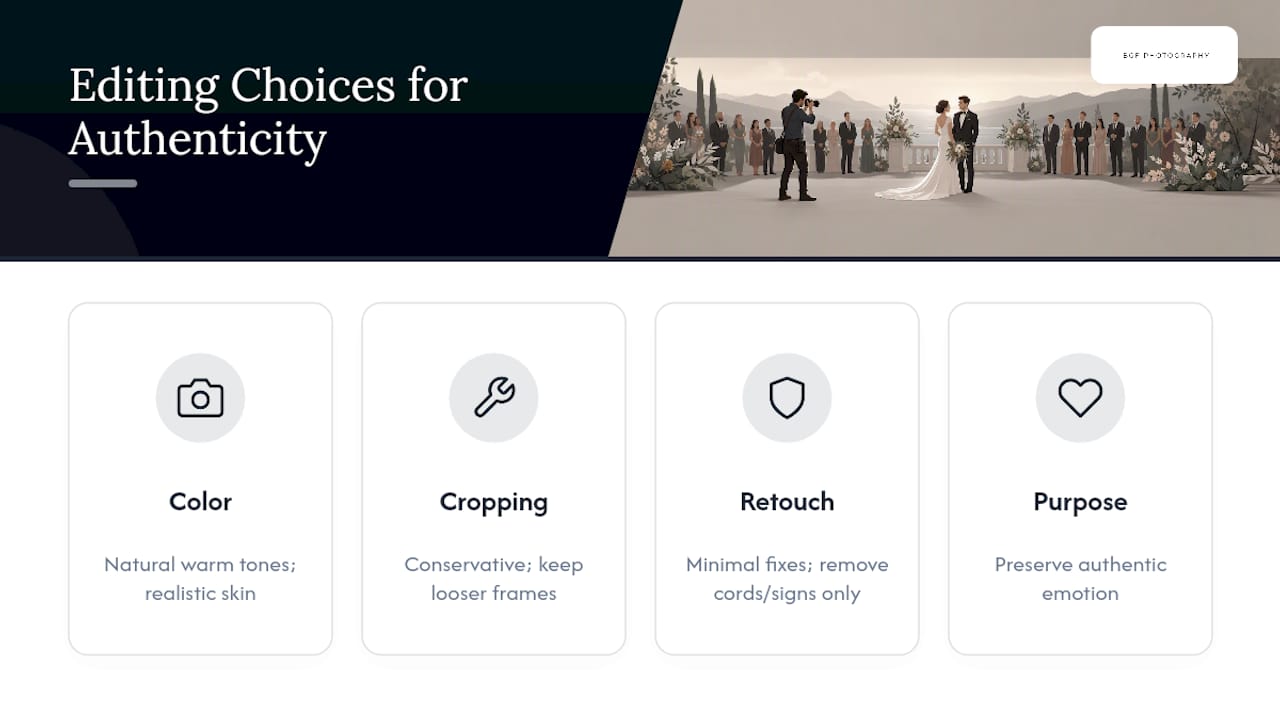
That shows up in a few concrete ways. Color grading tends to lean natural and warm rather than heavily stylized, keeping skin tones and lighting close to how the moment actually looked. Cropping stays conservative, since candid frames are often shot a little looser to allow for unpredictable movement, and aggressive cropping can start to feel like staging after the fact. Retouching is typically minimal, focused on removing genuine distractions (a stray cord, a exit sign in the background) rather than smoothing every wrinkle or blemish, because over-retouching a candid image creates a strange mismatch between a spontaneous moment and an artificially perfected face.
Photographers working in this style also tend to keep a wider variety of expressions and moments in the final gallery, including the in-between frames: someone mid-laugh, a slightly blurred dance move, a candid glance that isn't flattering in a traditional sense but is completely real. A heavily curated, only-the-best-angle edit runs against the whole premise of documentary work. If film photography is part of the package, editing usually respects the film's natural grain and color response rather than forcing it to match digital frames exactly, since part of the appeal is that nostalgic, slightly imperfect texture film naturally produces.
Common Misconceptions About Unobtrusive Wedding Photography
The biggest misconception is that documentary coverage means no formal photos at all. In practice, nearly every documentary-led photographer builds in a brief, structured session for family groupings and couple portraits. The difference from traditional photography isn't the presence of posed shots, it's how small a role they play and how efficiently they're handled.
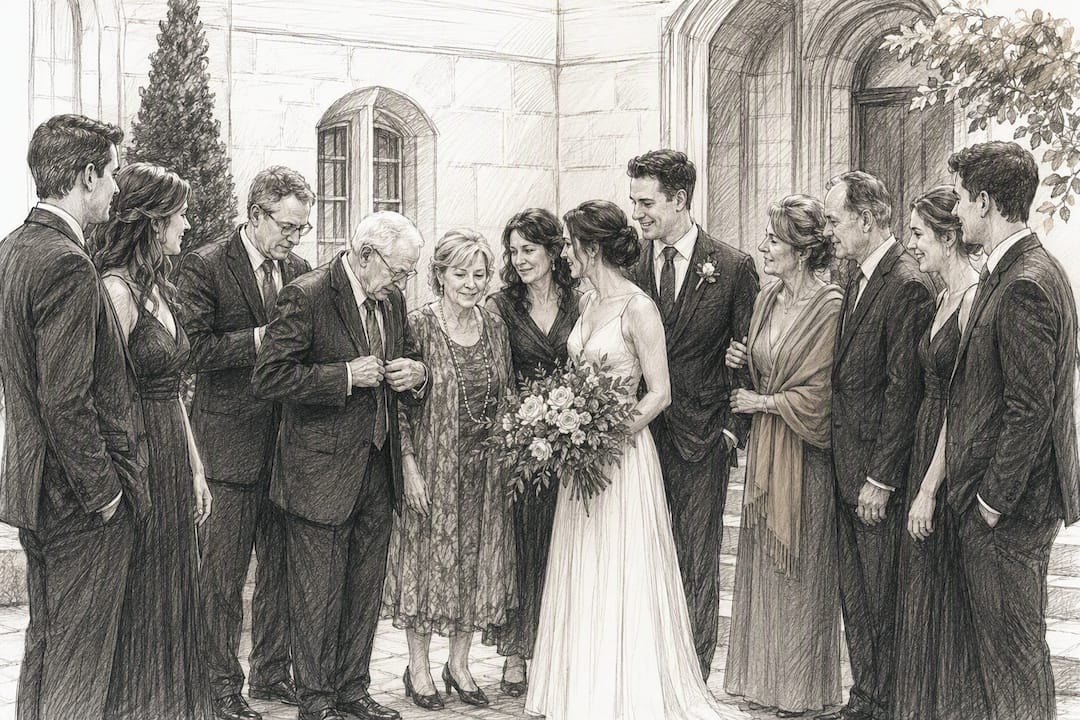
A second misconception: that "unobtrusive" means invisible in some literal sense. Photographers don't disappear. They're in the room, often moving around quite a bit to find better angles. What changes is that they don't direct the scene or ask people to perform for the camera. As one industry breakdown points out, photographer promises about being "unobtrusive" mean different things across different businesses, which is exactly why asking specific workflow questions during the hiring process matters more than trusting the word itself.
A third misconception assumes this style produces a lower volume of usable images because nothing is staged. The opposite tends to be true. Photographers shooting candidly often take far more frames than posed shooters, since they're capturing continuous action rather than single composed setups, and editing that volume down to a strong final gallery is part of the skill.
Finally, some couples assume documentary style only works for large, high-energy weddings. It works just as well, arguably better, for small and intimate ceremonies, where there's less crowd noise competing for the photographer's attention and more room to catch quiet, personal moments between a handful of people who know each other well.
When Documentary-Led Coverage Might Not Be the Right Fit
Documentary coverage isn't the right fit for every couple, and that's worth saying plainly. If you have a very specific, editorial vision in mind, matching pages you've saved from a magazine or a particular influencer's aesthetic, a more directed, cinematic approach will get you closer to that exact look. Documentary work depends on real moments happening organically, which means results vary based on what your day actually delivers, not on a shot list executed to spec.
Couples who want extensive, styled portrait sessions (multiple outfit changes, elaborate posed sequences, a dedicated hour or more for photos) should look at photographers who specialize in that kind of directed portraiture rather than documentary coverage. And if you're someone who feels anxious being photographed unless you know exactly when the camera is on you, the unpredictability of candid shooting might create more stress than comfort.
The simplest rule of thumb: choose documentary-led coverage if you'd rather remember your wedding through what actually happened than through a series of perfectly arranged images. Choose a more directed style if control over the final look matters more to you than spontaneity. Either way, confirm your family and portrait needs in writing before you sign a contract, since that's the detail most likely to cause friction later if expectations aren't aligned upfront.
— Billy
Book BGF Photography for Candid, Documentary-Led Coverage
BGF Photography specializes in exactly the approach this guide describes: candid-first photography and videography that captures real emotion as it happens, with optional film photography for couples who want that nostalgic texture in their gallery. Serving couples throughout Buffalo, Rochester, and the Finger Lakes, we build tailored coverage around your actual day, not a generic template.
Booking means transparency from the start. You can review complete wedding sets, not just highlight reels, to understand what consistent documentary coverage looks like across an entire day. Hybrid packages pair photography and videography under one cohesive style, which means you're not managing two separate vendors with two different visual languages. Family formals get handled in a focused 10 to 15 minute window, so your guests stay in the celebration instead of standing around waiting.
If this style sounds like what you want for your wedding, check available dates and review packages on the investment and pricing page to see what fits your day.
Sources
- Documentary photography guide — Zola
- What to Expect With a Candid Wedding Photographer — Ray & Kelly
- Documentary vs posed wedding photography — Nicola Gotts
- Documentary style wedding photography — Cascadian Exposures
FAQ
Is $4,000 a Lot for a Wedding Photographer?
It depends heavily on your region and the coverage included, but costs vary widely for full-day documentary coverage in many US markets. Ask exactly what's included (hours, galleries, video, film add-ons) before comparing quotes.
What Is the 30-5 Rule for Weddings?
There's no single standardized "30-5 rule" in wedding photography; the concept most couples are referring to is reserving a short 10 to 30 minute window for formal portraits so the celebration isn't interrupted for long. Some photographers tighten that further to a 10 to 15 minute family-formals session for maximum efficiency.
What Is the 20-60-20 Rule in Photography?
Definitions of this rule vary across sources and it isn't a universally standardized industry term, so treat any specific breakdown with caution. Rather than relying on a rigid formula, focus on asking your photographer directly how they balance candid coverage against planned portrait time.
What Is the Best Wedding Photography Style?
There's no single best style, only the best style for how you want to remember your day. Couples who value authentic emotion and presence over posed perfection tend to prefer unobtrusive, documentary-led coverage, while couples with a specific editorial vision often prefer a more directed, cinematic approach.
Does BGF Photography Offer Film Photography?
Yes, BGF Photography offers optional film photography alongside digital coverage, giving couples a nostalgic, timeless quality in select images or full galleries depending on the package.