
Under U.S. copyright law, the photographer owns the copyright to your wedding photos the moment the shutter clicks. What couples actually receive is almost always a personal-use license, not the copyright itself. This license usually covers printing and personal social sharing, but not resale or commercial use. If you want more, you need it in writing, because verbal promises from a photographer carry no legal weight once the contract is signed.
TL;DR:
- Couples typically receive only a personal-use license for wedding photos, which allows printing and social sharing but does not grant copyright ownership.
- The photographer automatically owns the copyright from the moment the photo is created, unless a specific written work-for-hire agreement or full copyright assignment is in place.
- To expand usage rights, couples should negotiate and obtain written agreements for licenses, assignments, or limited exclusive rights, often involving additional fees.
- Registering images with the Copyright Office within three months of publication is necessary for claiming statutory damages if legal action becomes necessary.
- Social media posting grants platforms a broad license to display and distribute your images but does not transfer the underlying copyright ownership.
Table of Contents
- Wedding Photo Rights Under U.S. Copyright Law
- What Rights Do Couples Actually Get?
- Getting Broader Rights: Assignments and Exclusive Licenses
- Why Photo Registration With the Copyright Office Matters
- Your Contract Checklist: 10 Questions Before You Sign
- A Practical Take on Negotiating Photo Rights
- Wedding Photos and International Copyright Rules
- Fair Use and Wedding Photos: What It Actually Covers
- How Social Media Sharing Affects Your Photo Rights
- Why Most Advice on This Topic Misses the Point
- Sources
- FAQ
Wedding Photo Rights Under U.S. Copyright Law
The rule is simple, even when couples find it surprising: whoever presses the shutter owns the copyright. Title 17 of the U.S. Code states that copyright vests in the author of a work the instant it's created, and in a wedding context, the author is the photographer, not the couple who hired them.
There's one exception that almost never applies here. A "work made for hire" shifts ownership to the hiring party, but only under narrow conditions, mainly when a photographer is a salaried employee acting within their job, or when both sides sign a specific written work-for-hire agreement before the wedding. Freelance wedding photographers, which describes nearly everyone in this business, don't fall into that category by default.
Owning a print is not the same as owning the copyright. You can hang a framed photo on your wall without owning a single exclusive right to reproduce or distribute it. And because copyright transfers must be in writing to be legally valid, nothing your photographer says out loud, no matter how generous it sounds, changes who holds the rights.
- Copyright vests automatically in the photographer at the moment of creation.
- Work-made-for-hire status requires a specific written agreement and rarely applies to independent photographers.
- A physical or digital photo file is separate from the copyright that governs its use.
- Any transfer of copyright ownership must be documented in writing to hold up legally.
What Rights Do Couples Actually Get?
Most couples never touch the copyright at all. What they get instead is a personal-use license, sometimes called a print release, that grants permission to use the images for private purposes without transferring any ownership. This is the standard arrangement across the wedding industry, and understanding the difference matters more than the paperwork suggests.
- Print release: Permission to print photos at a lab or online service and share digital files for personal use, without granting copyright.
- Personal-use license: The broader category covering everyday activities like posting to your own social media, emailing photos to family, or building a photo book.
- Copyright assignment: A full legal transfer of ownership rights, which is rare and typically requires a separate written agreement and often an additional fee.
Under a typical license, you can print photos for your home, share them on your personal Instagram or Facebook, and give copies to relatives, making them perfect for creative keepsakes like those in our wedding cross stitch ideas guide. What you usually cannot do is sell prints, license images to a magazine or brand, or edit and redistribute the photographer's work as your own. Many photographers also reserve the right to use select images in their own portfolio, website, or marketing, sometimes asking for a photo credit if you repost professional images elsewhere. None of this is arbitrary. It reflects standard industry practice, where retaining copyright while granting generous personal-use rights covers nearly every real need a couple has.
Getting Broader Rights: Assignments and Exclusive Licenses
If a personal-use license doesn't cover what you need, maybe you're launching a business using your engagement photos, or a wedding vendor wants to license an image, you have two real options: a copyright assignment or an exclusive license. An assignment transfers ownership outright and, per Title 17, must be signed and in writing to count. An exclusive license lets you use the images in specific, defined ways without touching ownership, and it's usually far cheaper to negotiate than a full transfer.
- Ask for a limited assignment tied to a specific use case (commercial licensing, a specific product line) rather than a blanket transfer.
- Expect an added fee. Photographers rarely give up rights for free, since it affects their own portfolio and future income.
- Request a portfolio carve-out that lets the photographer keep marketing rights while you get expanded personal or commercial use.
- Get any post-signing agreement in a written amendment. A text message or a verbal "sure, go ahead" won't protect you later.
Pro Tip: If you only need to sell a handful of prints for a family reunion or a small side project, ask for a narrow written amendment covering that single use instead of a full copyright assignment. It's faster to negotiate and far less expensive.
Why Photo Registration With the Copyright Office Matters
Registration isn't required to own copyright, that happens automatically. But it's required before a photographer, or a couple holding an assignment, can file an infringement suit in the U.S., and it determines whether statutory damages and attorney's fees are even on the table.
Timing changes everything here. Photographers who register their images within three months of publication, or before an infringement occurs, can pursue statutory damages and attorney's fees without proving actual financial loss, which is often difficult and expensive to calculate. Register late, and you're limited to actual damages, meaning you'd have to prove specific dollar losses in court.
- Registration is optional for ownership but mandatory for filing a U.S. infringement lawsuit.
- Group registration options let photographers register batches of published or unpublished images together, cutting down on paperwork for a single wedding shoot.
- Prompt registration preserves access to statutory damages, which can be far more valuable than trying to prove actual harm.
This is also why many professional photographers register wedding galleries as a routine business practice, not just a legal formality.
Your Contract Checklist: 10 Questions Before You Sign
A photography contract is where all of this becomes real. Vague language now means confusing arguments later, so read the usage section as carefully as the pricing.
- Who owns the copyright? Confirm it's the photographer unless you've negotiated otherwise in writing.
- What exactly does my license cover? Printing, social sharing, and gifting to family should be spelled out explicitly.
- Can I edit the photos myself? Many photographers prohibit re-editing or filtering their work.
- Can the photographer use my photos for marketing? Check for a portfolio or promotional-use clause.
- Do I get raw, unedited files? This is often a separate add-on rather than a standard inclusion.
- How long will my photos be stored? Ask about the photographer's retention policy in case you need a re-download later.
- Is there a fee for expanded rights? Get any additional cost for commercial use or assignment in writing.
- Can I license images to a vendor or publication? This usually requires a separate agreement.
- What happens if I'm unhappy with the final images? Look for language on revisions, refunds, or dispute resolution.
- How are amendments handled? Confirm that any later changes require a signed written update, not a text message.
Pro Tip: If a contract feels one-sided on usage rights, don't just walk away, ask for a redline. Most photographers will negotiate specific clauses, especially around portfolio use and print releases, before they'll walk away from a booking.
A Practical Take on Negotiating Photo Rights
Sample language helps more than legal jargon. For a personal-use license, something like "Client is granted a non-exclusive, personal-use license to print, share, and display the delivered images for non-commercial purposes" covers most needs. If you want expanded rights, try: "Photographer agrees to assign copyright ownership of [specific images] to Client for the limited purpose of [specific use], in exchange for [fee], documented in a signed written amendment."
Photographers keep copyright for real business reasons: it protects their portfolio, their pricing power, and their ability to control how their work represents their brand. The most common, and most reasonable, compromise is a broad personal-use license paired with a narrow portfolio carve-out for the photographer. That structure covers nearly everything a couple actually wants to do with their images.
- For more on what "unedited" really means in a delivery package, see this breakdown of raw wedding photo files.
- If storage and retention questions are on your mind, this guide on how long photographers keep wedding photos is worth a read before you sign anything.
Wedding Photos and International Copyright Rules
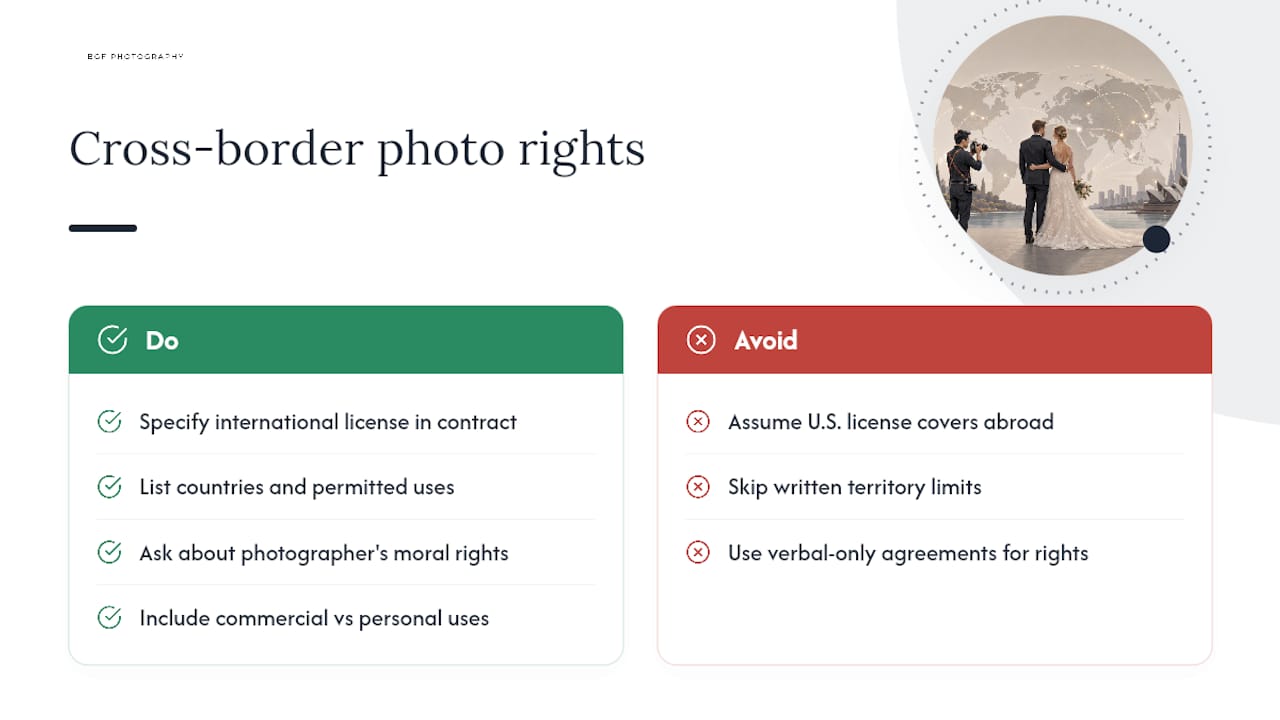
Copyright protection generally follows the country where a work was created and the treaties that country belongs to, not simply where the couple lives. The United States and most countries are members of the Berne Convention, which means copyright protection in one member country is typically recognized in others without requiring separate registration everywhere.
This matters most for destination weddings. If you marry in Italy, France, or Mexico with a photographer based there, the ownership default is usually still "the photographer owns it," but the specific rules on moral rights, contract enforceability, and permitted uses can vary by country. Some countries, particularly in the European Union, also recognize stronger "moral rights" for photographers, meaning they retain certain rights over how an image is used or credited even after a transfer of economic rights. The U.S. doesn't apply moral rights nearly as broadly.
If you're hiring a U.S.-based photographer for weddings in Buffalo, Rochester, or Finger Lakes but plan to use the images abroad, for a foreign wedding website, a destination magazine feature, or international print sales, it's worth clarifying in writing that your license extends internationally. Some contracts limit usage rights to U.S. territory by default, and a couple planning a bilingual wedding website or a feature in an overseas publication should ask about that scope explicitly before the big day, not after.
The safest approach is to treat any cross-border use, commercial or personal, as a specific line item in your contract negotiation rather than assuming your U.S. license automatically travels with you.
Fair Use and Wedding Photos: What It Actually Covers
Fair use is one of the most misunderstood ideas in copyright law, and it's narrower than most people assume. It allows limited use of copyrighted material without permission for purposes like commentary, criticism, news reporting, or education, evaluated case by case using factors like purpose, amount used, and market effect.
In practice, fair use rarely helps a couple who wants to use their wedding photos beyond their license. Posting your own wedding photos on your personal social media isn't a fair use question at all, that's simply covered by your personal-use license. Fair use becomes relevant in narrower situations: a local news outlet running one of your photos alongside a story about your wedding venue, a blogger writing critical commentary about a photographer's style using a small excerpt, or an educational course discussing composition techniques.
Fair use is not a workaround for skipping a license. If a wedding vendor wants to feature your photos on their commercial website to sell services, that's not commentary or criticism, it's commercial use, and it requires the photographer's permission regardless of who's in the photo. Similarly, if you want to sell prints of your own wedding photos as a side business, fair use won't protect that either, because it's a direct commercial use of someone else's copyrighted work.
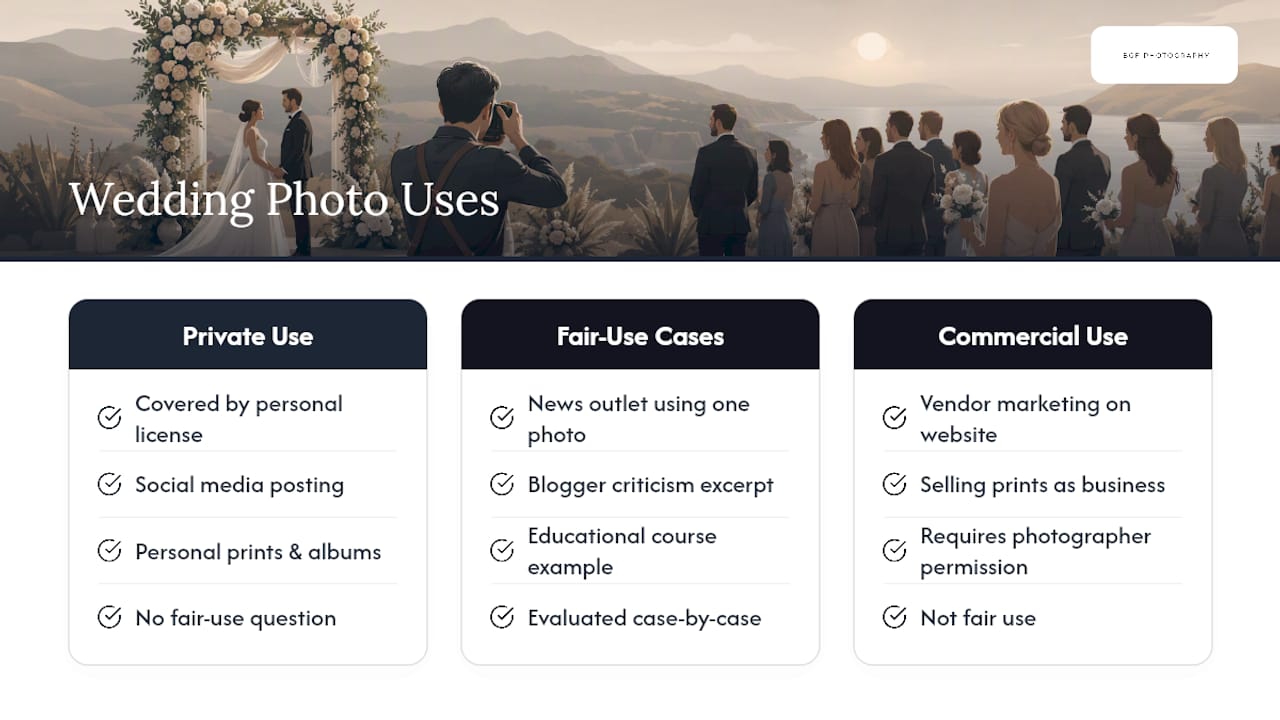
The practical rule for couples: if you're using your own photos for your own private life, you're operating under your license, not fair use. If a third party wants to use them commercially, they need permission from the copyright holder, and that's the photographer, not you.
How Social Media Sharing Affects Your Photo Rights
Posting your wedding photos to Instagram or Facebook doesn't change who owns the copyright, but it does introduce a layer of permissions worth understanding. When you upload an image, you're typically covered to do so under your personal-use license. What changes is what happens after you post.
Most social platforms require you to grant them a broad license to host, display, and distribute anything you upload, as part of their terms of service. That license is separate from your photographer's copyright and doesn't override it. You're not transferring copyright to Instagram, but you are giving the platform permission to use your post in ways spelled out in its terms, which can include appearing in ads or being shown to other users beyond your followers.
Tagging your photographer when you post is common courtesy, and many contracts actually require it as a condition of your personal-use license. If your contract has a credit requirement, skipping the tag technically puts you outside the terms of your license, even if no one enforces it.
The bigger risk shows up when someone else reposts your wedding photo without permission, a wedding blog, a vendor's marketing account, or a stranger. You don't automatically have standing to demand it come down, since you don't hold the copyright. That right belongs to the photographer. If you want to report a wedding photo being misused online, your fastest path is usually contacting your photographer directly, since they're the one who can file a copyright claim or a platform takedown request.
Why Most Advice on This Topic Misses the Point
The conventional advice on wedding photo rights spends too much time on the legal default and not nearly enough on the negotiation that actually matters. Yes, the photographer owns the copyright. That's settled law and won't change based on how badly you want otherwise. But treating that fact as the end of the conversation does couples a disservice, because the real decision isn't "who owns this," it's "what specific uses do I need, and did I ask for them in writing."
Most couples never need a copyright assignment. They need a clearly worded personal-use license that covers printing, sharing, and gifting, plus maybe one narrow carve-out for a specific future use they can already anticipate, a small business launch, a feature in a hometown newspaper, whatever it is. Ask for that specifically, get it in the contract, and skip the philosophical debate about ownership entirely.
Where couples actually get burned isn't the copyright default. It's vague contract language, no written amendment when plans change, and assuming a verbal promise from a photographer means anything once the ink is dry. Fix that, and the rest sorts itself out.
— Billy
Sources
- Title 17, Chapter 2 — Copyright ownership and transfer (U.S. Code)
- Copyright registration of photographs — MC Law
- Photographer lawyer guidance — Weinberg Legal
FAQ
Do I Own the Rights to My Wedding Photos?
No, in almost every case the photographer owns the copyright automatically once the photo is created. Couples typically receive a personal-use license or print release instead, which covers printing and personal sharing but not commercial use or resale.
What Is the 30-5 Rule for Weddings?
There's no established "30-5 rule" in U.S. copyright law or standard wedding photography contracts. If you've seen this term used elsewhere, treat it as informal shorthand from a specific vendor rather than a legal standard, and check your actual contract for the precise usage terms it lists.
What Should I Do if I'm Unhappy With My Wedding Photos?
Start by reviewing your contract for language on revisions, refunds, or dispute resolution, then request a written amendment or direct conversation with your photographer before escalating. Legal remedies should be a last resort, reserved for clear contractual breaches or copyright infringement, not simple dissatisfaction with editing style.
Can a Photographer Use My Wedding Photos Without My Permission?
Photographers generally retain the right to use their own images for portfolio and marketing purposes unless your contract states otherwise, since they hold the copyright. If your contract includes a specific restriction on portfolio use or requires your approval first, that clause controls and the photographer must honor it.