
Most couples in the U.S. spend between $1,500 and $4,700 on wedding photography, with a national average of roughly $3,000 for a full-day package, according to The Knot Real Weddings Study. Zola's Wedding Cost Index puts that figure closer to $4,400, and WeddingWire's data lands lower at around $2,000. The spread exists because three factors do most of the work:
- Hours of coverage — a 4-hour package and an all-day package can differ by $1,500 or more
- Geography — New York City and San Francisco photographers routinely start at $4,000+, while mid-size Midwest markets often start under $2,000
- Experience level — a photographer with a decade of weddings and a published portfolio charges two to three times what a newer shooter does
If you are building a wedding photography budget right now, $2,500–$4,000 covers a solid mid-market professional in most U.S. cities. That range is where most couples land, and it is the baseline this guide uses throughout.
Table of Contents
- What the national averages actually look like
- What drives a wedding photographer's price
- How pricing tiers break down by experience level
- How prices change by region across the U.S.
- When to book, deposit norms, and what your contract must include
- How to choose the right wedding photographer
- Three realistic sample wedding budgets
- How these numbers were derived
- Key Takeaways
- What most couples get wrong about photography budgets
- BGF Photography covers Buffalo, Rochester, and the Finger Lakes
- Sources and further reading
- FAQ
What the national averages actually look like
Survey averages vary because each platform samples a different pool of couples. Here is a side-by-side look at the three most-cited benchmarks:
| Source | Reported Average | Common Spending Band |
|---|---|---|
| The Knot Real Weddings Study reports a national average for a wedding photography package, with spending ranges typically between lower and upper mid values | ||
| Zola Wedding Cost Index indicates a higher national average, with a broad typical spending range | ||
| WeddingWire presents a lower spending range, reflecting a different sample | ||
| Brides | $3,000 | $2,500–$4,000 |
A few quick takeaways for budgeting:
- Percentage rule: — Zola recommends allocating roughly 9% of your total wedding budget to photography. On a $35,000 wedding, that is $3,150.
The $3,000 figure from The Knot is the most widely cited single number in the industry, and it is a reasonable planning anchor for most U.S. markets.
What drives a wedding photographer's price
Understanding the cost factors behind any quote helps you evaluate it on value, not just sticker price.
Experience and reputation carry the most weight. A photographer with 10+ years, a consistent editorial style, and strong reviews can charge $5,000–$10,000 or more. A newer photographer building their portfolio may charge $1,200–$2,000 for similar coverage hours. The gap is not just skill — it is also demand. Booked-out photographers raise prices because they can.
Hours of coverage directly set the floor of any package. Most photographers price by coverage tier: 4 hours, 6 hours, 8 hours, or all-day. Each additional hour beyond a package typically runs $150–$400 depending on the photographer's rate. A ceremony-only package at 3–4 hours can cost $800–$1,800, while a full 10-hour day with a second shooter can push $5,000+.
Second shooters add $300–$800 to a package, sometimes more for experienced associates. For weddings over 100 guests or with multiple venues, a second shooter is not optional — it is how you get coverage of the groom getting ready while the lead photographer is with the bride.
Deliverables shift price significantly. A package that includes only digital files costs less than one that bundles a 30-page album, an engagement session, and print credits. Wedding albums can substantially increase the overall cost when added to base packages. The Knot notes that all-inclusive packages often deliver better value than booking items à la carte.
Post-production time is invisible to couples but real in cost. Professional editing and postproduction require significant time investment which contributes to costs. Software subscriptions (Adobe Lightroom, Capture One), backup drives, and cloud delivery platforms are ongoing business expenses that ShutterReview's pricing guide identifies as major drivers behind professional rates.
Travel and destination fees apply when a photographer travels more than 30–60 miles from their home base. Mileage reimbursement, hotel stays, and airfare can add $500–$3,000+ to a destination wedding package.
Season and date affect availability and price. Saturday weddings in May, June, September, and October book fastest and command the highest rates. A Friday or Sunday wedding, or a January date, can sometimes save $300–$700 with the same photographer.
Pro Tip: Ask about off-peak discounts before assuming a photographer is out of your budget. Many photographers offer reduced rates for weekday or winter weddings — the same quality, lower price.
How pricing tiers break down by experience level
Most of the market falls into four recognizable tiers. Here is what each one typically looks like:
| Tier | Price Range | Hours | Team | Key Deliverables |
|---|---|---|---|---|
| Budget / Entry | $800–$1,800 | 4–6 hrs | 1 shooter | Digital gallery, basic editing |
| Mid-Level | $1,800–$2,000 | 6–8 hrs | 1 shooter | Full gallery, online delivery, some prints |
| Professional | $5,000–$10,000 | 8–10 hrs | Lead + second shooter | Gallery, engagement session, album option |
| Luxury / Renowned | $50,000+ | Full day+ | Full team | Premium album, fine art prints, film options |
A few things worth knowing about each tier:
- Professional-tier photographers typically have 5+ years of weddings, consistent style across all lighting conditions, and clear contracts. This is where wedding photography packages start including second shooters as standard.
- Luxury photographers are destination artists with editorial credits, long waitlists, and pricing that reflects brand value as much as skill. The $50,000 ceiling cited by Brides is real, though rare.
Film photography adds another layer. Hybrid film/digital coverage, where a photographer shoots some rolls on medium-format film alongside digital, typically adds $400–$1,500 to a package depending on film costs and lab processing.
How prices change by region across the U.S.
Geography moves wedding photography costs more than almost any other single factor. Here are representative ranges by region, based on aggregated data from Pix Wedding and The Knot's regional breakdowns:
| Region | Typical Range | Notes |
|---|---|---|
| Northeast (NYC, Boston) | $3,000–$5,000+ | Highest cost-of-living premium |
| Mid-Atlantic (DC, Philadelphia) | $2,500–$4,000 | Strong demand, limited weekend availability |
| Southeast (Atlanta, Charlotte) | $2,500–$4,000 | Growing market; wide quality range |
| Midwest (Chicago, Columbus) | $1,800–$4,000 | Strong mid-market; Chicago skews higher |
| South (Dallas, Houston) | $2,500–$4,000 | Large market; competitive pricing |
| Southwest (Phoenix, Las Vegas) | $1,200–$3,000 | Destination surcharges common |
| West Coast (LA, Seattle) | $3,000–$5,000+ | Comparable to Northeast in major metros |
| Upstate NY (Buffalo, Rochester) | $1,200–$2,500 | Lower cost of living; strong regional talent |
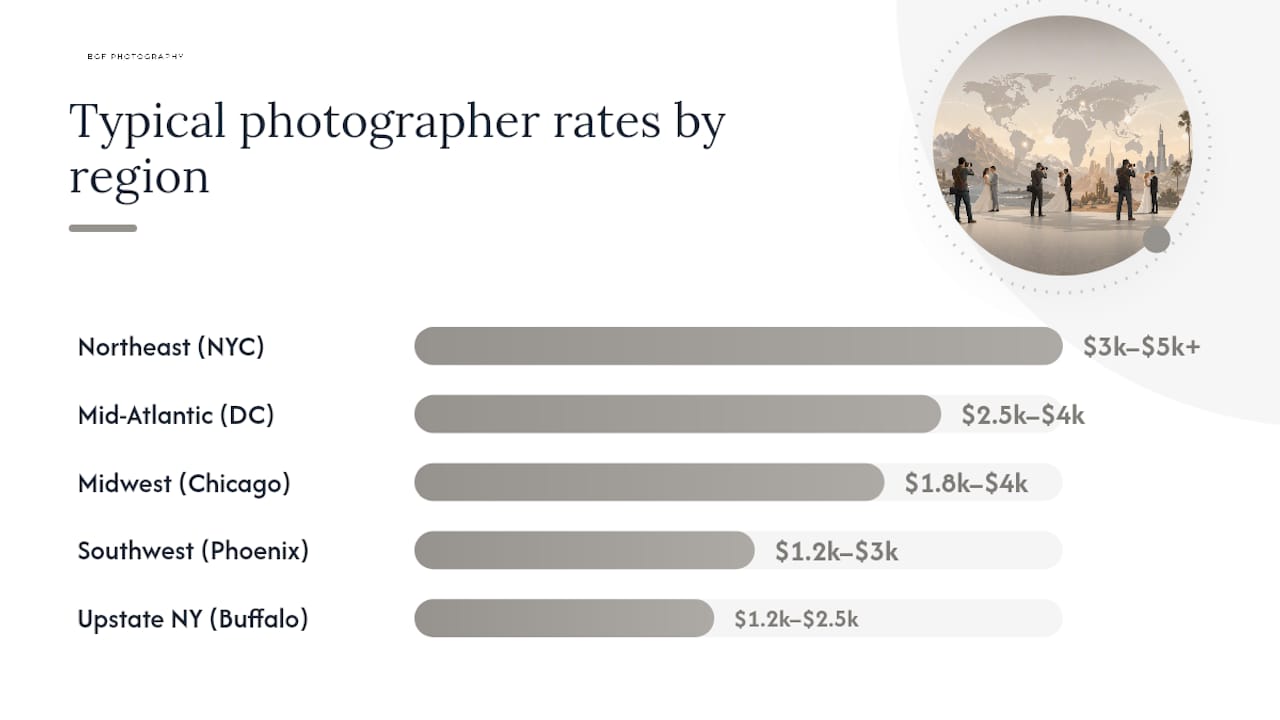
Metro pricing reflects cost of living, vendor demand, and the concentration of high-end venues. A photographer based in Manhattan will price differently than one based in Buffalo, even with identical skill and style.
When evaluating an out-of-area photographer's quote, check these points:
- Does the travel fee cover mileage only, or also hotel and meals?
- Is the travel fee a flat rate or per-mile?
- Does the photographer have experience shooting at your venue or in your region?
- Will travel time cut into coverage hours, or is it billed separately?
When to book, deposit norms, and what your contract must include
Booking timeline: For peak-season Saturday weddings (May, June, September, October), book your photographer 12–18 months out. Popular photographers in major markets fill their calendars faster than that. Off-peak dates (November through March, weekdays) offer more flexibility, but 6–9 months is still a safe window. Booking late, inside 3 months of your date, limits your options significantly and rarely saves money.

Deposits and payment schedules: Most photographers require a non-refundable retainer of 25%–50% of the total package at signing to hold the date. The balance is typically due 30 days before the wedding. Some photographers offer installment plans for the remaining balance.
Contract essentials — confirm every one of these before signing:
- Exact coverage hours and start/end times
- Number of photographers (lead and second shooter)
- Deliverables: number of edited images, file format, resolution, and delivery method
- Image ownership: who holds copyright, and what personal print release is granted to you
- Turnaround time for the final gallery
- Overtime rate per hour if the event runs long
- Cancellation and rescheduling policy, including what happens to the retainer
- Travel and accommodation clauses for any venue outside the photographer's home area
- Backup equipment policy
- What happens if the photographer is unable to attend (illness, emergency)
Photographers nearly always retain copyright and provide a personal print release, which lets you print images for personal use. Full copyright transfer is rare and typically costs significantly more. The Knot's guidance confirms this is standard industry practice.
Pro Tip: Build photographer rapport before the wedding day. Couples who connect with their photographer before the event consistently report more natural, relaxed images. An engagement session is the most efficient way to do this.
How to choose the right wedding photographer
Price is a filter, not a decision. Here is a practical framework for the actual choice:
Step 1: Set your non-negotiables. Coverage hours, second shooter yes/no, and whether you want an album or just digital files. These determine your realistic budget floor.
Step 2: Match style to your wedding. A documentary/candid photographer and a posed editorial photographer produce very different images. Review wedding photography styles before you start inquiring so you know what you are looking for.
Step 3: Evaluate consistency, not highlights. Request full wedding galleries from at least two recent weddings. Highlight reels show a photographer's best 30 images. Full galleries show how they handle a dark reception hall, an overcast outdoor ceremony, and the chaotic family formals.
Step 4: Assess rapport. You will spend 8+ hours with this person on one of the most personal days of your life. If the consultation feels transactional, that matters.
Questions to ask during an inquiry:
- Are you available on our date, and will you personally be our photographer?
- How many weddings have you shot at our venue or in similar settings?
- What backup equipment do you carry?
- How do you back up files on the wedding day and after?
- What is your typical editing turnaround?
- Can we see a sample contract before we commit?
- What is your overtime rate if the event runs long?
- Do you have liability insurance?
Red flags to watch for:
- No written contract, or a contract that omits overtime rates and cancellation terms
- Evasive answers about who will actually shoot your wedding
- Portfolio with inconsistent quality across different lighting conditions
- No clear answer on file backup procedures
- Pricing that seems too low to be sustainable (often signals a photographer who will not be in business when your gallery is due)
Pro Tip: When reviewing a photographer's portfolio, look at their unique style across multiple weddings, not just one. Consistent emotion, light, and composition across different venues is the real signal of a reliable professional.
Three realistic sample wedding budgets
Here is how photography costs fit into three common wedding scenarios:
| Wedding Type | Total Budget | Photography Spend | % of Budget | What That Covers |
|---|---|---|---|---|
| Elopement / Micro-wedding | $5,000–$10,000 | $800–$1,800 | 12%–18% | 3–4 hrs, 1 shooter, digital gallery |
| Mid-size wedding (75–150 guests) | $5,000–$10,000 | $2,500–$4,000 | 9%–12% | 8 hrs, lead + second shooter, gallery + engagement session |
| Higher-end wedding (150+ guests) | $50,000 | $5,000–$10,000+ | 8%–12% | Full day, full team, album, film option |
A few notes on these scenarios:
- The elopement percentage runs higher because fixed costs (travel, minimum hours) compress less at small budgets.
- The mid-size range aligns closely with Zola's 9% guideline and is the most common scenario for U.S. couples.
- If photography is your top priority, reallocating from florals or catering is a legitimate strategy. A $500 reduction in centerpieces can fund an extra hour of coverage or an album upgrade.
Couples adding hybrid photo/video coverage should budget an additional $1,500–$4,000 for videography, depending on the package. Booking both under one studio, as BGF Photography offers, often reduces the combined cost compared to hiring two separate vendors.
How these numbers were derived
The figures in this article draw from five primary sources:
- The Knot Real Weddings Study — the most widely cited U.S. wedding photography benchmark, providing national averages, regional breakdowns, and percentile ranges
- Zola Wedding Cost Index — an independent sample that skews slightly higher and provides the 9% budget-allocation guideline
- WeddingWire cost data — a lower-end benchmark reflecting a broader vendor pool including newer photographers
- ShutterReview's 2026 pricing guide — detailed breakdown of business costs that underlie professional rates, including editing, software, and insurance
- Pix Wedding's 2026 statistics aggregation — useful for guest-count and regional spread data
Baseline assumptions: All averages use an 8-hour full-day package as the standard unit. Ranges reflect the 25th–75th percentile of reported spending where available. Regional samples are aggregated from multiple surveys and may not reflect hyper-local micro-markets.
Key caveat: Survey averages shift year to year and vary by platform methodology. The $3,000 national average from The Knot and the $4,400 from Zola are not contradictory — they reflect different sample pools. Use both as reference points, not absolutes, and get at least three local quotes to calibrate for your specific market.
Custom add-ons (albums, engagement sessions, drone, film) alter final price significantly. Always compare base package prices on equal terms before drawing conclusions from competing quotes.
Key Takeaways
Most U.S. couples spend a mid-market range on wedding photography, centered around a national average rough estimate for a full-day package, and geography, experience, and coverage hours explain most of the variation.
| Point | Details |
|---|---|
| National average | The Knot places the U.S. average at $3,000 for a full-day package; Zola's index reports $4,400. |
| Budget allocation | Zola recommends spending roughly 9% of your total wedding budget on photography. |
| Book early | Peak-season Saturday dates fill 12–18 months out; waiting limits options without saving money. |
| Check the contract | Confirm overtime rates, cancellation terms, image ownership, and file backup before signing. |
| BGF Photography | BGF Photography offers candid, hybrid photo/video packages in Buffalo, Rochester, and the Finger Lakes — view packages and pricing. |
What most couples get wrong about photography budgets
Most couples treat photography as a line item to trim. That instinct is understandable, but it is worth thinking through what you are actually buying. Flowers last a day. The food is gone by midnight. The photographs are what you will look at for the rest of your life, and what your kids will look at after that.
The conventional wisdom says "spend 10% on photography." That is a reasonable starting point, but it misses the real question: what do you actually want from your images? Couples who prioritize candid, emotional coverage and invest accordingly almost never regret it. Couples who cut to the budget tier to save $800 sometimes do.
There is also a widespread misunderstanding about what photographers charge for. The day-of hours are the smallest part of the job. A professional photographer spends 40–80 hours editing a single wedding, maintains $5,000–$20,000 in equipment, pays for software, insurance, and storage, and runs a business with real overhead. When a quote feels high, it usually reflects that reality, not a markup.
The other thing couples underestimate is the value of stylistic consistency. A photographer who produces beautiful images at one venue but struggles at yours is not the right hire. That is why requesting full galleries from multiple weddings matters more than any highlight reel. Consistency across lighting conditions, venues, and moments is what separates a reliable professional from someone who got lucky on a sunny outdoor wedding.
BGF Photography covers Buffalo, Rochester, and the Finger Lakes
If you are planning a wedding in Western or Central New York, BGF Photography offers candid, documentary-style coverage with a natural, unobtrusive approach. Packages include hybrid photo/video options so you can book both under one cohesive style and vision, which typically costs less than hiring two separate vendors and produces a more consistent final product. Film photography is also available for couples who want that nostalgic, timeless quality alongside digital coverage.
BGF Photography serves couples in Buffalo, Rochester, the Finger Lakes, and surrounding areas. To see package options, what is included at each coverage level, and how to request a personalized quote, visit the packages and pricing page. Bring your date, venue, and a rough sense of your coverage priorities — that is all you need to get a clear, honest quote.
Sources and further reading
The following sources were used to build the averages, ranges, and guidance in this article:
- The Average Wedding Photographer Cost, Explained
- Wedding Photographer Cost: What Couples Really Pay - Zola Expert Wedding Advice
- Wedding Photographer Cost Guide - WeddingWire
- Complete Wedding Photography Pricing Guide: Understanding Costs in the United States | ShutterReview
- A Complete Guide to Wedding Photography Prices - Brides
- Wedding Photography Statistics 2026: 60+ Numbers Couples Should Know | Pix Wedding
- Wedding vendor tipping cheat sheet - The Knot
- Should you tip wedding photographers - Zola
For city-level quotes, check local vendor marketplaces and request at least three quotes from photographers whose full galleries you have reviewed. For couples in the Buffalo, Rochester, and Finger Lakes region, the BGF Photography packages page is a good starting point for understanding what professional coverage looks like at different investment levels.
FAQ
What is a normal budget for a wedding photographer?
Most U.S. couples spend between $2,500 and $4,000 on a full-day wedding photographer, with a national average near $3,000 according to The Knot Real Weddings Study. Zola recommends allocating roughly 9% of your total wedding budget to photography.
Is $4,000 a lot for a wedding photographer?
$4,000 sits at the upper end of the mid-market range and is typical for an experienced professional with a second shooter in most U.S. cities. In major metros like New York or Los Angeles, $4,000 is closer to the starting price for established photographers.
How much should a photographer charge for a 3-hour wedding?
A 3-hour ceremony-only or elopement package typically runs $800–$1,800 depending on the photographer's experience and location. Most photographers set a minimum booking fee even for short coverage, so rates per hour are higher on shorter packages than on full-day bookings.
Is $5,000 too much for a wedding photographer?
$5,000 is not excessive for a professional-tier photographer offering 8–10 hours of coverage, a second shooter, and an engagement session. It falls within the standard range for experienced photographers in mid-to-large U.S. markets and is well below luxury pricing, which can reach $10,000 or more.