
Sharing a single wedding vision early saves time, money, and relationship stress. Couples who define what they want together, before booking any vendor, make faster decisions and fight less over details later. Start with three things this week:
- Write a one-sentence mission statement together
- Build a shared moodboard with 10 to 15 images
- Agree on your top 3 priorities and where money goes first
Do these three things before you touch a checklist, and every vendor conversation, budget fight, and family opinion gets easier to handle.
Key Takeaways
A shared wedding vision, built as a one-sentence mission statement paired with a condensed moodboard, reduces planning conflict and speeds every major decision that follows.
| Point | Details |
|---|---|
| Write the mission statement first | Draft a one-sentence statement of feeling and priorities before booking any vendor. |
| Build a condensed moodboard | Collect 10 to 15 annotated images that communicate mood, not just aesthetics. |
| Use specific, bounded asks | Replace vague requests with tasks and deadlines to engage a disengaged partner. |
| Brief every vendor the same way | Share your mission statement, priorities, and moodboard with each vendor category. |
| Align photography coverage with your vision | BGF Photography plans hybrid photo and video coverage around your must-capture list and mission statement. |
Table of Contents
- What Is a Wedding Vision, and How Is It Different From a Theme?
- What Are the Real Benefits of Sharing Your Vision as a Couple?
- When Should You Define and Align Your Wedding Vision?
- How Do You Create a Shared Wedding Vision Together?
- How Do You Talk to Your Partner About Your Vision Without Fighting?
- How Do You Communicate Your Vision to Vendors?
- What Do You Do If Your Partner Seems Disengaged From Planning?
- Why Does Your Photographer Care About Your Shared Vision?
- Ready to Turn Your Vision Into Coverage That Matches It?
- Sources
- FAQ
What Is a Wedding Vision, and How Is It Different From a Theme?
A wedding vision, sometimes called a mission statement, is a short written statement of what you want your wedding to feel like and what matters most to you as a couple. It covers experience and priorities, not colors and decor. A wedding mission statement helps you focus decisions, speed up choices, and give vendors a clear planning target instead of a scattered wish list.
A theme is visual. "Rustic barn" or "black tie garden party" describes a look. A vision describes a feeling: "We want our closest people laughing together in one room, with no rush and no performance." Both matter, but the vision comes first.
Try this template: "Our wedding should feel like [feeling]. We prioritize [top value] over [lower value]. We will not compromise on [non-negotiable]."
- Feeling: relaxed, joyful, intimate, elegant
- Top value: guest connection, great food, unforgettable photos
- Non-negotiable: your grandmother's blessing, an outdoor ceremony, live music
What Are the Real Benefits of Sharing Your Vision as a Couple?
Couples who plan with a shared vision make decisions faster because they stop relitigating the same values every time a new choice appears. Instead of debating linen colors from scratch, you check the choice against your mission statement and move on.
Guests feel the cohesion even when they can't name it. A ceremony where every element points toward the same feeling, quiet and intimate, or big and celebratory, reads as intentional rather than assembled from Pinterest boards. Vendors benefit too: a clear brief means fewer revisions and imagery that actually matches what you imagined, instead of a generic interpretation of "boho" or "classic."
- Faster decisions with less back-and-forth
- Less resentment because priorities were agreed on early, not negotiated under pressure
- Stronger teamwork heading into married life
- Vendors deliver closer to your first ask, not a third revision
One common conflict: one partner wants a large family-style reception, the other wants an intimate ceremony with 30 guests. A shared mission statement, written before the venue search, forces that conversation early instead of during a stressful walkthrough three months before the date.
Couples who plan together instead of dividing the work in silence also avoid the resentment that builds when one partner feels shut out of decisions that affect them just as much.
When Should You Define and Align Your Wedding Vision?
Define your vision before you book any major vendor and before you finalize your guest list. Vision-first planning changes what you prioritize, which changes your budget allocation before a single deposit goes down.
- Month 1 to 2: Write your mission statement together
- Month 2 to 3: Build your moodboard and top 3 priorities
- Month 3: Draft vendor briefs and start booking photographer, venue, and caterer
Starting with vision instead of a generic checklist prevents wasted research time on venues or vendors that never fit your priorities in the first place.
Pro Tip: Book your photographer and videographer only after your vision is written down. A photographer who reads a real mission statement, not just a Pinterest link, plans coverage differently than one working from vague requests.
How Do You Create a Shared Wedding Vision Together?
- Each partner writes three words describing how they want the day to feel, alone first
- Compare lists and circle overlaps; write one sentence combining them into your mission statement
- Collect a modest number of images into a shared moodboard, using Pinterest, Canva, or a shared Google Doc
- Annotate each image with what you actually like about it, lighting, texture, mood, not just "pretty"
- Condense your mission statement, top 3 priorities, and moodboard into a one-page brief
A vision board works best as a decision filter, not a random collection of pretty photos. Include non-visual details too: music style, food format, guest experience. Your one-page brief should contain:
- Mission statement (one sentence)
- Top 3 priorities, ranked
- Logistics basics: date, guest count, budget range
- Must-capture list for photo and video
How Do You Talk to Your Partner About Your Vision Without Fighting?
Lead conversations with the answer, not a debate. Say what you want in one sentence, then explain why, instead of building up to it. "I want our reception to feel casual and loud, because I want people dancing by 8pm" gives your partner something concrete to respond to.
Use specific, behavioral asks instead of vague complaints. The Post-it method works well here: write a task on a note, hand it over, and set a deadline. "Can you confirm the DJ deposit by Friday?" gets a response. "Can you help more with planning?" doesn't.
- Assign tasks by interest, not fairness: whoever cares more about flowers leads that decision within your agreed budget
- Keep planning sessions to 30 minutes, with an agenda, not open-ended venting
- Use one shared document so nobody repeats a conversation that already happened
Pro Tip: If a decision keeps stalling, ask: "On a scale of 1 to 10, how much do you care about this?" Whoever scores higher leads, within budget. It's a fast way to end a stalemate without a real argument.
How Do You Communicate Your Vision to Vendors?
Every vendor needs the same core document, adjusted for their specialty. Hand your photographer, florist, caterer, and venue coordinator a version of your one-page brief so nobody guesses at your intent.
- Mission statement and top 3 priorities, unchanged across all vendors
- A condensed moodboard of 10 to 15 images, captioned with what you like about each
- Budget range for their category specifically
- Logistics: timeline, guest count, ceremony and reception locations
Your florist needs to know if "romantic" means loose garden roses or structured, monochrome arrangements. Your caterer needs to know if "casual" means a taco bar or a plated three-course meal. Ask vendors directly: "Based on this brief, what would you recommend, and what's the biggest limitation you see given our budget?" For more guidance, check our F&Q's with practical vendor-facing questions to ask. Expect some pushback on ambitious requests within a tight budget. That's useful information, not a rejection. For photography specifically, sharing your vision directly with your photographer at your first planning meeting sets the tone for every shot list decision that follows.
What Do You Do If Your Partner Seems Disengaged From Planning?
First, figure out what's actually happening. A partner avoiding spreadsheets isn't necessarily avoiding the marriage, planning stress is a normal trigger for tension, and treating it as a repair-focused problem rather than a character flaw changes the conversation entirely.
- Give one specific, bounded task with a deadline, not an open invitation to "help more"
- If tasks keep slipping, name three non-negotiables each and trade decision-making power on the rest
- If disagreement stalls repeatedly, bring in a neutral third party, a planner or, for deeper relationship friction, a therapist
Pro Tip: Assign one task your partner already cares about, like music or the guest list for their side of the family. Interest beats obligation every time.
Why Does Your Photographer Care About Your Shared Vision?
A photographer reads your mission statement for information you might not realize it contains: the light quality you're drawn to, the pacing you want, and the moments you'd be devastated to miss. A couple whose vision says "quiet, unposed, emotional" gets covered very differently than a couple whose vision says "bold, editorial, high energy."
Your must-capture list, shared at the planning meeting, becomes the backbone of the coverage plan. It tells the photographer where to stand during the ceremony, which family members need a formal portrait, and which moments deserve extra attention versus a quick candid pass. This is why matching photography style to the couple's actual vision matters more than picking a photographer based on portfolio aesthetics alone.
- Bring your mission statement and moodboard to the first meeting, not just a Pinterest link
- Write a one-page must-capture list: specific people, specific moments, specific traditions
- Mention lighting preferences explicitly if you know them, golden hour outdoor shots versus dim reception ballroom light call for different planning
Pro Tip: Create your must-capture list before your planning meeting, not during it. A photographer working from a written list plans coverage better than one working from memory of a rushed conversation.
A Note on Working With Aligned Couples
Every photographer notices the difference. Couples who show up with a shared vision, even a rough one, move through their day with less friction, fewer arguments over timing, and photos that actually reflect what they wanted. Write your mission statement this week. It's the cheapest planning tool you'll use.
Ready to Turn Your Vision Into Coverage That Matches It?
Once your mission statement and moodboard exist, the next step is finding a photography and videography team that reads them the right way. BGF Photography builds hybrid photo and video coverage around your actual priorities, not a generic package, so your must-capture list and mission statement directly shape how your wedding day gets documented.
That means one cohesive style across both photography and film, candid coverage that captures real moments instead of staged ones, and a planning conversation that starts with your vision instead of a sales pitch. If you're ready to see how your priorities translate into coverage, check available dates and packages and bring your one-page brief to the first consultation. It's the fastest way to know if the fit is right before you book anything else.
Sources
- When Your Partner Is Not Helping With Wedding Planning — Psychology Today
- Wedding mission statement — The Knot
- How to create a wedding vision board that actually works — Plan A Wedding
- Wedding Planning Checklist vs. Wedding Vision — Intentionally Wed
FAQ
What Is the 7-7-7 Rule for Married Couples?
Regularly checking in on your relationship helps keep communication consistent. It's a general relationship habit, not a wedding-specific rule, but applying a steady rhythm during engagement helps keep planning conversations regular instead of reactive.

What Is the 50/30/20 Rule for Weddings?
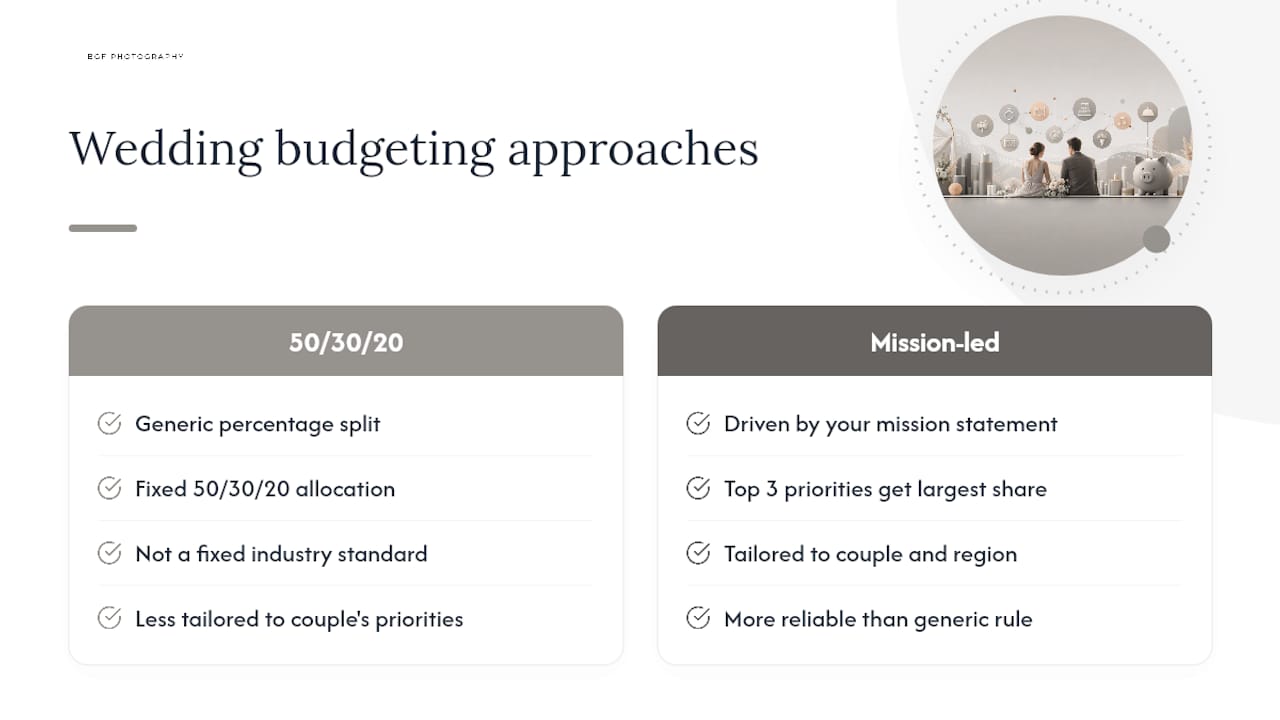
This budgeting approach isn't a fixed wedding industry standard, and specific splits vary by couple and region. A more reliable method is letting your mission statement and top 3 priorities determine where the largest share of your budget goes, rather than applying a generic percentage rule.
Why Do Some Couples Choose Not to See Each Other Before the Wedding?
Some couples skip a first look to preserve the emotional impact of seeing each other for the first time at the ceremony, while others prefer a private first look to calm nerves and get relaxed portraits done early. Either choice should reflect your shared vision, not tradition alone, and it's worth discussing with your photographer during the planning meeting.
What Is the Timing Rule for Wedding Photo Sessions?
Many photographers recommend building in short, unhurried windows, often referred to loosely as a "golden window," for portraits during optimal light rather than rushing through a tight schedule. The exact minutes vary by wedding size and season, so confirm a realistic timeline with your photographer directly rather than following a fixed number.
How Does a Trade Framework Help When Partners Disagree?
Each partner lists three to five non-negotiables, and decisions outside those lists become negotiable trades rather than fights. This trade-based approach converts vague disagreements into specific, resolvable choices.