
TL;DR:
- Professional wedding photographers in Buffalo rely on multiple camera bodies and comprehensive backup workflows to ensure uninterrupted coverage. They perform on-site backups at key moments and follow the 3-2-1 rule to protect images from data loss and theft. Couples should ask photographers about their backup equipment, data procedures, and mutual-aid plans to ensure reliable service.
Backup equipment is the professional standard that separates reliable wedding photographers from those who gamble with your memories. The role of backup equipment in Buffalo wedding photography goes beyond carrying extra gear. It defines whether a photographer can deliver complete, uninterrupted coverage when a camera body fails mid-ceremony, a memory card corrupts during cocktail hour, or a flash unit dies before the first dance. Industry standards in 2026 require multiple camera bodies for continuous coverage, and the most prepared photographers also carry redundant lenses, flash units, batteries, and memory cards. Protecting your wedding photos starts the moment the shutter fires and extends through a multi-stage backup workflow that keeps your images safe long after you leave the venue.
What essential backup equipment does a Buffalo wedding photographer need?
Professional wedding photographers must bring at least two, ideally three camera bodies to every wedding. That number is not arbitrary. A single camera failure during the ceremony means missed moments that no one can recreate. Three bodies give a photographer a working primary, a ready secondary, and a true emergency spare.
Camera bodies and lenses
Every key focal length needs a backup lens. A photographer who carries only one 35mm prime and one 85mm portrait lens is one dropped lens away from a coverage gap. The professional standard is to carry at least two options for each critical range: wide, mid, and telephoto. That way, a cracked front element or a stuck aperture blade does not end the shoot.
Flash units, batteries, and memory cards
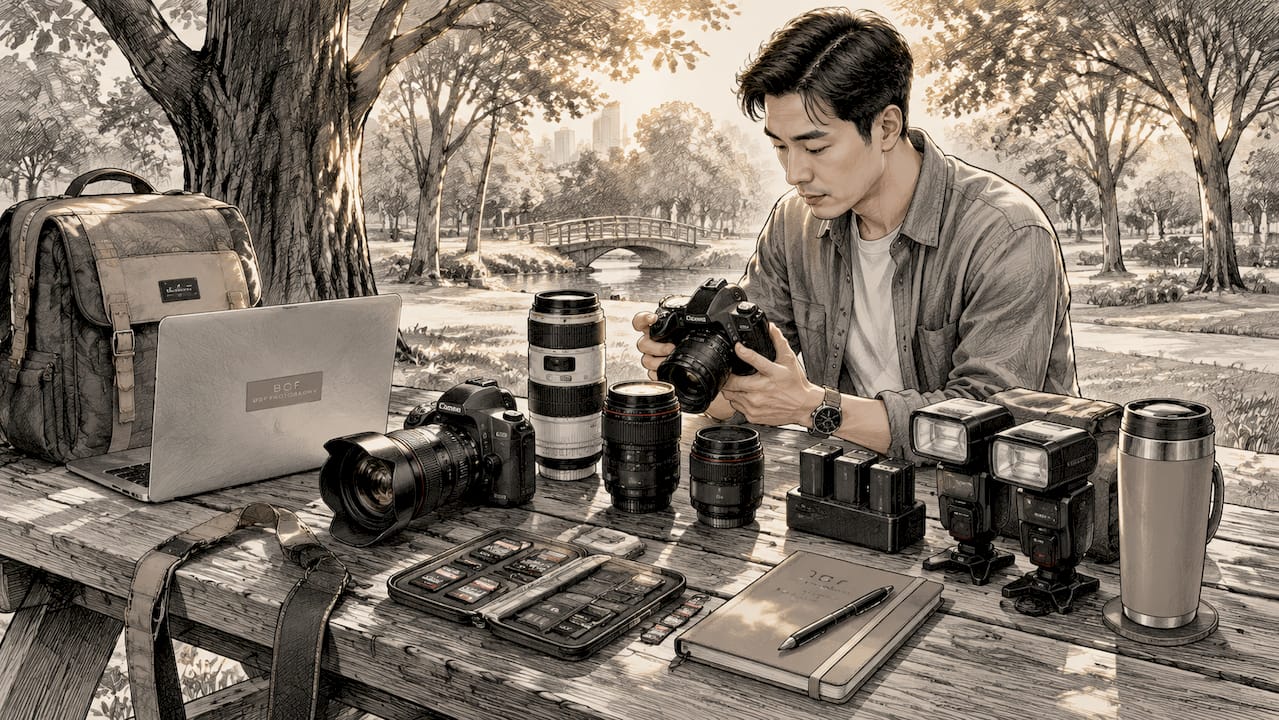
Comprehensive on-site backup gear spans cameras, lenses, flash units, spare batteries, and enough memory cards to cover the entire event twice. Flash units fail from overheating, battery drain, and trigger signal loss. Carrying two or three flash units with independent triggers means a single failure never leaves a reception table in darkness. Fully charged spare batteries for every body and flash should be loaded into a dedicated pouch, not buried in a bag.
Dual-slot camera bodies
Dual-slot camera bodies write images simultaneously to two memory cards, providing real-time redundancy. If one card corrupts mid-ceremony, every image already exists on the second card. This technology is one of the most underrated protections in wedding photography. Couples rarely ask about it, but it is the first line of defense against data loss before any backup workflow even begins.
Pro Tip: Ask your photographer whether their primary camera bodies have dual memory card slots. If they shoot on a single-slot body with no redundancy plan, that is a real risk worth discussing before you sign a contract.
The full backup kit for a professional Buffalo wedding photographer should include:
- Two to three camera bodies, all charged and tested before the event
- Backup lenses covering wide, mid, and telephoto focal lengths
- Two or more flash units with independent wireless triggers
- Spare batteries for every body and flash, fully charged
- Enough memory cards to cover the entire day twice
- A dedicated card case kept separate from the primary shooting bag
Every item on that list represents a specific failure point. A photographer who covers all of them has built a system that keeps shooting no matter what breaks.
How do professional backup workflows protect your wedding photos?
Carrying backup gear handles equipment failure. A backup workflow handles data loss. These are two separate problems, and the best photographers solve both.
On-site backup timing
On-site backups happen at three key moments during a wedding day: after the ceremony, before the reception starts, and after the grand exit. Each checkpoint transfers images from memory cards to a portable SSD or card reader. This limits the window of exposure. If something goes wrong between the ceremony and reception, only that block of images is at risk, not the entire day.
The three-stage timing looks like this in practice:
- After the ceremony: cards are copied to a portable SSD while guests move to cocktail hour.
- Before the reception: a second copy is made to a separate drive before the couple enters.
- After the grand exit: all remaining images are backed up before the photographer leaves the venue.
The 3-2-1 backup rule
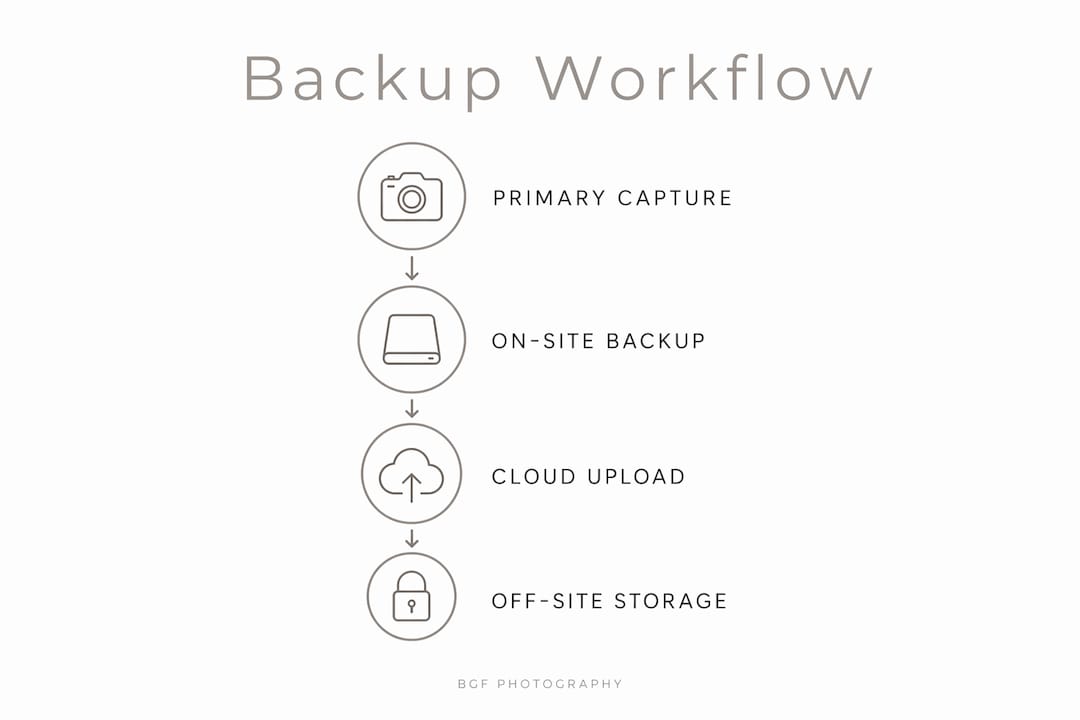
The 3-2-1 backup rule is the gold standard for image data protection: 3 copies of every image, stored on 2 different media types, with 1 copy held off-site. For wedding photographers, this typically means memory cards plus a portable SSD on location, and a cloud upload that begins as soon as the photographer reaches a reliable connection.
| Stage | Location | Media type |
|---|---|---|
| Primary capture | On camera | Dual memory cards |
| On-site backup | Photographer's bag | Portable SSD |
| Off-site backup | Cloud storage | Automated upload |
This three-layer structure means a single point of failure, whether a stolen bag, a corrupted drive, or a house fire, cannot destroy your wedding photos.
Physical separation of storage
Photographers physically separate backup storage from primary storage on-site to protect against theft or total loss. Keeping both drives in the same camera bag defeats the purpose of redundancy. A professional keeps the backup SSD in a jacket pocket, a car, or a second bag. If the primary kit is stolen or damaged, the backup survives.
Pro Tip: Ask your photographer where they physically store their backup drives during the reception. The answer tells you a lot about how seriously they treat data security.
Cloud storage and automation
Automated cloud uploads eliminate the vulnerable gap between leaving the venue and completing a full backup at home. Protecting your images starts when the shutter fires and extends through automated cloud synchronization. A photographer who waits until the next morning to back up images leaves an overnight window where a laptop theft or hard drive failure could erase the entire wedding. Cloud backup closes that window.
One important clarification: RAID storage is not a backup. RAID mirrors data across multiple drives in real time, but it also mirrors deletions and corruptions. A true backup is a separate, independent copy that does not change when the primary does.
Why does backup planning matter specifically for Buffalo couples?
Buffalo presents specific challenges that make backup planning more urgent than in many other markets. Understanding those challenges helps you ask better questions when you meet with photographers.
Weather and gear performance
Western New York weather is unpredictable across every season. Outdoor ceremonies in june can turn cold and wet without warning. Winter weddings at venues like those near Niagara Falls or along the Lake Erie shoreline expose gear to temperature swings that drain batteries faster and fog lens elements. Cold temperatures reduce battery life significantly, which means a photographer relying on a single set of batteries per body is already operating at reduced capacity before anything goes wrong.
Buffalo venue variety and equipment risk
Buffalo's wedding venue mix ranges from historic ballrooms like those in downtown hotels to converted industrial spaces, outdoor vineyard settings, and lakefront properties. Each environment creates different equipment risks. Low-light industrial venues push flash units harder. Outdoor vineyard ceremonies expose gear to dust and moisture. A photographer who has not accounted for these variables in their backup kit is not fully prepared for a Buffalo wedding.
Mutual-aid agreements as a human backup
A mutual-aid agreement between photographers provides a reliable human backup in emergencies. If a photographer becomes ill the morning of your wedding, a mutual-aid agreement means a trusted colleague steps in. This is not the same as a second shooter. A second shooter works alongside the primary photographer. A mutual-aid partner is a contingency for when the primary photographer cannot work at all. Ask every photographer you interview whether they have this arrangement in place.
The questions worth raising during your consultation include:
- Do you carry two or three camera bodies to every wedding?
- What is your plan if your primary body fails during the ceremony?
- How do you back up images on-site, and when does the first backup happen?
- Do you have a mutual-aid agreement with another photographer in Buffalo?
- Where do you store backup drives during the event?
Backup gear redundancy reflects a professional photographer's commitment to risk management and client trust. A photographer who answers these questions clearly and confidently has thought through failure scenarios. One who deflects or gives vague answers has not.
How should you talk to your Buffalo photographer about backup plans?
Most couples never ask about backup equipment. That is a mistake. The conversation is short, and the answers reveal a great deal about a photographer's professionalism.
What to ask about gear
Start with camera bodies. Ask how many they bring and whether those bodies have dual memory card slots. Then ask about lenses. A photographer who carries one lens per focal length is one accident away from a coverage gap. Ask about flash units and whether they carry independent triggers. Ask about batteries and whether they bring enough to cover the full event without recharging.
For deeper guidance on what to look for when evaluating a photographer's preparedness, the wedding photography planning guide covers the specific questions worth raising before you book.
What to ask about data protection
Ask when the first on-site backup happens. The answer should be "after the ceremony," not "when I get home." Ask what media they use for on-site backups and whether they use cloud storage. Ask whether they physically separate their backup drives from their primary kit during the event.
Understanding how to choose a photographer who prioritizes these practices is one of the most practical steps you can take during the planning process. A photographer who has a clear, detailed answer to every data question is one who has built these habits into their workflow, not one who is making it up as they go.
What to confirm about contingency plans
Confirm whether the photographer has a second shooter and whether that second shooter also carries backup gear. Confirm the mutual-aid arrangement. Ask what happens to your images if the photographer's primary computer fails before editing is complete. The importance of backup gear extends well beyond the wedding day itself. Images need to survive the editing and delivery process too.
Pro Tip: Request that your contract specifies the minimum number of camera bodies and backup drives the photographer will bring. A verbal promise is easy to forget. A written commitment is not.
Key takeaways
Backup equipment and multi-stage data workflows are the professional standard for Buffalo wedding photography, and every couple should confirm both before signing a contract.
| Point | Details |
|---|---|
| Minimum camera bodies | Bring at least two, ideally three bodies to cover any single equipment failure. |
| Dual-slot redundancy | Dual-slot bodies write to two cards simultaneously, protecting images the moment they are captured. |
| 3-2-1 backup rule | Three copies, two media types, one off-site location is the gold standard for image data safety. |
| On-site backup timing | Back up after the ceremony, before the reception, and after the grand exit to limit exposure windows. |
| Ask before you book | Confirm backup gear counts, data workflows, and mutual-aid agreements during your consultation. |
Why I think backup questions are the most important ones couples never ask
Gear fails. I have seen it happen at weddings where everything looked perfect on paper. A camera body that passed every pre-shoot check went dark during the processional. A flash trigger lost its signal right before the first dance. These are not horror stories. They are ordinary events in a profession where equipment runs hard for eight to twelve hours straight.
What separates a professional from an amateur is not whether gear fails. It is what happens in the three seconds after it does. A photographer with a second body already around their neck misses nothing. A photographer scrambling to restart a single camera misses the moment.
The couples I have seen most relieved after their wedding are the ones who asked hard questions during the consultation. They knew their photographer carried three bodies. They knew the first backup happened before cocktail hour ended. They knew there was a mutual-aid agreement in place. That knowledge did not make their wedding more romantic. It made it possible to be fully present without worrying about what might go wrong behind the lens.
Backup planning also affects delivery timelines. A photographer who loses images to a corrupted card and has no redundancy faces a painful conversation with their clients. A photographer with a proper workflow delivers on time because nothing was lost. The wedding day timeline and the backup workflow are connected. Both protect the final product.
My honest advice: treat backup questions the same way you treat questions about price and style. They are not optional. They are the difference between a photographer who is prepared and one who is hoping for the best.
— Billy
BGF Photography's approach to backup coverage
BGF Photography brings multiple camera bodies and a full complement of backup lenses, flash units, and memory cards to every Buffalo wedding.
The backup workflow follows the 3-2-1 rule, with on-site copies made at each major event milestone and automated cloud uploads beginning as soon as the event ends. BGF Photography's hybrid coverage model means both photo and video are captured under one consistent system, with redundancy built into every stage. Couples who want to understand exactly what that coverage includes can review the full details on the packages and FAQ page. If you are still in the early stages of planning, the candid wedding photos guide is a practical starting point for understanding what professional coverage looks like from the first shot to the final delivery.
FAQ
What is the minimum backup gear a wedding photographer should carry?
A professional wedding photographer should carry at least two camera bodies, backup lenses for each key focal length, multiple flash units, spare batteries, and enough memory cards to cover the full event twice.
What is the 3-2-1 backup rule in wedding photography?
The 3-2-1 rule means keeping three copies of every image on two different media types, with one copy stored off-site, typically in cloud storage, to protect against total data loss.
Do dual-slot camera bodies really make a difference?
Dual-slot bodies write every image to two cards simultaneously. If one card corrupts during the shoot, every photo already exists on the second card, making this one of the most reliable protections against data loss.
When should a photographer perform on-site backups during a wedding?
On-site backups should happen at three points: after the ceremony, before the reception begins, and after the grand exit. This limits the window of exposure if something goes wrong between stages.
What is a mutual-aid agreement and why does it matter for Buffalo couples?
A mutual-aid agreement is a formal arrangement between two photographers to cover each other's weddings in an emergency. It protects couples if their primary photographer becomes unable to work on the wedding day.