

Why wedding films capture missed moments photos simply can’t
Wedding films preserve what photographs physically cannot: sound, motion, and the passage of time. A photo freezes a single frame. A film holds the nervous exhale before the doors open, the tremor in a father’s voice during his toast, the way two people look at each other three seconds after the vows end, when the officiant is still speaking and the rest of the room has disappeared.
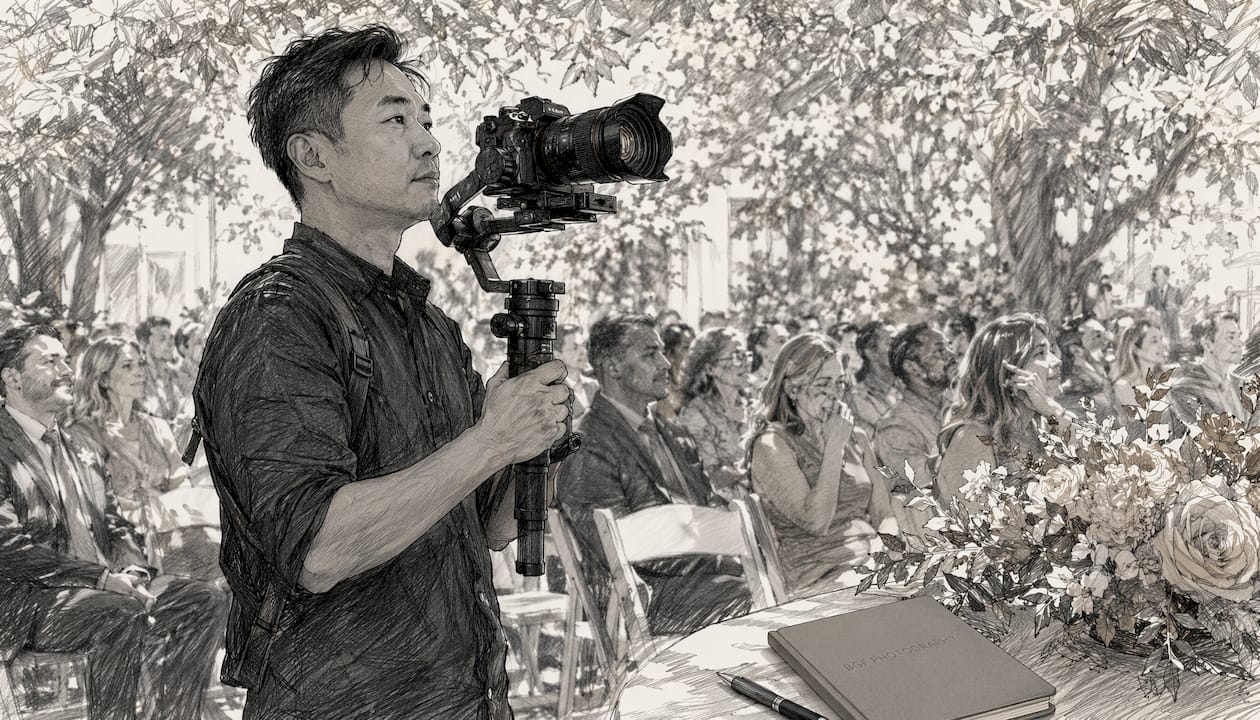
Many couples who skip wedding videography later regret it. That number is striking, but the reason behind it is even more telling: couples don’t miss having footage of the ceremony. They miss hearing their own voices. They miss the laughter they forgot the shape of.
What wedding films uniquely preserve:
-
Spoken vows in both partners’ voices, with every pause and tremor intact
-
Ambient sound: clinking glasses, rustling fabric, the low hum of a room filling with people
-
Guest reactions happening while the couple faces forward at the altar
-
Unscripted gestures: a hand squeeze, a wiped tear, a look across the room
-
Emotional flow across the full arc of the day, not just its peaks
-
The atmosphere of a room full of everyone who matters, all in one place
Photography captures what a moment looked like; film captures why it felt the way it did.
Key moments that only a wedding film reveals
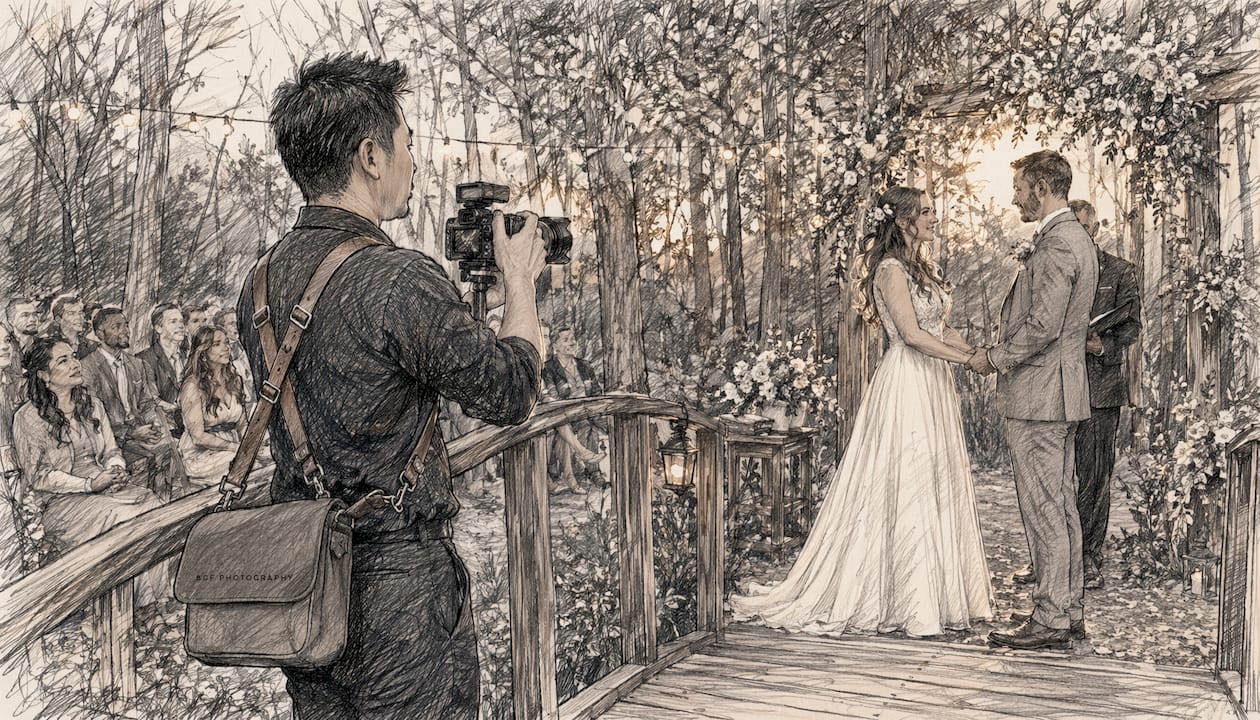
The footage that makes couples cry on first viewing is almost never what they expected. It’s the quiet stuff, the in-between moments that happened while everyone was looking somewhere else.
Candid, unguarded moments are consistently the most emotionally powerful footage in any wedding film. A parent taking a slow breath before a speech. A best friend mouthing “you’ve got this” from the front row. The look two partners exchange when they round the corner after the recessional and finally have a second alone. None of these are scheduled. None of them last more than a few seconds. And most couples have no memory of them at all.
A few specific moments that film captures and photos routinely miss:
-
The full recessional: not just the peak moment of the first kiss, but the chaotic, joyful five minutes after, when guests pile out and descend on the couple at once
-
Guest arrivals: families meeting for the first time, old friends spotting each other across the room, kids already trying to escape their formal clothes
-
The speeches, from the audience’s perspective: the couple faces forward; the camera catches every reaction behind them
-
Late-night dancing: by 11 PM, the photographer has typically packed up. The dance floor at its peak rarely gets documented without video
Pro Tip: Ask your videographer to position a second camera facing the guests during the ceremony. The reactions happening behind you are often the most emotional footage in the entire film.
A skilled videographer reads the room the way a good journalist reads a scene: watching the periphery, anticipating the frame before it forms, noticing what’s happening three steps to the left of where everyone else is looking.
Common mistakes couples make about wedding videography
The most frequent and costly mistake is treating audio as an afterthought. Poor audio quality ranks among the top videography failures at weddings, alongside insufficient coverage time and failure to account for event delays. A film where the vows are muffled or the speeches are swallowed by room noise is not a useful record of anything.
Other mistakes worth knowing before you book:
-
Skipping videography to save money without accounting for the regret rate. The average cost of wedding videography in the US is about $2,300, and it is also the vendor category couples most commonly regret cutting.
-
Relying on a rigid shot list instead of allowing for candid coverage. A checklist approach produces polished footage that feels flat. The moments that matter most are never on a list.
-
Failing to coordinate with the photographer. When the two teams don’t communicate, they end up in each other’s shots, missing transitions, or doubling up on coverage while gaps go unfilmed.
-
Not discussing audio logistics for outdoor or acoustically difficult venues. Wind, hard floors, and bare walls can make speeches technically unusable without a lapel microphone.
For couples writing personalized vows, capturing those vows clearly on film becomes especially important. Written vows on paper carry the words. Video carries the voice, the pause, the moment the emotion breaks through.
How photography and videography work better together
Photography and videography are not competing for the same job. They capture fundamentally different things, and treating them as a unified strategy produces a far more complete record of the day than either medium alone.
Research on multisensory memory encoding shows that stimuli engaging multiple channels simultaneously are encoded more deeply and retrieved more accurately. A photo of the first dance triggers the auditory memory of the music from the film. The film triggers the visual recall of the detailed photo capturing the groom’s expression. Each medium reinforces the other.
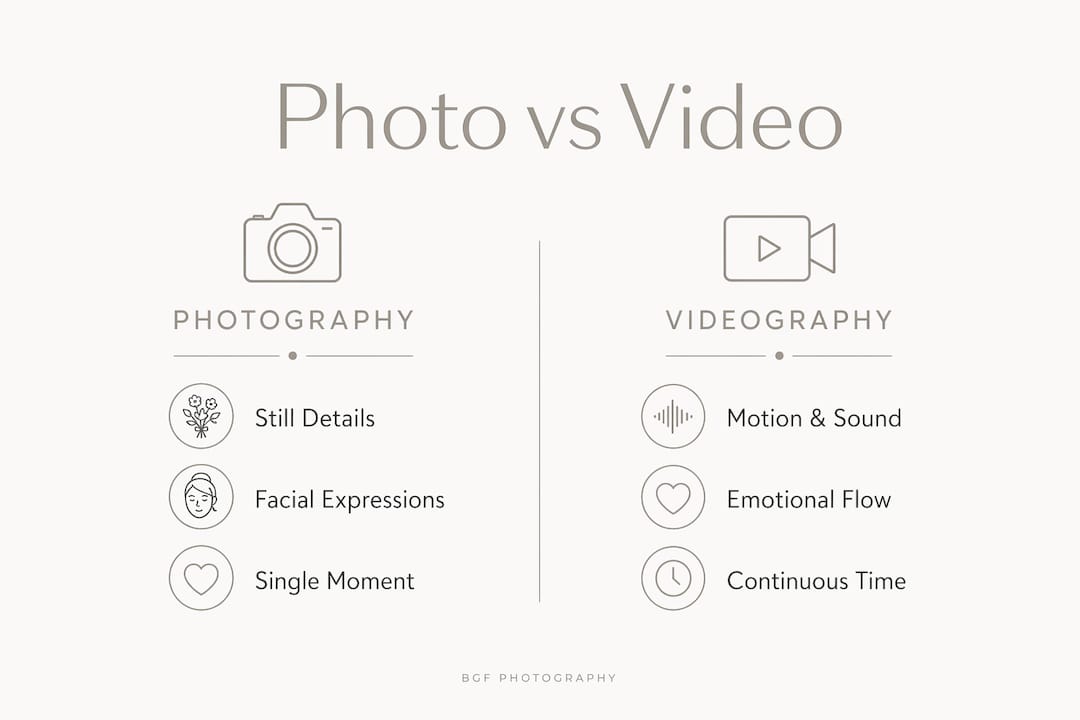
| Medium | What it captures best | Primary strength |
|---|---|---|
| Photography | Still details, facial expressions, precise moments | Instant sharing, wall prints, visual record |
| Videography | Motion, audio, emotional flow across time | Reliving the experience, preserving voices |
| Both together | Full multisensory memory of the day | Deepest long-term memory retention |
A Kent wedding photographer working alongside a videographer describes the pairing well: photography captures how things looked; videography captures how things felt. Neither replaces the other.
Why a wedding film becomes a family heirloom
The value of a wedding film compounds over time. In the first year, couples watch it to relive the day. A decade later, they watch it to hear voices.
For many couples who watch their film years later, the most precious thing it contains is the voice of a parent or grandparent who has since passed away. That cannot be recovered after the fact. No photograph carries that.
Films also reveal what couples missed while living the day. Ambient conversations and sounds that slipped past in the blur of the wedding become fully audible on film, filling gaps in memory that couples didn’t even know existed. Watching the film together creates a shared experience that reinforces the emotional bond of the day itself, something that viewing photos alone doesn’t replicate in the same way.
What science says about video and emotional memory
The neuroscience here is specific. Wedding videos activate the hippocampus and amygdala more fully than still images, triggering more detailed and emotionally rich memory retrieval. The hippocampus performs what researchers call pattern completion, reconstructing the full sensory experience from partial cues. The amygdala determines the emotional weight of what’s retrieved, and for wedding memories, that weight is exceptionally high.
A 2014 study by Bowen, Kark, and Kensinger at Boston College found that video stimuli trigger significantly more detailed memory retrieval than static images or verbal descriptions. The combination of motion, sound, facial expressions, and environmental context activates the hippocampus more broadly, essentially loading more of the original experience back into conscious awareness.
| Memory mechanism | How wedding films engage it |
|---|---|
| Hippocampal pattern completion | Motion and audio cues reconstruct the full sensory experience |
| Amygdala emotional encoding | Emotionally charged events are stored and retrieved with greater vividness |
| Dual coding (visual + auditory) | Multimodal stimuli create deeper, more durable memory traces |
| Dopamine reward activation | Rewatching triggers the same neural reward circuits as positive anticipation |
Repeated viewing strengthens these memory traces over time. Each rewatch reinforces the emotional memory rather than wearing it down, which is the opposite of how most people assume memory works.
BGF Photography brings both mediums together under one vision
Couples who want both photography and videography often face a coordination problem: two separate teams, two different styles, two sets of priorities competing for the same moments. BGF Photography solves that by offering hybrid coverage, photography and videography handled together under one cohesive aesthetic and approach.
Based in the Buffalo and Rochester, NY areas, BGF Photography takes a candid, unobtrusive approach that lets genuine moments unfold rather than directing them. The result is footage and images that feel like the day actually was, not a polished performance of it. For couples who want to hear their vows again, catch the reactions they missed, and hold onto the voices of the people they love, that kind of coverage is what makes the difference between a record and a memory.
See available packages and coverage options to find the right fit for your wedding day.
Key Takeaways
Wedding films preserve sound, motion, and emotional flow that photography alone cannot capture, making them the only medium that lets couples fully relive their day.
| Point | Details |
|---|---|
| Video captures what photos miss | Motion, audio, and unscripted moments are only preserved on film, not in still images. |
| Regret rate is high | Many couples who skip wedding videography later regret it. |
| Audio is the most treasured element | Voices, vows, and laughter become more precious over time, especially after a loved one passes. |
| Both mediums work best together | Multisensory memory encoding means photos and video reinforce each other for deeper recall. |
| BGF Photography offers hybrid coverage | Photography and videography under one cohesive style, serving Buffalo and Rochester, NY couples. |
FAQ
Why do wedding films capture moments photos can’t?
Film records sound, motion, and continuous time, while a photo freezes a single fraction of a second. Voices, laughter, ambient atmosphere, and unscripted gestures only exist in video.
Do most couples regret skipping wedding videography?
Yes. Many couples who skip wedding videography report regretting it, most often because they wanted to hear their vows and speeches again.
Why do some wedding videos feel more emotional than others?
Films built around cinematic storytelling rather than simple chronological coverage create genuine emotional movement. The editing choices, music selection, and decision to linger on candid moments rather than posed ones determine whether a film feels alive or flat.
Should you watch your wedding film together for the first time?
Watching together produces a meaningfully richer experience. The shared emotional response creates what researchers describe as co-regulation, where partners synchronize their emotional states, deepening the bond the film is meant to preserve.