
Children are the most honest subjects at any wedding. The role of children in wedding photography is to deliver genuine emotion, spontaneous laughter, and unscripted moments that no amount of careful posing can replicate. A flower girl who stops mid-aisle to wave at grandma, a ring bearer who trips on his own shoes, a toddler who falls asleep in a grandparent’s arms during the reception: these are the images couples return to decades later. This guide gives you practical, expert-backed strategies for including kids in your wedding photos in ways that feel natural, creative, and deeply personal.
How do children naturally enhance wedding photography?
Children bring a quality to wedding photos that adults simply cannot manufacture: total honesty. They have no interest in performing for the camera. They react to what they feel, and that unfiltered response is exactly what makes documentary wedding photography so powerful.
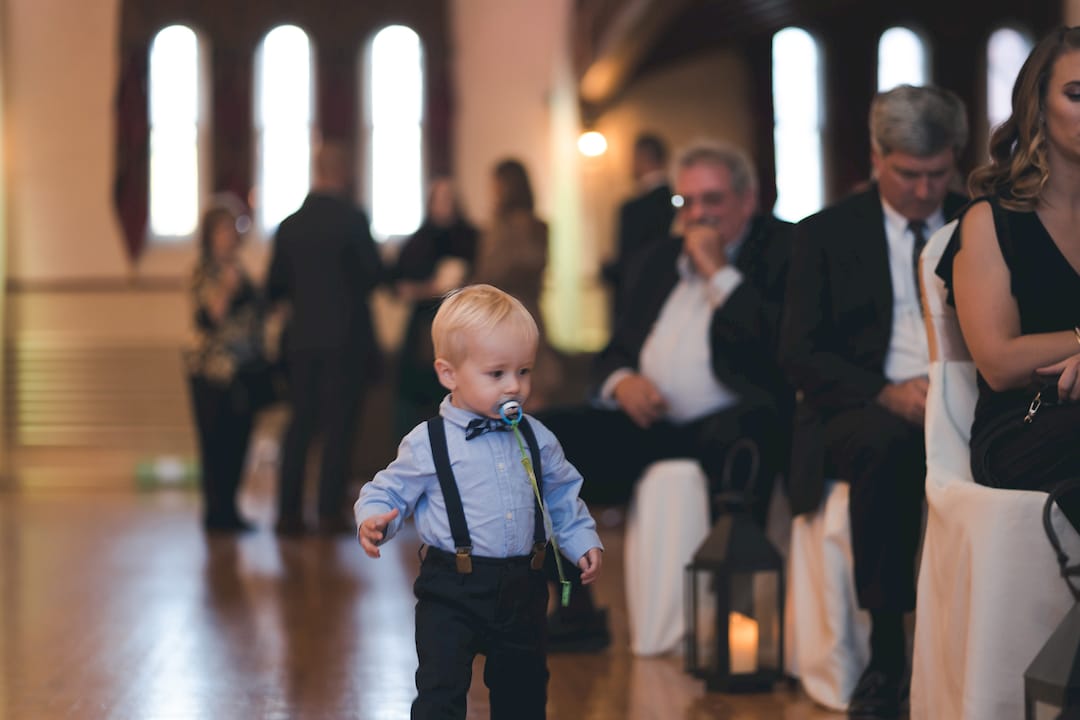
Think about the moments that tend to go viral from wedding albums. A child peering through a gap in the church doors. A toddler dancing alone on the reception floor. A little girl mimicking the bride’s bouquet toss with a handful of grass. None of these are directed. They happen because children absorb real human variation in a way that adults suppress. That authenticity is what makes the whole wedding story feel believable rather than staged.
“Kids don’t interrupt the structure of weddings. They test whether the day can absorb real human variation authentically.” — Wedding photography insight
The narrative value children add goes beyond cute moments. When a child reaches up to hold a grandparent’s hand during the ceremony, that single frame carries three generations of family history. Generational portraits involving children and grandparents create treasured keepsakes that preserve family heritage beyond fleeting trends. The role of grandparents in wedding photography is closely tied to children: together, they anchor the family story in a way that no adult portrait can.
Experienced photographers also note that children function as emotional barometers. When a child laughs freely, the adults around them relax. When a child cries, the adults comfort. Both reactions produce images full of genuine connection. A candid wedding photographer who understands this will position themselves to capture those ripple effects rather than trying to control them.
-
A child’s spontaneous reaction during vows often captures the ceremony’s emotional peak better than any staged portrait.
-
Kids walking down the aisle create natural movement and energy that static adult processions rarely produce.
-
Children playing during cocktail hour give the photographer rich material while guests relax and interact naturally.
-
A child’s perspective, literally lower to the ground, produces compositions that adult photographers cannot replicate from standing height.
What practical strategies help incorporate children into wedding photography?
Planning is the single biggest factor in whether kids in wedding photos turn out well or become a source of stress. The good news is that a few targeted decisions before the wedding day make an enormous difference.
Schedule child-heavy portraits first. Children’s energy and patience peak early. Scheduling portraits early in the timeline and using a subtraction method keeps sessions efficient and accounts for children’s limited patience. The subtraction method means you start with the full group assembled and then dismiss people one by one rather than building the group up. This keeps children from standing idle while adults are gathered, which is when meltdowns typically happen. A well-planned wedding day timeline accounts for this directly.
-
Brief your photographer on each child’s personality. A shy four-year-old needs a completely different approach than a confident seven-year-old. Photographers who initiate planning calls 60–90 days before the wedding map family dynamics and key relationships to document. Share details like whether a child is camera-shy, has a favorite toy, or responds well to humor.
-
Identify each child’s safe person. Identifying a child’s safe person who remains visible during photos relaxes the child and prevents panicked expressions. This is the adult the child trusts most. Keep that person nearby during any formal portrait session.
-
Set a hard limit on posing time. Professional photographers emphasize children should not pose more than 5–10 minutes without a break. After that window, you get diminishing returns fast.
-
Build in a buffer activity. Have a small bag of quiet distractions ready: a favorite snack, a small toy, or a simple task like “hold these flowers very carefully.” Giving children a job keeps them engaged without requiring them to stand still.
-
Communicate your expectations clearly to parents. Parents of young children need to know the photo schedule in advance. Surprise requests for portraits when a child is already tired or hungry produce exactly the results you want to avoid.
Pro Tip: Ask your photographer to spend five minutes with each child before the wedding day, even just a quick hello at the rehearsal dinner. Children who recognize the photographer as a familiar face are far more relaxed on the wedding day itself.
How can couples creatively include children in wedding photography?
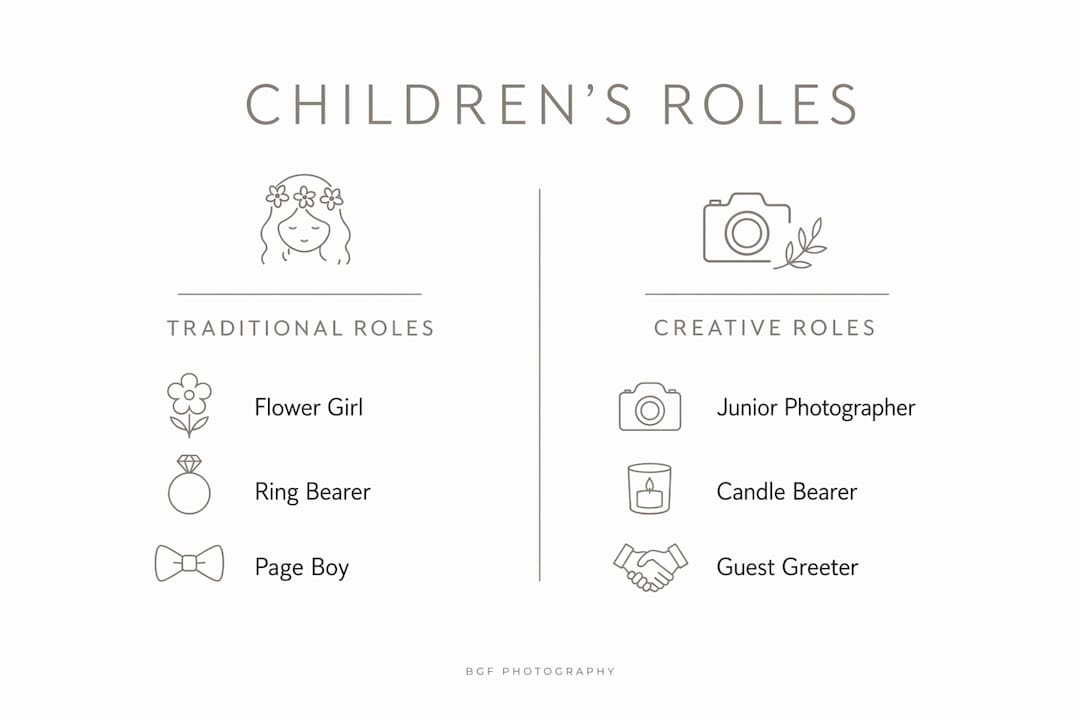
The classic roles, flower girl and ring bearer, are well established for a reason. They give children a clear purpose, a costume, and a moment of their own. But creative inclusion goes much further than walking down an aisle.
One of the most compelling trends in child-friendly wedding photography right now is giving children their own cameras. A child-operated camera produced over 70 images with more than 550,000 views in late 2025 and early 2026. That number reflects how powerfully a child’s perspective resonates with audiences. Children photograph what interests them: the dog under the table, the dessert display, the way light hits the dance floor. These images enrich the wedding album with angles and subjects that no adult photographer would prioritize.
Giving children cameras empowers them creatively and offers unique candid images from their perspective, enriching the wedding album with authenticity. A simple disposable camera or an inexpensive digital camera works perfectly. The goal is engagement, not technical quality.
-
Flower girls with flexibility. Let flower girls scatter petals at their own pace rather than marching on cue. The pauses, the looks back at parents, and the occasional handful thrown straight up in the air produce far better photos than a rigid walk.
-
Junior attendants with real roles. Older children, ages 8–12, often respond well to being given a genuine responsibility: holding the bride’s train, directing guests to their seats, or carrying a sign. Responsibility produces pride, and pride photographs beautifully.
-
Activity stations during cocktail hour. A small table with bubbles, chalk, or simple crafts keeps children occupied and creates natural photo opportunities as adults interact with them.
-
Children as part of the first look. Including a child in the first look moment, especially if the couple is already parents, creates an emotionally layered reveal that goes far beyond the traditional two-person version.
| Creative role | Best age range | Photography benefit |
|---|---|---|
| Flower girl | 3–7 years | Natural movement and color along the aisle |
| Ring bearer | 4–8 years | Focused task creates confident expressions |
| Junior attendant | 8–14 years | Genuine responsibility produces authentic pride |
| Child photographer | 5–12 years | Unique low-angle perspective and candid subjects |
| Activity station participant | 2–10 years | Relaxed, engaged expressions during candid coverage |
Pro Tip: If you have a child who is particularly camera-shy, assign them a task that faces away from the photographer. Photographing a child from behind as they watch the ceremony or hold a parent’s hand produces intimate, story-driven images without requiring any eye contact with the lens.
What is the difference between posed and candid approaches when photographing children?
The choice between posed and candid photography with children is not just a style preference. It directly affects how comfortable children feel and what kind of images you end up with.
Posed portraits with children follow a structured format: specific positions, direct eye contact with the camera, and deliberate expressions. These images have clear value for formal family records and wall prints. The challenge is that children under age eight rarely sustain the required stillness and compliance for more than a few minutes. Forced posed portraits often produce stiff expressions, visible frustration, or the classic “cheese face” that looks nothing like the child’s actual personality.
| Approach | Strengths | Challenges | Best use |
|---|---|---|---|
| Posed portrait | Clean composition, formal record | Requires compliance, short window | Family wall prints, formal keepsakes |
| Candid documentary | Authentic emotion, natural expressions | Less compositional control | Album storytelling, emotional moments |
| Directed candid | Balance of both, low pressure | Requires skilled photographer | Group shots, activity-based moments |
Candid documentary photography treats children as subjects to observe rather than direct. The photographer stays back, reads the room, and waits for moments to unfold. This approach suits children’s natural behavior far better. A child who forgets the camera is there will give you their real face, their real laugh, and their real relationship with the people around them. Photographer invisibility is a core skill here: the less children notice the camera, the better the images become.
The directed candid approach sits between the two. The photographer gives a loose prompt, “walk over to grandma and give her a hug,” and then documents what happens naturally rather than posing the result. This works particularly well for capturing family heritage moments with multiple generations in the frame. Children respond to activity-based direction far better than position-based direction.
The best wedding photographers use all three approaches depending on the child, the moment, and the light. Knowing which style fits your wedding vision starts with choosing a photography style that matches your family’s personality before the wedding day.
Key takeaways
Children add the most authentic emotional depth to wedding photography when photographers work with their natural behavior rather than against it.
| Point | Details |
|---|---|
| Schedule portraits early | Child-heavy photos should happen first, before energy drops and patience runs out. |
| Use the subtraction method | Start with the full group assembled, then dismiss people to keep children from waiting idle. |
| Identify each child’s safe person | A trusted adult nearby relaxes children and prevents anxious expressions in portraits. |
| Give children a camera | Child-operated cameras produce unique low-angle perspectives that adult photographers cannot replicate. |
| Match style to the child | Candid and directed candid approaches consistently outperform rigid posed portraits with young children. |
What I’ve learned from photographing kids at weddings
The biggest mistake couples make is treating children’s behavior as a problem to manage. A child who refuses to stand still is not ruining your photos. That child is giving your photographer the raw material for the best image in your album.
I have watched a ring bearer sit down in the middle of the aisle and refuse to move. The couple panicked. The guests laughed. The flower girl sat down next to him in solidarity. That image, two small children sitting cross-legged on the aisle runner while the whole church erupted, became the single most requested print from that entire wedding. No amount of planning produces a moment like that. You can only be ready for it.
What I have found is that relaxed children give the best photos, and relaxed children come from relaxed adults. When parents are anxious about their child performing correctly, children feel it immediately. When parents are told explicitly, “don’t worry, we’ll work with whatever happens,” the whole energy shifts. That shift shows up in every frame.
Patience is not a soft skill in this context. It is the technical requirement. An experienced photographer who genuinely enjoys working with children will wait out a meltdown, pivot to a different family grouping, and come back when the child is ready. Forcing a shot when a child is overwhelmed signals the need for rest, not persistence. The photographers who understand that distinction produce consistently better results with young subjects.
My advice: when you interview photographers, ask them directly how they handle a child who refuses to cooperate. The answer tells you everything about their experience and their temperament. You want someone who laughs and says, “that’s my favorite kind of challenge.” You do not want someone who describes a system for keeping children in line.
— Billy
BGF Photography and authentic family moments at your wedding
Couples who want their wedding photos to tell the full family story, including the chaos, the laughter, and the quiet moments between generations, need a photographer who genuinely works that way every day.
BGF Photography specializes in candid wedding photography and videography in the Buffalo and Rochester, NY areas, with a natural and unobtrusive approach that lets real moments happen without interference. That approach is exactly what child-friendly wedding photography requires. If you have children playing a role in your wedding day, BGF Photography’s hybrid coverage captures both the still images and the moving moments in one cohesive style. Browse wedding packages and FAQs to see how BGF Photography tailors coverage for families, or view real wedding galleries at BGF Photography weddings to see candid family moments in action.
FAQ
What is the role of children in wedding photography?
Children bring spontaneous emotion and authentic reactions that create the most memorable images in a wedding album. Their unscripted behavior adds intimacy and depth that posed adult portraits rarely achieve.
How long should children pose for wedding photos?
Professional photographers recommend no more than 5–10 minutes of posing at a time before giving children a break. Exceeding that window typically produces stiff, unhappy expressions.
What is the subtraction method for group photos with kids?
The subtraction method starts with the full group assembled and then dismisses people one by one. This approach keeps children from waiting idle while adults gather, which reduces the chance of meltdowns.
Can children take their own wedding photos?
Yes, and the results are often remarkable. A child-operated camera at one wedding produced over 70 images that received more than 550,000 views, capturing angles and subjects that adult photographers would never prioritize.
How do I choose a photographer who is good with children?
Ask directly how they handle a child who refuses to cooperate. Photographers with genuine experience working with kids describe patience and flexibility as their default response, not systems for keeping children compliant.