
The best nontraditional wedding photos come from changing how the day is photographed, not from adding more poses. Let moments unfold, shoot them from unexpected angles, use your venue as the backdrop, and work with a photographer who stays out of the way. Below are the ideas we would actually put on a list for a couple, with notes on how to plan them so they survive a busy wedding day.
TL;DR
- Nontraditional means documentary first: little direction, real reactions, and a few portraits that still feel like you.
- The easiest wins are a first look, getting-ready details, unusual angles (low, high, reflected, through guests) and a venue feature as your backdrop.
- Film adds texture and a nostalgic feel, and it works best as a deliberate layer on top of digital coverage.
- Ask when sneak peeks arrive, and book photo and video together if you want one cohesive look.
Table of Contents
- What makes a wedding photo nontraditional
- Getting-ready ideas that go beyond the dress on a hanger
- The first look, and other moments built for real reactions
- Unusual angles and perspectives
- Using your venue as the backdrop
- Photo booths and interactive photo ideas
- Film photography for a nostalgic look
- Sneak peek photos: which moments to share first
- Photo and video that look like one story
- Our perspective on nontraditional wedding photos
- Working with BGF Photography
- How to turn these ideas into a plan
- FAQ
- Sources
What makes a wedding photo nontraditional
A traditional wedding gallery leans on the formal group lineup, the stiff portrait and the posed cake cut. A nontraditional one leans on what actually happened: a grandfather wiping his eyes, the bridal party laughing at a toast, a hug that lasted longer than planned.
That approach has a name in the industry. Wedding photojournalism favors candid storytelling, documenting events with little to no direction so genuine emotions and spontaneous interactions are captured. If you want to understand the style in depth, our guide to what to expect from photojournalistic wedding photography walks through a full day.
Nontraditional does not mean you get no portraits. The same source notes that couples can tell their photographer what they prefer, so documentary coverage and portraits that feel authentic can sit side by side. The difference is how the portraits are made: with a prompt and some space, not a rigid pose count.
A useful way to think about it: you are choosing three things.
- How much direction you want. None, a little, or a lot.
- Where things happen. A traditional church aisle, or a barn, a backyard, a historic hall, a lakeshore.
- How it is recorded. Digital only, digital plus film, photo only, or photo plus video.
Every idea below is a combination of those three choices.
Getting-ready ideas that go beyond the dress on a hanger
Getting ready is where nontraditional photos start, because nobody is performing yet. A few ideas that work well:
- Let the room be messy. Open suitcases, steamers, a half-eaten snack tray and robes on chairs tell the story better than a staged flat lay.
- Photograph the people, not just the objects. A parent fastening a necklace, a friend reading a letter, a groomsman tying someone else's tie.
- Use what is at the location. One photographer's advice for fun and unique getting-ready photos is outside our research, so we will keep this to our own experience: bring one personal item that means something, like a handwritten note or a family watch, and let it show up naturally in the frame.
- Keep the details short. Rings, shoes, invitation and perfume bottle take ten minutes with a photographer who knows what to look for. Longer than that and you are losing time with your people.
The goal is a set of images that, five years from now, remind you what the morning felt like, not what the room looked like.
The first look, and other moments built for real reactions
If you want one idea that is both nontraditional and reliable, it is the first look. It is arranged by the photographer, but it remains a powerful way to capture raw, natural reactions from the couple or family members, because the reaction happens in private, without a crowd watching.
Variations worth considering:
- A first look with a parent or sibling instead of, or in addition to, your partner.
- A first look in an unexpected place. One Washington, D.C. wedding moved its first look into a historic hallway after rain pushed plans indoors, and the bride's entrance down an ornate staircase became a signature moment. A weather change can become your most distinctive set of photos.
- A back-to-back first touch. You stand on either side of a door or wall, hold hands, and talk before you turn around. It is quiet, and it photographs beautifully.
- Letter or vow exchange. Reading private vows to each other away from the guests gives you honest faces and no performance.
Other moments that tend to produce strong candid images without any staging: the processional from the photographer's side view (to catch your partner's face), the toasts (watch the audience, not the speaker), the first dance's last thirty seconds, and the late-night dance floor when ties are off and shoes are in hand. We cover more of these in our candid wedding photos must-have list and in what to capture and how.
Unusual angles and perspectives
Changing where the camera is can make an ordinary moment look nontraditional. One venue's guide to new wedding angles suggests a handful of approaches you can ask your photographer about:
- Aerial or drone views of the first dance. From above, the dance floor becomes a pattern of people around the two of you.
- Low, ground-level views of a train sweeping behind you or of a first kiss.
- Reflections in mirrors, windows and other reflective surfaces, which let you show two layers of a scene at once.
- Images taken from behind flowers or through dancing guests, which add depth and a feeling of being in the room.
We would add a few from our own work approach:
- Shoot the guests' reactions. A frame of your best friend crying at the ceremony is as valuable as the one of you at the altar.
- Use doorways and windows as natural frames. They keep attention on the subject and tell you where you are.
- Pull back. A wide frame of a field, a lakeshore or a big room with two tiny figures in it says something a close-up cannot.
If you want aerial coverage, ask early. Drone rules vary by venue and location, and some venues restrict flights, so confirm permission before you count on those shots. We offer drone coverage, and an additional drone pilot is available for $500 to $700 when a larger property or a longer day calls for it.
Using your venue as the backdrop
The most nontraditional photos are usually the ones that could only have been taken at your wedding. That means making the venue do the work instead of bringing in props.
The Brides photo-booth guide makes this point about booth backdrops: use a distinctive brick wall, wood door or natural setting at the venue instead of buying a custom backdrop. The same logic applies to portraits. Walk your venue with your photographer, or look at it on your own beforehand, and note:
- Where the light is soft in the late afternoon.
- Which walls, doors, stairwells or windows have texture.
- Where there is a quiet corner you can slip away to for two minutes.
- What is unique to the place: an old barn beam, a vineyard row, a lake dock, a historic ballroom.
In upstate New York, that often means working with what the region gives you: lake light, vineyard rows in the Finger Lakes, converted barns and industrial spaces in Buffalo and Rochester, and big seasonal changes that make a fall wedding look nothing like a June one. We are not going to claim a list of specific venues here, but a good photographer will already know which corners of your venue photograph well.
Big, designed settings
Some couples go further and design the setting itself. A New York City wedding used floor-to-ceiling video projections and 360-degree video mapping in a historic venue, so the room changed through the night, alongside a bronze mirrored aisle and custom metal floral sculptures. A Los Angeles wedding at a 1923 mansion paired faded-glamour styling, dripping candles and an unruly floral installation with a marble pool and synchronized swimmers.
Those are large productions, and you do not need either budget to borrow the idea. Pick one strong visual element, a dramatic installation, a mirrored surface, a swath of candles, and build your photo opportunities around it.
Photo booths and interactive photo ideas
A photo booth is not nontraditional by itself. How you set it up is what matters. The Brides guide to 25 DIY photo booth ideas, updated November 16, 2025, suggests setups such as a flower wall, a caravan, a lounge, an unusual installation, a colorful backdrop, a neon sign or a venue feature, along with hats, custom signs, paper cutouts, disposable cameras or Polaroids. It also reports that photo-booth rentals average $700.
The booth guide lays out the main formats:
| Format | What you get | Good fit when |
|---|---|---|
| Traditional enclosed booth | Nostalgic photo strips | You want a keepsake for guests |
| Open-air booth | Customizable backgrounds, larger groups | You expect a crowd and a dance-floor feel |
| DIY station with instant or disposable cameras | Candid, imperfect, personal images | You want guests to become part of the photo story |
One expert in that guide says an interactive photo experience can work without elaborate props or filters, because guests mostly want a simple, memorable image, and the venue can provide the backdrop.
Our take: disposable cameras on tables are one of the best low-cost ideas, because the photos guests take are different from the ones a professional takes. Treat them as a bonus layer, not a replacement for professional coverage.

Film photography for a nostalgic look
If you want your photos to feel like they belong to no particular year, film is the most direct route. Film has a softer tonal range, visible grain and color that looks different from digital. That is the nostalgic quality many couples are describing when they say they want something timeless.
How couples can use it without making the whole day a film shoot:
- Pair film with digital. Digital handles dim receptions and fast action. Film adds portraits, details and quiet in-between moments.
- Choose the moments for film. Portraits in good light, the first look, family photos outdoors and the ceremony kiss are strong candidates.
- Pick your format. Medium format and 35mm produce different looks. Medium format tends to feel more deliberate and detailed, while 35mm is quick and suits candid moments.
- Budget by the roll. Film is priced per roll, so you control how much of it you get.
We offer optional medium format and 35mm film at $100 per roll. That lets you add a film layer to a full-day package without committing to shooting everything on film.
One honest note: because film is shot with fewer frames and developed afterward, you will not see it on the back of a camera, and results take longer to arrive than a digital sneak peek. That is part of the appeal for many couples, and it is why a mixed approach tends to feel safest.
Sneak peek photos: which moments to share first
A sneak peek is a small set of edited images delivered soon after the wedding, before the full gallery is ready. Couples ask for them because the full set takes time, and the first look at your photos is often one of the most emotional parts of the aftermath.
Which moments work best for a sneak peek:
- Your portrait or first look, because it gives you a single image to share with family.
- A ceremony moment, such as the kiss or the exit.
- One candid of your people, such as the bridal party laughing or a parent crying.
- A detail or venue image, which sets the scene.
Timing varies by photographer and by the season, so ask directly when sneak peeks are delivered and how many to expect before you sign. If you plan to announce your wedding on social media right away, tell your photographer so the sneak peek is edited in the style you want to see online. Our guide to storytelling wedding photos shows the kind of images that make a sneak peek set feel complete.
Photo and video that look like one story

If you want cinematic video, the way you plan it affects how nontraditional the day feels. Two separate vendors with separate schedules often means two sets of requests to the couple and two people stepping into the same moments. A hybrid approach, with photo and video under one vision, means one conversation about style, one timeline and fewer people to coordinate.
What to plan so coverage feels cohesive without disrupting the celebration:
- Share your style references once. Send the same few images or films to everyone, so the color, pace and mood match.
- Build a timeline with breathing room. Leave gaps between portraits and events so nobody is rushing you.
- Choose a video length that matches how you will watch it. A short highlight is easy to share. A longer film is for family and those who want the whole day.
- Decide on audio early. Vows, toasts and speeches are the moments video captures that photos cannot.
- Tell your guests what to expect. If you want an unplugged ceremony, say so on your website or a sign.
Our video options are priced separately so you can choose the length: a 3-6 minute highlight video is $1,400, a 9-15 minute featurette is $1,800 and a 30-60 minute full-length video is $2,600. Unedited footage is $500 if you want the raw material, and additional video edits range from $200 to $600. For more on the editorial look, see our explainer on editorial wedding photography.
Our perspective on nontraditional wedding photos
We get asked for nontraditional ideas constantly, and our answer is usually the same: the idea matters less than the space around it. A couple who is relaxed and comfortable in front of the camera will look more original than a couple following a list of clever poses.
That is why we work in a natural, unobtrusive way. We stay close, we stay quiet, and we let moments happen so we can document them well. We would rather catch your mom fixing your collar than ask you to pretend she is. We also like film as an optional layer, because it gives a gallery a nostalgic feel that digital alone does not.
If you take one thing from this article, let it be this: choose a photographer whose existing work already looks like what you want. Ideas can be added. Style cannot be bolted on after the fact. For a longer read on this, see our guide to unique wedding photography styles and our explanation of what candid wedding photography is.
— Billy
Working with BGF Photography
We photograph and film candid weddings in Buffalo, Rochester and the Finger Lakes, with optional film, drone coverage and hybrid photo and video packages under one cohesive style. Full wedding day coverage is $4,500 to $5,200, an engagement session is $600, and an elopement is $2,200. You can see every package and add-on on our investment page.
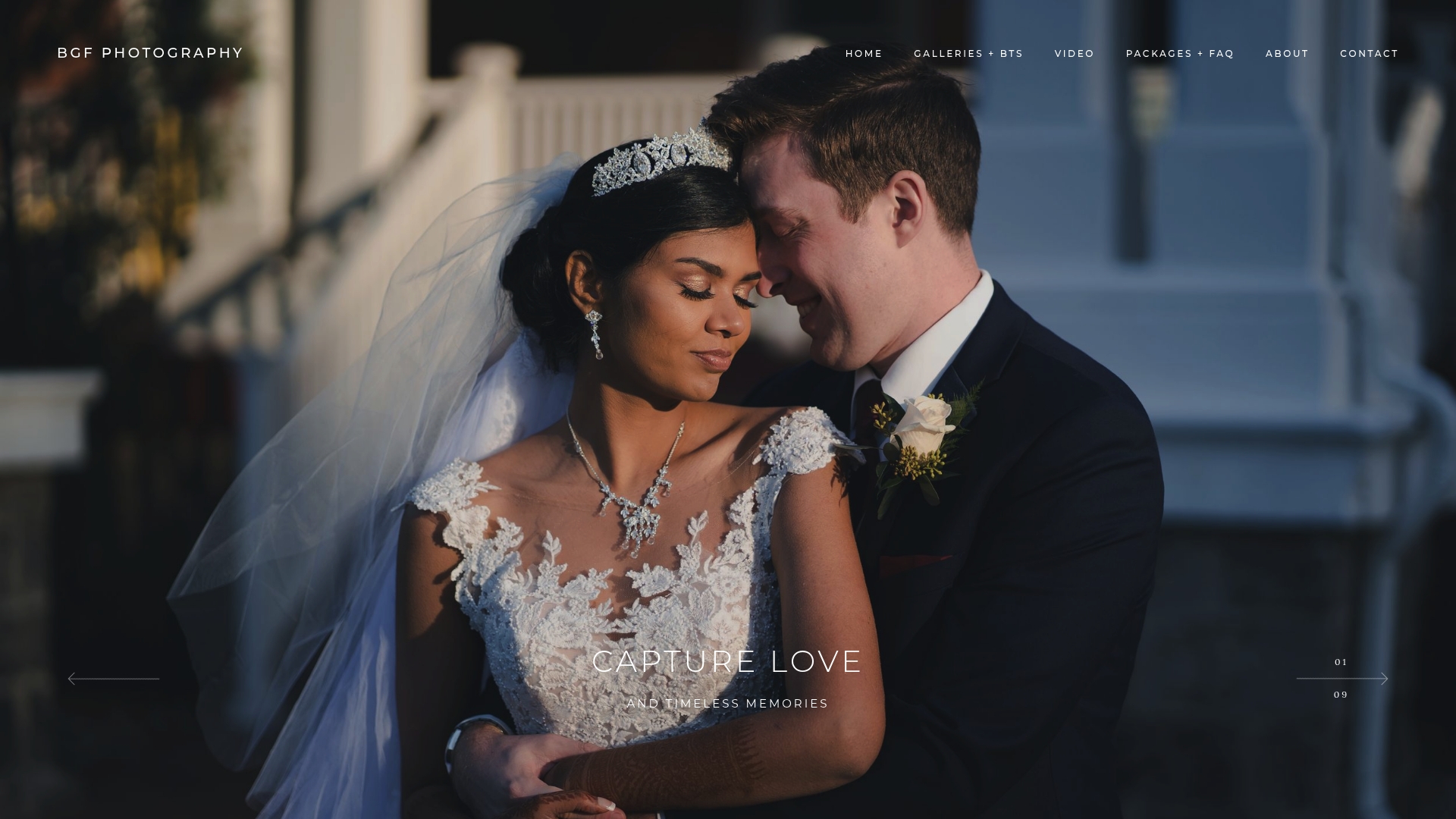
An engagement session is a good first step if you are nervous about being photographed. It lets you see how we work and how you look in candid photos before the wedding day.
How to turn these ideas into a plan
You do not need to use every idea. Pick three or four and tell your photographer why they matter to you.
- Choose your anchor moments. For example: a first look, a private vow exchange, a dance-floor finale.
- Pick one distinctive visual element. A venue feature, a mirrored surface, an aerial shot.
- Decide on a film layer. If you want it, say how many rolls and for which moments.
- Walk the venue. Note the best light and the quietest corners.
- Set a sneak peek expectation. Ask when and how many.
- Keep a shot list short. A short list of must-have family photos is enough. Everything else should be left to unfold.
For brides who want a more natural portrait session, we cover the details in our post on candid bridal portrait tips.
FAQ
What counts as a nontraditional wedding photo?
It is any photo that comes from a real moment or an unexpected approach, rather than a posed lineup. That can mean candid documentary images, unusual angles, film, or a setting that is personal to you. Most couples mix a few of these with a short list of classic family photos.
Can I have nontraditional photos and still get family portraits?
Yes. Give your photographer a short list of the family groupings you need and a time slot for them, then let the rest of the day unfold on its own. A short, organized family session usually takes less time than a long, loosely planned one.
Are nontraditional photos more expensive?
Not necessarily. The cost depends on coverage hours, add-ons and your photographer. At BGF Photography, full wedding day coverage is $4,500 to $5,200, and add-ons such as film at $100 per roll or an additional drone pilot at $500 to $700 are optional.
When should I ask for sneak peek photos?
Ask before you book. Timing varies by photographer, so find out when sneak peeks are delivered, how many you will get and whether you can choose which moments are shown first.
Is film worth it for a nontraditional wedding?
If you love a soft, nostalgic look, yes. Most couples add film to digital coverage for portraits and quiet moments, which keeps the cost per roll manageable and gives you reliable digital images for the rest of the day.
Sources
- 10 Tips and Ideas for Creative Wedding Photojournalism, Fstoppers
- 25 DIY Photo Booth Ideas for Your Wedding, Brides
- A Simple Guide to Wedding Photo Booths, Brides
- New York City wedding with video projections, Brides
- Los Angeles mansion wedding, Martha Stewart Weddings
- Intimate Washington, D.C. wedding, Martha Stewart Weddings
- Wedding Shots Reimagined: Capturing Emotions from New Angles, The Bell Tower on 34th